


Miranda van Iersel, an assistant professor at New Mexico State University (NMSU), earned the 2025 Gentec-EO Laser Lab Award. The award provides international recognition for supporting hands-on optics and photonics education.
Van Iersel, who is from NMSU’s Klipsch School of Electrical and Computer Engineering, plans to share her award with students.
Through the award, van Iersel received a Pronto SI laser power meter, a portable device measuring laser beam intensity. She will integrate the instrument into multiple undergraduate and graduate courses. It will allow students to directly connect theoretical concepts to real-world optical measurements.
NMSU reported that Van Iersel discovered the award opportunity while attending an international optics education conference in Glasgow, Scotland. Laser technology leader Gentec-EO invited educators to apply, showing how the device enhanced classroom and laboratory instruction.
“It was a very short proposal focused on how the device would be used in education,” van Iersel said. “I’m teaching several optics- and laser-focused courses, so it was easy to explain how valuable a small, portable measurement tool like this would be for students.”
How Pronto SI Benefits NMSU Engineering Students
The Pronto SI will be used in three core electrical and computer engineering courses, starting with 400-level Introduction to Optics. For many students, the class serves as their first in-depth exposure to optical concepts. This ranges from ray and wave optics to lasers and fiber optics.
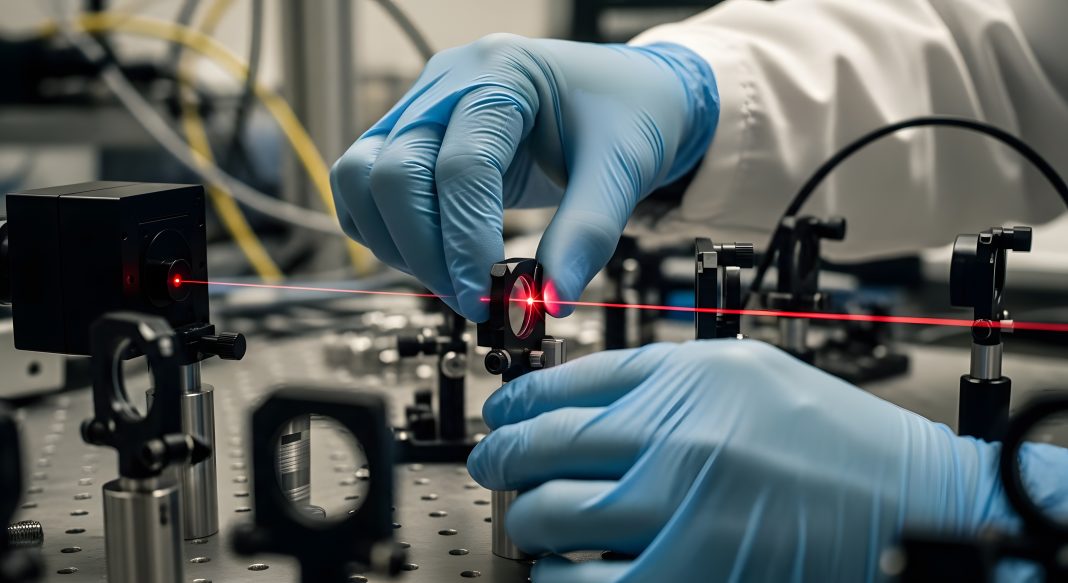
“Because this is their first serious introduction to optics, demonstrations are incredibly important,” van Iersel said. “With this device, I can bring laser measurements directly into the classroom and show students how things like alignment affect laser power in real time.”
In the 500-level Fundamentals of Photonics course, students participate in multiple laboratory experiments throughout the semester. Van Iersel will incorporate the new device into experiments on optical alignment, fiber optics, Gaussian beam characterization and polarization effects.
“For example, when students are aligning an optical setup, they can now see exactly how even a slight misalignment impacts the measured power,” van Iersel said. “That kind of immediate feedback really helps build intuition, which is essential for anyone working in optics or photonics.”
Pronto SI Benefits Extend Beyond NMSU Students
Graduate students will gain additional benefits from the award through a specialized elective course on lasers. In this class, students work with open laser cavities. They explore how factors such as mirror distance and internal obstructions influence laser output and beam modes.
“The Pronto SI allows us to expand the experiments and better connect theory to the measurements students will encounter in real research labs,” van Iersel said.
Van Iersel also plans to use the device for outreach activities beyond formal coursework. These include demonstrations for middle and high school students during campus open house days and summer camps. Additionally, she will incorporate the tool into undergraduate research projects, internships, and senior capstone experiences.
Much of van Iersel’s research focuses on how light interacts with complex environments such as air and water. Her work has practical implications for optical communication, environmental monitoring and sensing technologies.
Award Expands Opportunities for NMSU Engineering Students
Van Iersel’s lab is currently exploring optical techniques to detect microplastics in water, a growing environmental concern. Researchers study how light scatters and absorbs across different materials to develop faster methods for identifying contaminants.
“These are problems students don’t always realize are connected to optics,” van Iersel said. “But once they see how measuring light applies to everything from internet communication to environmental health, it really changes how they view the field.”
With the Gentec-EO Laser Lab Award, van Iersel expands opportunities for NMSU engineering students to gain hands-on optical instrumentation experience. This investment supports both education and research across multiple levels.
“This is exactly the kind of tool that helps students bridge the gap between equations on a page and the real systems they’ll work with in their careers,” van Iersel said.