

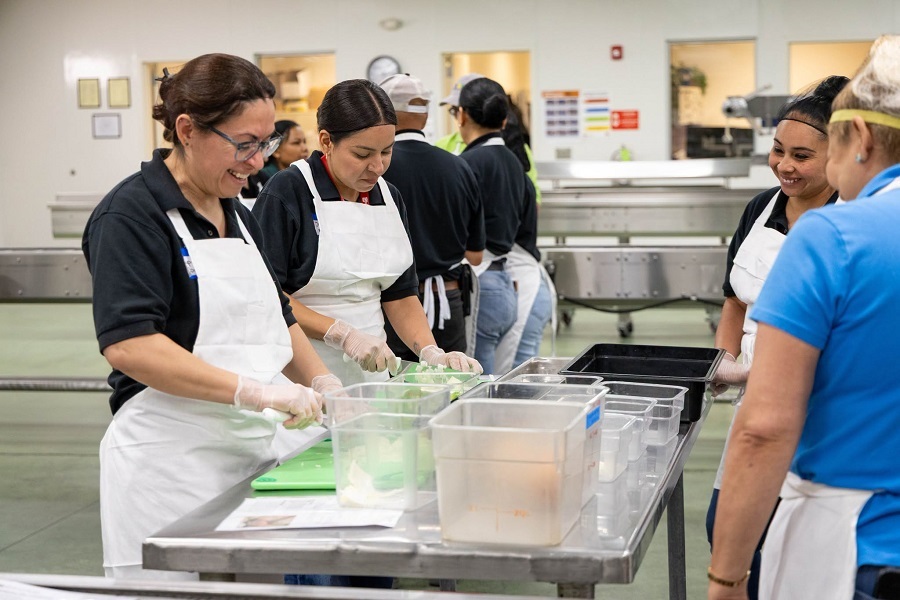
Cafeteria workers are apprehensive as Albuquerque Public Schools is moving forward with its plans for healthier school meals by making more food from scratch.
Some cafeteria workers worry that these new goals could add more pressure to a team already feeding thousands of students on a tight schedule.
Now, the main question for Albuquerque Public Schools is whether they have the resources to provide better meals without overworking the staff who make breakfast and lunch happen.
A Healthier Plate, a Heavier Load
New Mexico’s Healthy Universal School Meals program seeks to transform what children eat at school, requiring school districts to meet standards for scratch or speed-scratch cooking, student and family input, local food sourcing, and responsible food-waste management.
The state’s final rules reduced the threshold for freshly prepared food from an initially proposed 75 percent to 50 percent, with speed-scratch methods permitted. Marie Johnson, the executive director of Food and Nutrition Services for APS, said the goal is reaching 51 percent scratch cooking. She said APS is not yet 51 percent scratch cooking. “But we can get there and we will get there.”
The changes sound simple on paper, but not in practice because it requires a major shift in how school kitchens operate as workers need to prepare ingredients, follow recipes, cook, portion, and serve food on time.
The main concern is whether the district’s push for healthier meals matches the staffing, facilities, and support needed to make it work.
The Workers Behind the Lunch Line
A cafeteria worker’s day starts well before the first student arrives. They organize ingredients, cook food, clean surfaces, check equipment, and follow menus.
Then they serve hundreds of students in a short lunch period, always working to keep the food moving.
Even after the last tray is served, the job isn’t done. Workers still need to clean the kitchen, maintain equipment, store supplies, and handle waste.
Now, as APS expands freshly prepared offerings, workers are asking whether the additional preparation can be absorbed into existing schedules.
Their concerns aren’t about opposing healthier food. They want to know if the district understands what it takes to make these meals for so many students.
Union workers have spoken up about heavy workloads and possible illegal practices, like being asked to work off the clock.
At an APS School Board meeting Wednesday, CWA Local 7070 Vice President Alvaro Rivera said, “There’s no way of scratch cooking in these employee areas for three-and-a-half hours.”
“We cannot do scratch cooking in that amount of time,” he added.
CWA Local 7070 President Paul Aguilar said, “The manager on site is getting their time card and clocking them out and then asking them to stay until the work is done.”
“This is unacceptable; it is illegal; it is not something we can do,” Aguilar said.
The District’s Ambitious Vision
APS has openly supported the move to scratch cooking.
In July 2026, the district showcased new cafeteria recipes during a family listening session, highlighting a shift toward more made-from-scratch food. Officials said a new requirement would make 50 percent of meal components freshly prepared, with “chef hat” icons identifying freshly prepared items on menus.
The district’s Food and Nutrition Services department says its mission is to provide nutritious, appealing and high-quality meals while supporting student health and academic success.
This vision includes more fresh ingredients, meals that reflect students’ cultures, and listening to student feedback.
But for any food program to succeed, it needs good execution—and that depends on the people working in the kitchens.
APS’ own procedures state that cafeteria staffing should account for kitchen size, average daily participation, kitchen layout, and the type and number of feeding programs. The district also assigns Food and Nutrition Services responsibility for professional development and measures intended to improve quality and efficiency.
These policies raise an important question: Are staffing and training being updated to handle the extra work that scratch cooking brings?
The Numbers Behind the Pressure
The concerns become more significant when placed against the scale of APS’ operation.
According to a New Mexico Legislative Finance Committee report, Albuquerque Public Schools serves more than 70,000 students across more than 140 schools. The district operates a federally compliant 10,000-square-foot central kitchen that prepares and distributes meals across the system.
That centralized model offers efficiencies, but it also presents challenges. A single production problem can affect many students.
Meanwhile, preparing more food at individual schools requires suitable kitchens, equipment, and trained personnel.
The LFC has identified staffing, infrastructure, and vendor-related constraints as potential obstacles to school food authorities meeting the state’s freshly prepared food requirements.
The report also noted that APS had not purchased or prepared raw meat in more than two decades, citing food safety risks—a limitation when attempting to meet certain scratch-cooking
expectations.
These are not merely technical details. They go to the heart of whether the district’s food-service system is equipped for the changes being demanded of it.
When the Clock Is the Enemy
Students have limited time to eat.
Classes must begin. Food must be served at safe temperatures. Kitchen staff must complete preparation and cleanup within scheduled working hours.
Scratch cooking can add more steps to that process: peeling, chopping, measuring, mixing, cooking, monitoring, and portioning.
Each step requires labor. And when staffing is tight, extra prep can mean longer days, greater physical demands, or less time for essential cleaning and organization.
APS’ cafeteria substitute position, for example, is advertised as an hourly role averaging 3.5 hours per day, with assignments varying across school sites. The listed pay is $15 per hour, and the position is not eligible for benefits.
That alone does not establish a staffing crisis. But it raises the operational questions APS should be able to answer with staffing records, payroll data, and operational reports.
The Student at the End of the Tray
Ultimately, this debate is about children. A school meal is not just another institutional service. For many students, breakfast and lunch are essential sources of daily nutrition.
APS provides breakfast and lunch at no charge to all students. Its stated mission is to ensure meals are nutritious, appealing, and accessible.
But nutritional goals alone do not guarantee that students will eat what is placed before them. A meal can meet dietary standards and still be rejected if it is unappealing, poorly timed, or served in conditions that frustrate students.
An LFC report cited an APS survey of more than 1,400 students conducted in January 2025. Among the one-word responses describing school meals were “cold,” “bland,” and “dry,” alongside positive descriptions such as “delicious” and “fresh.”
The findings suggest that student experiences vary. That makes feedback essential.
If scratch cooking is intended to improve school meals, APS should be measuring more than compliance with a percentage target. It should also be asking if students enjoy the food, are they eating more of it and Is less being thrown away.
And perhaps most importantly: Are cafeteria workers being given the tools to produce meals students actually want to eat?
A Policy Built on Good Intentions
There is no doubt that children benefit from nutritious food. The dispute is more on implementation. Even the LFC has documented challenges involving staffing, infrastructure, procurement, and the capacity of school food authorities to meet the state’s freshly prepared food standards.
Those challenges do not prove that APS’ approach is neither destined to fail nor establish that cafeteria workers oppose healthier meals. Rather, they demonstrate that ambitious policy requires practical support.
That means appropriate staffing levels, functioning equipment, realistic preparation schedules, effective training, and mechanisms for workers to report problems before they become failures.
It also means listening to the people who know the kitchens best.

