


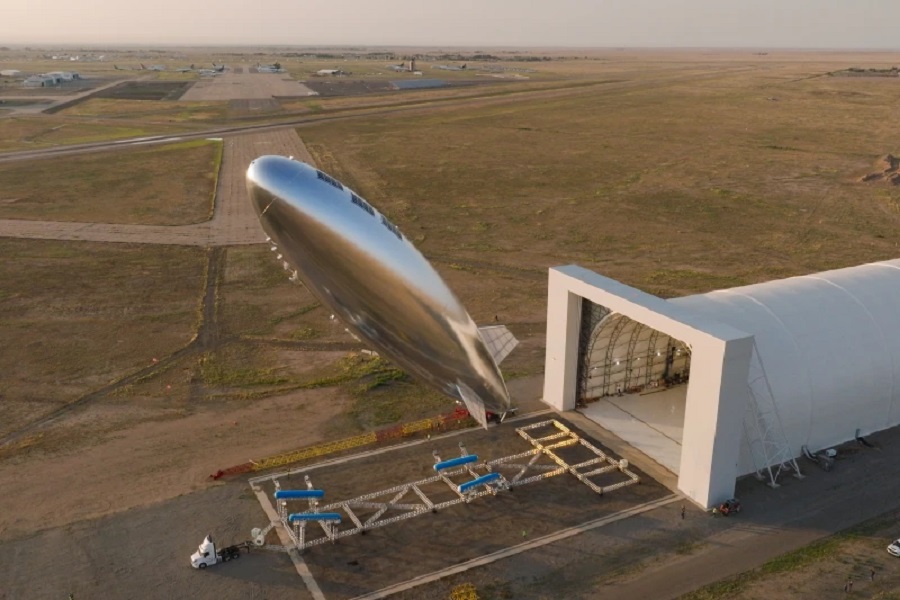
An unmanned high-altitude airship flew nearly 30,000 kilometres from New Mexico to Japan and back, providing mobile broadband from the stratosphere to ordinary smartphones in a trial which could have a transformative effect on the way wireless networks are constructed.
U.S. aerospace company Sceye announced on September 9 that its Service Test 1 (ST1) mission was officially moving forward.
The unmanned platform was launched on August 9 from New Mexico. It arrived in Japan 13 days later and remained in Japanese airspace for more than a week before re-entering U.S. airspace on September 4. Then, the aircraft reached near the company’s headquarters in Moriarty, New Mexico on September 5 to carry out its final checks and for a planned descent.
Over Japan, the platform cooperated with SoftBank Corp. in order to send text messages, make voice calls, provide internet access and deliver video streaming directly to devices that had not been modified via SoftBank’s core network. The engineers also carried out tests involving emergency alerts, communication with drones and onboard edge computing.
The aircraft was carrying SceyeCELL, basically a “cell tower in the sky.” The company says that just one of these high‑altitude systems can cover the same area as about 500 regular cell towers on the ground.
“Groundbreaking and historic only begin to describe our ST1 flight,” Sceye founder and CEO Mikkel Vestergaard Frandsen said in a statement. “This mission proved not only that our technology, vehicle systems, payload, and operational infrastructure are ready for connectivity services, but also that the stratosphere is where the future non-terrestrial infrastructure lies.”
The platform operated at an altitude ranging from 16.5 to 17 kilometres and kept itself within a station-keeping radius of as little as 5 kilometres over a target region off the coast of Japan.
Data was processed on board by a server that had been fitted on the platform, giving an average round-trip response time of 68 milliseconds, which is more than 40 per cent faster if the same tasks had been carried out via internet-based cloud servers, as stated by Sceye and SoftBank.
The two companies described this as the world’s first successful test of a mobile core network and web server functioning completely from a high-altitude platform.
HAPS, which are known as high-altitude platform systems, lie between terrestrial cell towers and satellites. They are sufficiently near the Earth to allow high-capacity links to be established, while at the same time being high enough to cover a large area. Sceye states that they can stay over a particular area for long periods at only a fraction of the cost of systems in orbit.
ST1 is the first time that Sceye has flown to Asia and marks the opening of its Service Test Program. SoftBank, which is a major Japanese telecommunications operator and an investor in Sceye, has indicated that it could be interested in commercial HAPS services in Japan as early as 2027.
Still, the trans-Pacific flight and the live connectivity tests suggests that stratospheric platforms could one day complement, or, in certain areas, lessen dependence on, existing ground towers and low-Earth orbit satellite networks.

