

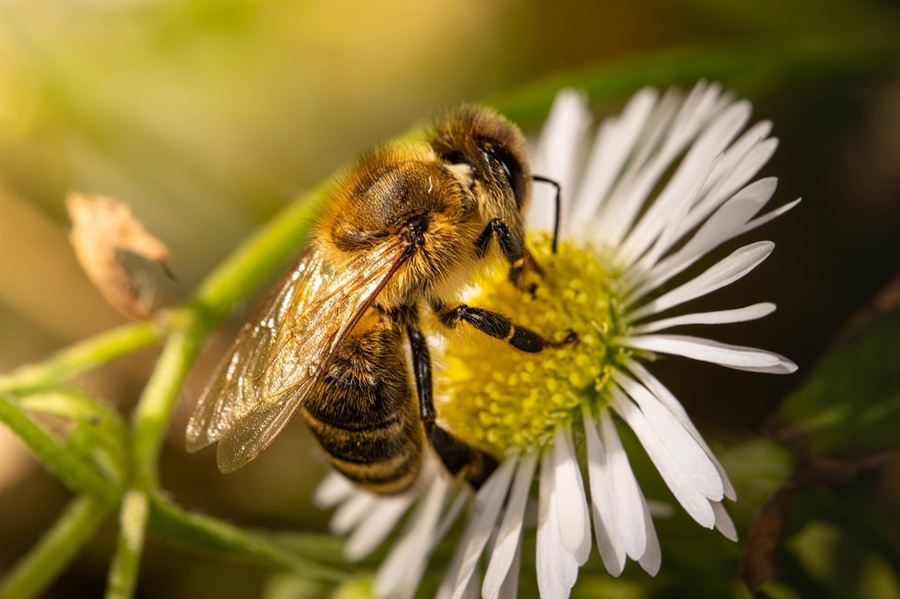
Many of New Mexico’s native bees remain so poorly studied that scientists do not know how their populations are changing, raising concerns about how drought, rising temperatures, and habitat loss could affect the state’s ecosystems.
Ashley Rohde, a postdoctoral researcher at NMSU, said public awareness of bee conservation often centers on honey bees, even though the state is home to a wide range of native species that play important roles in maintaining healthy ecosystems.
“When people hear ‘save the bees,’ they often think about honey bees because those are the bees that people have had the most interactions with and the most knowledge about,” Rohde said.
Researchers at New Mexico State University are trying to understand the wild pollinators, including species not yet formally identified, and the environmental pressures that could put them at risk.
New Mexico’s desert landscapes, particularly the Chihuahuan Desert, support an unusually diverse range of native bees. But limited research makes it hard to determine population trends or identify which species are most vulnerable to environmental changes.
Drought, shifting weather patterns, development, and pesticide use can affect bees differently depending on their habitats and life cycles.
Scarlet Sellers, a doctoral candidate in NMSU’s Department of Biology, studies bumble bees in higher-elevation areas, including the Sacramento Mountains and Gila National Forest. Her research examines how bee populations, despite being separated by geography remain genetically connected.
Mountain habitats can provide cooler conditions as temperatures rise, but those environments may offer limited room for species to adapt.
“If they’re already on the tops of mountains, there’s kind of nowhere else to go once you reach the top,” Sellers said.
Desert-dwelling bees face a different challenge: surviving extended dry periods when flowering plants become scarce.
Some native species spend long periods underground in a dormant state, emerging after rainfall when flowers provide food. Certain bees can remain dormant for multiple years, an adaptation that helps them survive drought.
However, increasingly prolonged dry conditions could disrupt timing of their emergence and availability of food, Sellers said.
Researchers also faced difficulties in tracking these populations because much of a bee’s life takes place underground. Scientists have fewer opportunities to observe their behavior and determine how environmental changes affect them before they emerge to forage.
“A big challenge in bee research is that these are much easier to research when they’re out moving around pollinating flowers because we can see them and we can actually access them,” Rohde said.
The consequences of a declining native pollinator population could affect all of New Mexico’s ecosystems. Bees help flowering plants reproduce, supporting vegetation that provides food and habitat for other wildlife.
“If all the pollinators go away, then all of the plants that require pollination by animals also go away,” Rohde said. “That’s going to be a foundational shift and probably a pretty catastrophic shift.”
The risks are not limited to bees. Rohde also pointed to the endangered Sacramento Mountains checkerspot butterfly near Cloudcroft, which she said researchers have not detected in the wild since 2022. The absence of recent sightings does not mean that the butterfly is extinct, but it has heightened concerns about its survival.
Despite the challenges, researchers see opportunities to improve insect conservation in New Mexico. Rohde said expanded access to state wildlife funding could support research into species that have historically received less attention.
Public participation can also help scientists fill in their knowledge gaps. The Xerces Society for Invertebrate Conservation manages the New Mexico Bumble Bee Atlas, which trains community scientists to document bumble bees across the state. Residents can also submit observations through iNaturalist, providing researchers with information about where and when species are found.
Reducing pesticide use can help protect pollinators, Rohde said, but she emphasized that lasting conservation requires broader community involvement.
“We really need to be working with a community if we want to see the needle move on any sort of pollinator conservation,” she said.
For researchers, better understanding New Mexico’s native bees is an essential first step toward protecting a largely overlooked part of the state’s natural heritage.
“We’ve got this very special resource in New Mexico that other places don’t have,” Rohde said. “This is one of the things that I think we should really be cherishing — one of the natural resources that we should be cherishing and protecting, simply because it’s something that makes New Mexico special.”

