

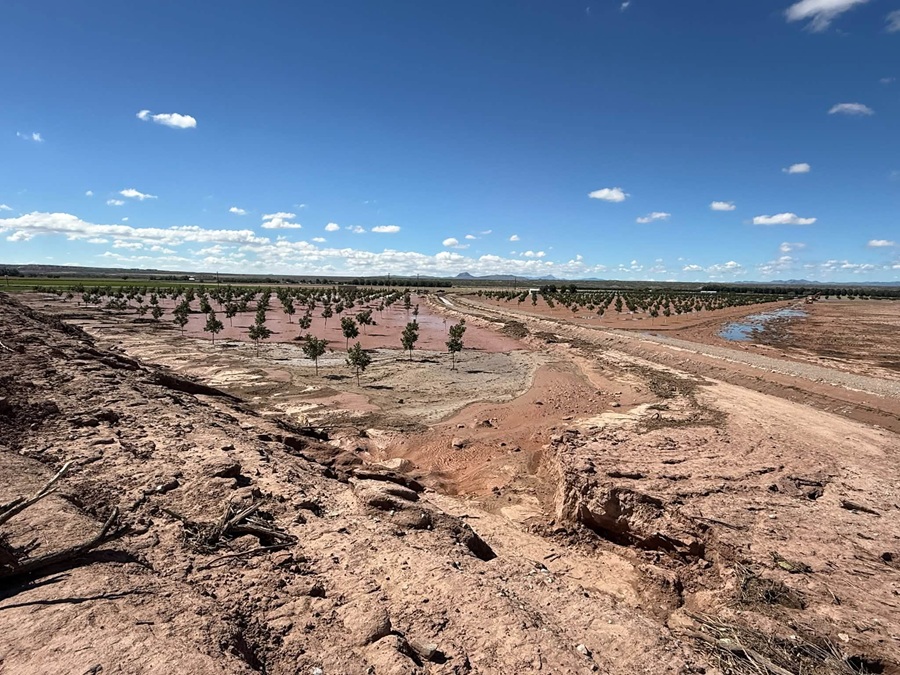
Aging farmers in southern New Mexico’s Hatch Valley, whose families have tilled the same ground for generations, fear they may be the last in their bloodlines to do so after drought, diseased plants, and a catastrophic September flood produced historic crop losses.
Veteran farmers in New Mexico’s Hatch Valley, many in their seventies and older, fear they may be the last in their families to work land cultivated for generations. A September 29 levee breach near Rincon, caused by heavy rains from Hurricane Polo, flooded the Rincon Arroyo watershed, destroying pecan orchards and equipment while leaving behind toxic clay deposits.
Combined with drought and curly top virus, the disaster contributed to green chile shortfalls of 20% to 50% this year. Farmers face continuing financial obligations despite lost harvests, contaminated wells, and bacterial hazards from floodwater sediment. Despite the losses, some, including Hatch Mayor Dennis Torres, expressed doubt about recovery, while others plan to continue farming through younger family members.
Every morning starting at 6 a.m., many of these veteran growers gather at The Pepper Pot, a family-owned diner famous for its Hatch chile empanadas. Last week the usual talk of Little League and the old Bracero Program turned serious as they confronted shortages measured in the millions of dollars.
“We prayed for the rain, and we got it,” said Shane Hopper, 78, a local blacksmith who joins the mostly septuagenarian group. “We’re all learning something now.”
A levee breach on Sept. 29 near the Rio Grande outlet in nearby Rincon unleashed muddy, silt-filled water across the 134-square-mile Rincon Arroyo watershed after heavy rains from Hurricane Polo saturated already wet ground. Don Hackey, approaching his 50th year farming, said the surge took about 40 minutes to inundate his pecan orchards and destroy costly equipment.
“You’re on first. They knock a grounder to shortstop, and you’ve got to make it to second. How’s that going to happen?” said Joe Lack, owner of Lack Farms, who came up 150 acres short on chile this season. “That’s where we’re at, and we’re trying our best just to survive this thing.”
Lack noted that equipment payments, water bills, taxes and land payments continue even when the harvest is gone. The thick clay left behind blocks oxygen to tree roots, turns toxic once dry and cannot be separated from pecans by farm machinery, Hackey said. Large puddles and clay-coated floors remained more than a week later.
Hatch Mayor Dennis Torres, speaking at the diner, captured the generational anxiety: “It takes years to recover. You don’t get recovery overnight. … I’ll speak for myself: I ain’t got no 20 years left in my life. I’m ready to give up. You get people that are 70, 80, 90 years old, and you lose your homes; you lose your farms; you lose your equipment. How do you replace that?”
The New Mexico Chile Association reported green chile shortfalls of 20% to 50% this year, worsened by persistently hot nights and curly top virus. Robert Carson, a Rincon farmer from a long chile-growing family, estimated his own supply dropped 40% and called starting in farming today “really risky.”Floodwaters created additional hazards, seeping into wells and spreading sediment that Lack called a “breeding ground for all bacteria,” including E. coli and Salmonella. Mold and the memory of tetanus shots after a 2006 flood remain concerns.
Farmers said maintenance of dams, arroyos and the Rio Grande too often comes only after disaster. “We don’t get ahead of problems. We deal with problems after it’s already a destructive force,” Hackey said.
Still, many refuse to quit. Hackey plans to hand management to his son Roy, a Hatch High School and New Mexico State University graduate nearing 40, though Roy worries recovery could take years. Chile continues to arrive at local restaurants, and some fields showed modest improvement in later harvests.
“The one thing about everyone in here is that they all keep a grin on their face,” Hopper said. “See how everybody keeps smiling? Everyone’s laughing.”