

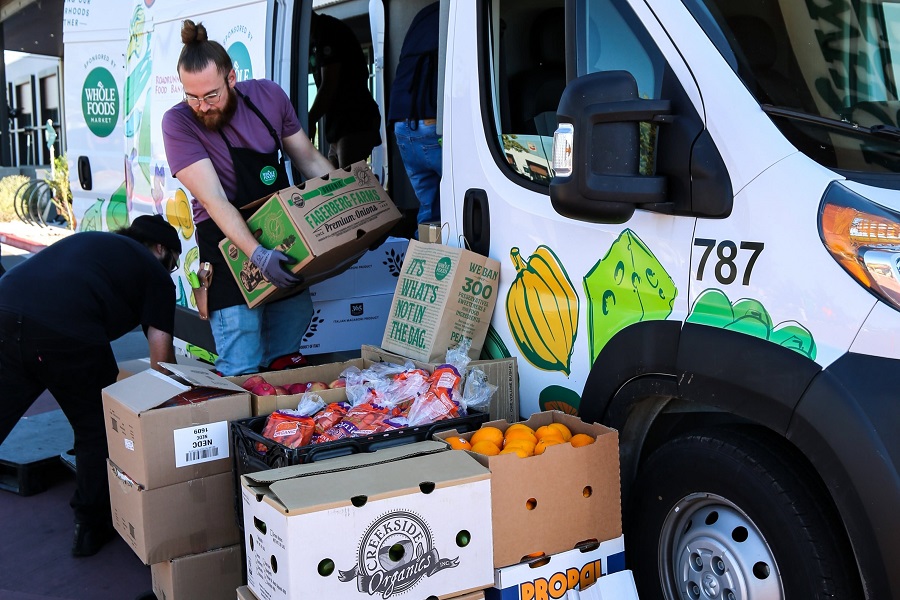
New Mexico food banks are seeing the effects of tighter federal food assistance rules as veterans lose access to benefits and more working families turn to emergency food pantries to put meals on the table.
New Mexico food banks reported increased demand after federal changes under the One Big Beautiful Bill Act imposed stricter SNAP work requirements on veterans, requiring 80 hours monthly of work, training, or job searching to maintain benefits. Officials told a legislative committee that rural veterans face particular difficulty meeting these rules, pushing more of them toward food pantries as a safety net.
Food pantry operators also noted a shift in clientele, with more employed families unable to afford sufficient groceries amid rising costs. Organizations like Roadrunner Food Bank reported 40-60% increases in demand while federal food supplies dropped 50% and transportation costs rose 70%, straining their capacity to help veterans and working families simultaneously.
The changes to the Supplemental Nutrition Assistance Program (SNAP) have increased pressure on food assistance providers already struggling with declining federal food supplies and rising transportation costs, officials told the Legislature’s interim Military and Veterans’ Affairs Committee on October 16.
The impact extends beyond veterans. Food pantry operators say the changing eligibility requirements are also altering the profile of people seeking help, with more employed individuals unable to earn enough to feed their families.
“We see more veterans seeking assistance at food banks and our network of food security partners than we have in the past because they can no longer access the SNAP program,” Jill Dixon, executive director of The Food Depot, a northern New Mexico food bank, told lawmakers.
Veterans face tighter SNAP requirements
Under the One Big Beautiful Bill Act, signed into law last year, veterans who previously qualified for an exemption from SNAP work requirements must now meet the program’s monthly work-related requirements to maintain benefits beyond three months.
The rules require affected recipients to document at least 80 hours a month of qualifying employment, volunteer service, job training or job searching.
The change has created additional hurdles for veterans who depend on food assistance, particularly those in rural New Mexico, where access to employment opportunities and support services can be limited.
Dixon told lawmakers that rural veterans have been disproportionately affected by the federal changes.
For veterans who no longer qualify for SNAP, food banks and community food pantries have become an increasingly important source of support. But those organizations say they lack the resources to fully absorb the additional demand.
SNAP changes reshape food pantry clientele
The changing requirements are also reflected in the people seeking assistance at the Veteran Integration Services food pantry in Albuquerque.
The pantry, supplied by Roadrunner Food Bank, provides veterans with bags of dry and canned goods and frozen produce. It serves more than 70 veterans and their families each week, with senior citizens accounting for an estimated 70% of those served, according to Cedric Smith, who helps operate the facility.
Smith said the pantry is struggling to maintain its supplies.
“We barely have enough to get us from week to week,” he said.
But the change is not just about the number of people seeking help. It is also about who needs it.
“Before it used to be a lot of homeless or low-income families. Now we get people that are working, but they’re not making enough money to buy the amount of food that their family might need,” Smith said.
His account points to a growing challenge for food assistance providers: having a job does not necessarily mean a household can afford enough food, especially as grocery and fuel costs rise.
For veterans affected by the new SNAP requirements, losing federal benefits can mean turning to food pantries to fill the gap. For working families, inadequate earnings can make emergency food assistance necessary even when household members remain employed.
Food banks struggle to meet growing needs
Roadrunner Food Bank, which serves communities that include Cannon and Kirtland Air Force bases, reported a 40% to 60% increase this year in the number of people seeking help.
Katy Anderson, the organization’s vice president of strategy, partnerships and advocacy, described the increase as “shocking.”
“Folks are telling us they’re struggling to make things work with the cost of groceries, the cost of fuel,” Anderson told lawmakers.
At the same time, food banks are dealing with a decline in federal food supplies and higher distribution costs.
Anderson said Roadrunner received 50% less food through the U.S. Department of Agriculture’s Emergency Food Assistance Program than it did two years ago. Its fuel expenses for transporting food were 70% higher than last year.
The figures illustrate the strain on organizations expected to help people who can no longer rely on SNAP, even as the food banks themselves face tighter resources.
Although rising living costs are also contributing to the demand, food bank officials specifically cited the loss of SNAP access among veterans as a reason more people are turning to charitable food assistance.
Lawmakers question the impact on veterans
The testimony prompted lawmakers from both parties to criticize the growing difficulty veterans face in obtaining food.
“It’s shameful. This isn’t a partisan issue — this is a humane issue,” said Sen. Gabriel Ramos, a Republican from Silver City.
State Rep. Art De La Cruz, a Democrat from Albuquerque, called veteran food insecurity a top priority and urged lawmakers to press New Mexico’s congressional delegation to address the issue in Washington.
“It seems unconscionable to me that you are or have been fully employed by the federal government, serving in a capacity that we all respect and honor, yet there would be some service members and veterans that can’t afford food,” De La Cruz said.
The testimony highlighted a widening gap between federal eligibility rules and the needs reported by local food assistance providers.
For veterans who lose SNAP benefits because they cannot meet the revised requirements, food pantries may provide a critical safety net. But with more working families also seeking help, food banks face a growing challenge: meeting the needs of people who are employed, have served their country or are living on limited incomes but still cannot afford enough food.
The experience reported by New Mexico food banks raises a central question about the changes: whether stricter requirements intended to govern access to federal food assistance will leave vulnerable households increasingly dependent on local charities to meet their basic needs.