
New Mexico health officials reported a sharp rise in flu activity as the 2026-27 respiratory illness season gets underway, according to KOAT. They also noted slight increases in COVID-19 and respiratory syncytial virus (RSV).
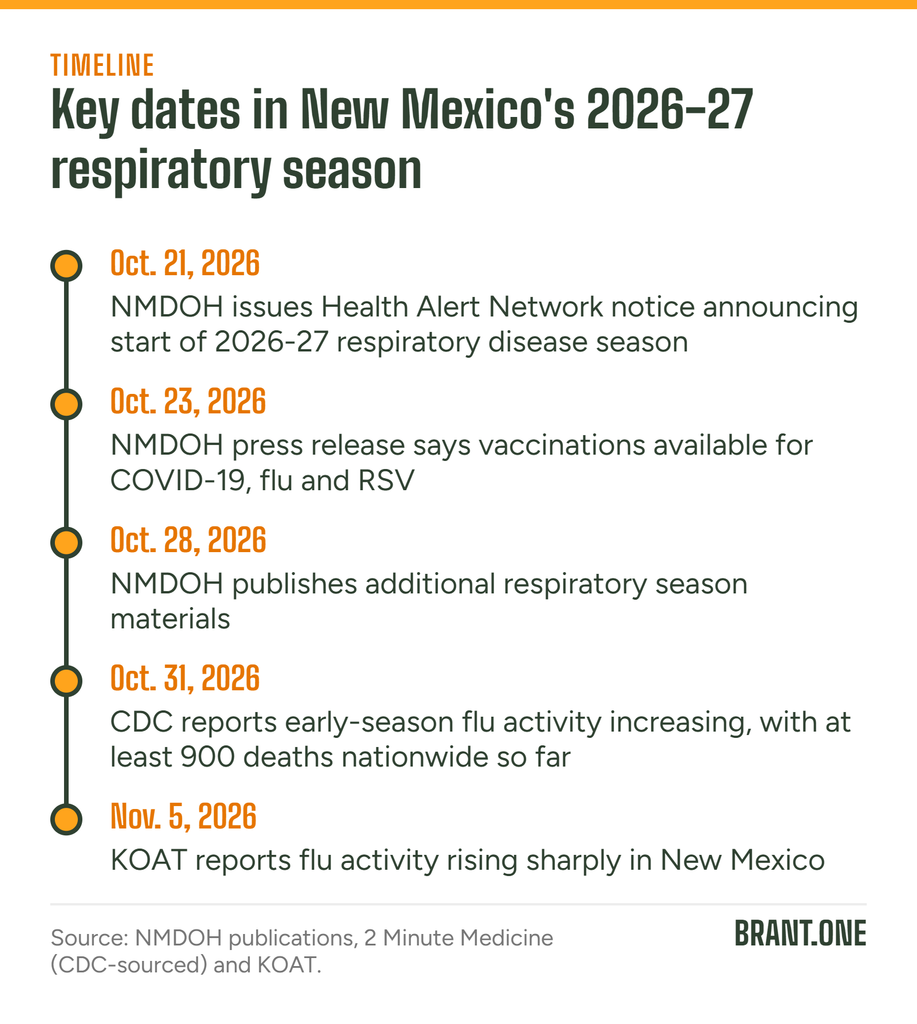
The New Mexico Department of Health declared the start of the 2026-27 respiratory illness season on October 21, citing a rise in flu activity along with slight increases in COVID-19 and RSV. Combined emergency department visits for these three illnesses rose from 0.72% to 1.5% between early and late October, a 52% increase, based on a newly implemented algorithm tracking ED discharge diagnoses.
Despite the steep rate of change, officials noted current percentages remain lower than the same period in 2023 and 2024, and the absolute numbers are not abnormal for this time of year. The department emphasized vaccination for flu, COVID-19, and RSV, particularly for young children, pregnant women, older adults, and those with chronic conditions, noting that these illnesses caused multiple deaths statewide last season.
The New Mexico Department of Health announced the start of the season on October 21 through a Health Alert Network (HAN) notice. The agency pointed to several consecutive weeks of climbing emergency department diagnoses for COVID-19 and flu. EIN Presswire reported that the NMDOH reiterated the warning in a follow-up press release two days later.
Neither the HAN notice nor the press release provided specific percentages or case counts for New Mexico. KOAT’s November 5 report also did not include any figures. However, the state tracks these numbers through its Viral Respiratory Infection Dashboard. KOAT said it draws on lab results, emergency department visits, and hospitalizations.
What the Numbers Showed in Late October
Brant.One asked for the figures behind the HAN alert. NMDOH communications office shared data from Deputy State Epidemiologist Dr. Chad Smelser. The combined percentage of emergency department (ED) visits for COVID-19, flu, and RSV reached 1.5% in the week ending October 24, according to the department. That means these three illnesses accounted for that portion of all ED visits, up from 0.72% in the week ending October 10, per the agency.
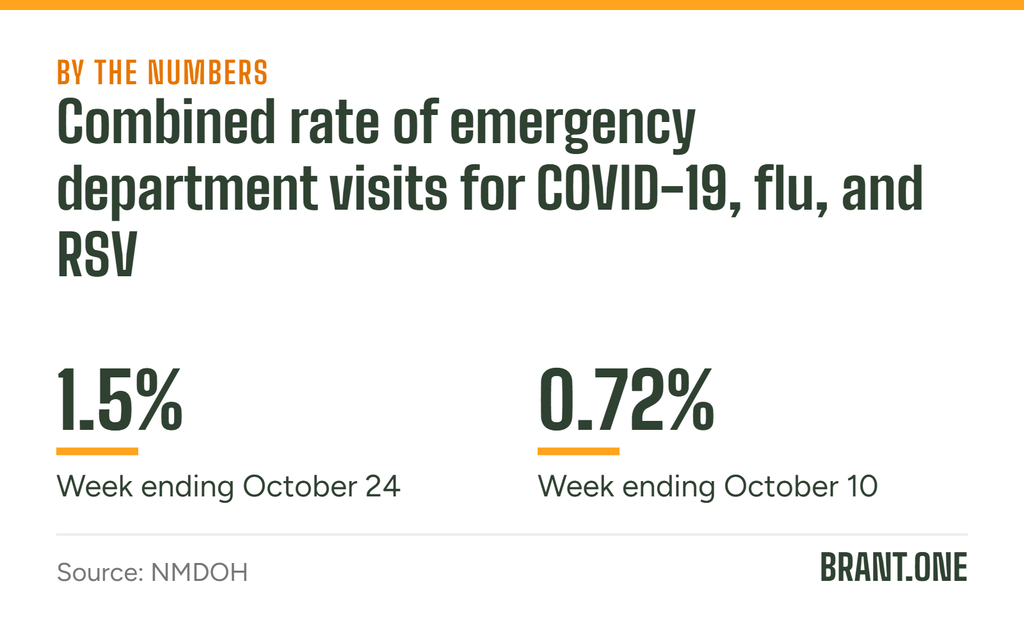
This increase prompted the department to declare the season-start call. NMDOH calculated a 52% rate of change between those weeks.
“A slope of this magnitude is a sharp rise and usually, compared to past years, signals the start of the respiratory season,” Smelser said in a statement. “It’s important to know the absolute number of ED visits is not abnormally high nor is the percent of visits due to respiratory symptoms, but the slope is steep.”
Comparing Respiratory Illness Data in Recent Years
NMDOH supplied figures for the same late-October week in the two previous seasons. The rate reached 2.4% in the week ending October 26, 2024, and 3.0% in the week ending October 21, 2023, according to the department.
This year’s figure remains below the levels recorded during the same week in the previous two years. However, the week-over-week increase prompted the department to describe the rise as significant.
Smelser advised readers not to draw conclusions from year-to-year comparisons alone. “Each respiratory season is unique,” he said, noting that some seasons start as early as September and others as late as November. He said “comparing weeks in different years does not typically provide useful information.”
Advertisement
Meanwhile, an older NMDOH surveillance report covered the 2023-24 season. Instead of tracking ED visit percentages, it focused on deaths linked to pneumonia and influenza.
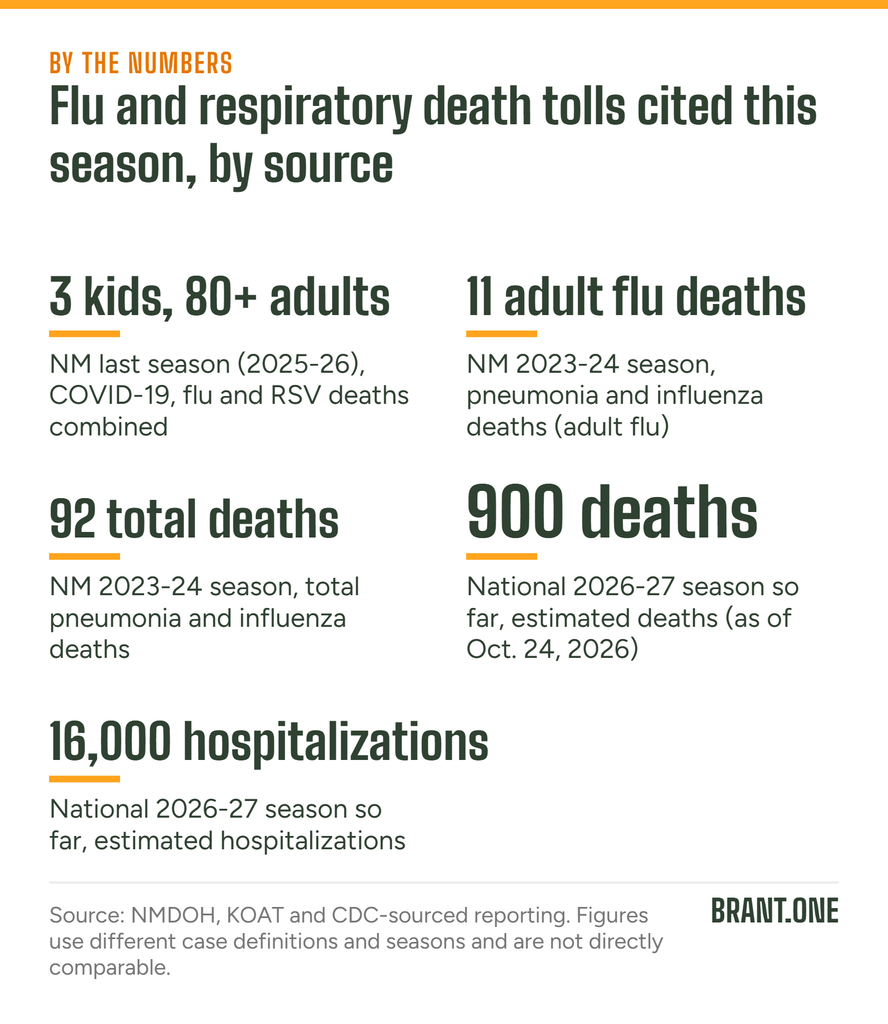
That report recorded 92 such deaths statewide, including 81 from pneumonia and 11 adult flu deaths. It reported zero flu-related deaths among children. The report did not track COVID-19 or RSV deaths separately.
Why NMDOH Changed How It Declares Respiratory Illness Season
According to the HAN alert, this is the first year NMDOH has utilized an algorithm to determine when the respiratory illness season begins. The method considers both the overall level and the rate of change in ED discharge diagnoses for COVID-19, flu, and RSV combined, the notice stated.
An ED discharge diagnosis refers to the illness a doctor records when a patient leaves the emergency room. It differs from a positive lab test or a count of influenza-like illness (ILI), which tracks a group of symptoms rather than a confirmed diagnosis.
“The algorithm was not used in previous years, as it is a recent development,” the department told Brant.One. The agency said you can check the VRI Dashboard for more details on how the algorithm works.
What NMDOH Says About the Term ‘Sharply’
The department did not identify a specific source for the phrase “rising sharply.” Brant.One asked why public-facing language used that description when the HAN notice and press release took a more measured tone.
“NMDOH cannot speak as to why ‘public facing language describe[s] the trend as ‘rising sharply,'” the agency said in a statement. The department said its message in the HAN notice and news release “has been consistent.”
The department also said it sees “nothing to date about this year’s data that the department considers abnormal compared with recent seasons.” That assessment echoes Smelser’s comment in the November 5 KOAT story that the current increase is not unusual for this time of year.
Why Prevention Matters for Families
Last season, COVID-19, flu, and RSV claimed the lives of three children and more than 80 adults in New Mexico, NMDOH Secretary Gina DeBlassie said via EIN Presswire. Many more people also required hospitalization.
According to the HAN alert, the department encourages health care providers to offer COVID-19, flu, and RSV vaccines to eligible patients. Its flu vaccination covers everyone six months and older, with particular emphasis on children under five, especially those under two; pregnant women; adults 50 and older; people with chronic conditions or weakened immune systems; and residents of long-term care facilities.
“We can’t highlight enough the importance of getting this season’s flu vaccine, or even the COVID-19 vaccine as both vaccines are updated every year. We also encourage people to talk to their health provider to determine if they or family members should be considered candidates for receiving the RSV vaccine. The three of these – and all routine vaccinations – improve chances of staying healthy and reduce the risk of severe outcomes for people even after being vaccinated,” NMDOH told Brant.One.
New Mexicans with questions about respiratory virus vaccines can call the NMDOH Helpline at 1-833-SWNURSE or text 66364, the department said.
According to the 2 Minute Medicine, as of the week ending October 24, the Centers for Disease Control and Prevention reported that flu activity remained low nationwide but was increasing in many areas. Activity also ran higher than usual for that time of the year, with an estimated 1 million illnesses, 16,000 hospitalizations, and 900 deaths so far this season.