

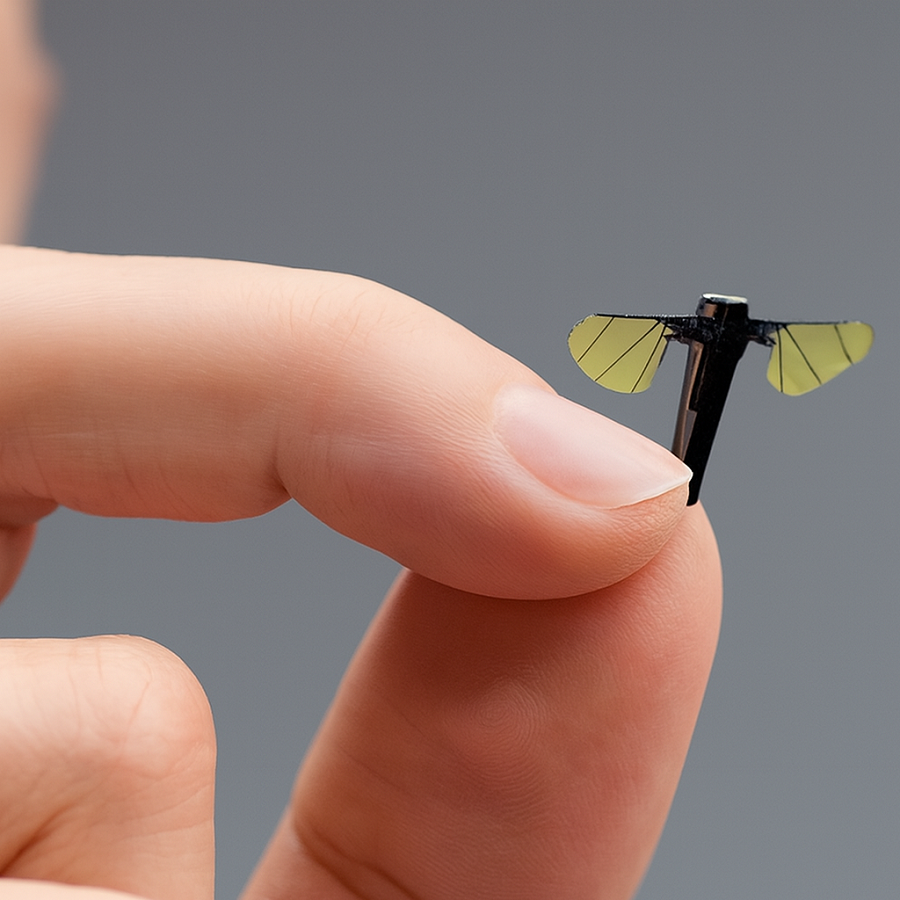
Insect-like robots may soon define the future of search-and-rescue and military reconnaissance. These micro-robots could enter collapsed buildings, battlefields, and disaster zones where humans and conventional machines cannot.
During earthquakes, buildings collapse, tunnels in urban combat zones, and narrow gaps beneath rubble are places where human responders and conventional machines struggle to operate. But the new research paper published in an open-access scientific journal suggests that bionic mechanical insects — tiny robots modeled after real insects — may offer a practical way forward.
In a study, researchers in China examine how to design and control bio-inspired micro-robots to move efficiently through confined, unpredictable environments, with potential applications in search-and-rescue operations and military reconnaissance.
Chinese engineers develop mosquito-sized bionic robot for battlefield reconnaissance. pic.twitter.com/xJFWMSgMS7
— Globe Eye News (@GlobeEyeNews) June 20, 2025
Learning from insects
The researchers turned to insects — specifically cockroaches — instead of wheels or tracks. Insects are known for their ability to move quickly, recover from obstacles, and survive in harsh environments.
By studying insect gait and body structure, the team developed mechanical designs that allow small robots to crawl, turn, and stabilize themselves on uneven terrain. These features are difficult to replicate with larger robots, which often require open spaces to function effectively.
The goal, the researchers say, is not to replace human responders or soldiers. It is to provide early access and situational awareness in places too dangerous or too small for people.
Insect-like robots built for tight spaces
The robots described in the study are designed to be lightweight and compact, using advanced materials and precision components to reduce size and energy consumption.
Movement is driven by piezoelectric actuators, which enable fast, precise leg motion while consuming minimal power — a key requirement for long missions in disaster zones or for surveillance operations. Sensors help the robots adjust their movement as terrain changes, allowing them to navigate debris, slopes, and unstable surfaces.
The study also explores intelligent motion-control systems that combine biological movement patterns with modern control algorithms, improving stability and adaptability.
Implications for disaster response
Access is often the biggest challenge in search-and-rescue operations. Entering unstable structures can put responders at risk, while delays can cost lives.
Micro-robots could be deployed ahead of rescue teams to explore collapsed buildings, locate trapped survivors, and assess structural conditions. Because of their size, multiple units could be sent in at once, helping responders build a clearer picture of conditions beneath the rubble.
Researchers caution, however, that these systems are still in development and are not yet ready for large-scale deployment.
A new layer of military reconnaissance
The same characteristics that make mechanical insects useful in disaster zones — small size, low power use, and adaptability — also raise interest in military contexts.
Insect-like robots could gather information in confined spaces without exposing soldiers to immediate danger. This is especially important in urban warfare and surveillance. Their insect-like movement may also make them less noticeable in certain environments.
The study does not directly address policy or ethical concerns. Experts, however, have increasingly warned that advances in autonomous and semi-autonomous systems will require clearer rules on deployment, accountability, and civilian protection.
Insect-like robots are still early, but moving fast
The research demonstrates promising prototype performance. But significant challenges remain, including durability, control reliability, and mass production.
Still, the direction of development reflects a broader trend in robotics: smaller, smarter systems designed to operate where humans cannot.
Climate-related disasters are becoming more frequent, and conflicts are increasingly moving into dense urban environments. These developments may make technologies like bionic mechanical insects part of the tools governments and responders rely on — raising both new possibilities and new questions about how such systems should be used.

