

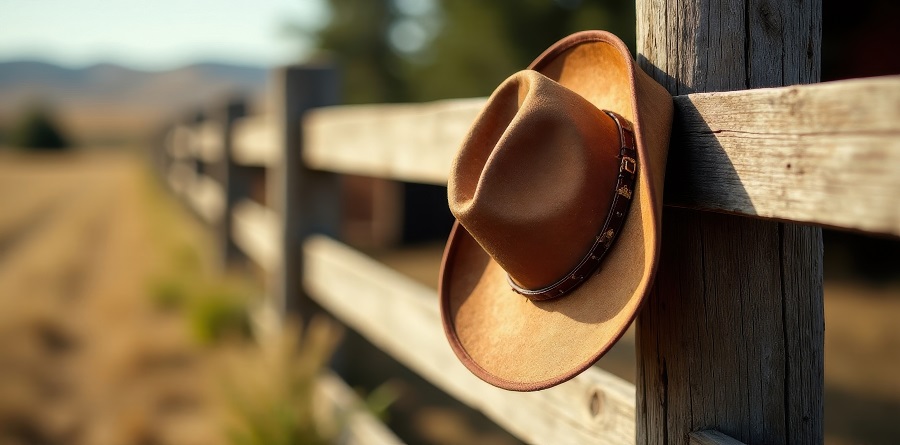
Time moves differently in the parched land of New Mexico’s Mimbres Valley. It blends in the wind, settles in the dust, and echoes in the voices of men who have spent their lives riding land that grinds slowly, changing — in some ways, disappearing.
Filmmaker Tamar Lando has returned to this landscape for nearly a decade to document what remains of the fading way of life. Her film, Land with No Rider, is neither narration-driven nor sweeping social commentary. The film unfolds instead through the quiet, unguarded reflections of aging ranchers — Anglo and Hispanic — whose lives are deeply intertwined with the land they cultivate.
Film critic Robert Daniels described the documentary as “a stirring ode to the last few acres of the West,” documenting both its beauty and its slow unfolding.
Finding a story in a voice
Lando did not plan to do the documentary. “I was interested in people’s voices — how they express their truths,” she said. At the start, she planned to take pictures of cowboys, a world completely strange to her, having lived her life in Southern California and later in New York City.
But everything changed when she met rancher John Fowler. “He had the most beautiful voice I’d ever heard,” the filmmaker recalled. “That voice shifted everything.”
Earning trust, capturing truth
Through the years, Lando returned time and again to the Mimbres Valley. She built relationships with her subjects, many of whom are in their 70s and 80s. Trust came. Conversations grew richer. Stories unfolded.
The result is a film documentary that allows its subjects to speak for themselves, in unembellished language, with its unexpected weight. “They’re incredibly poetic,” Lando said. “Their words are simple, but they have power.”
Life on the edge of change
The years of filming coincided with a drought that wiped out about 4 out of 10 of some ranchers’ herds. But the losses were more than just livestock. Many of the ranchers were also confronting aging, grief, and the gradual erosion of a way of life.
The film’s stillness carries tensions that Lando deliberately leaves unexplained. Debates over land use, wildfire management, and the growing divide between ranchers and environmental advocates across the American West underpin the tension. “I didn’t want to make a political film,” she said. “But those issues are there, just under the surface.”
A code without words
“These men live by a code,” she said. “It’s not something they articulate, but you see it — in how they treat people, in their sense of dignity, in keeping their word.” These quiet principles stood against the backdrop of a world filled with noise and distraction, particularly in cities like New York and Los Angeles.
A line in the film captures it best. “Cowboys are careful,” says Ramon, one of the ranchers. For the filmmaker, that simple phrase redefines a familiar image, pushing back against the myth of the reckless, good-looking cowboy often portrayed in Western films.
“To live on the land as they do, you have to understand its power,” she said. “Care isn’t weakness — it’s survival.”
Where to watch
Land with No Rider opens at Sky Cinemas on April 17. It will be followed by screenings at the Guild Cinema on April 20. Then the Taos Film Festival will feature the documentary.
The film offers no sweeping judgments, giving voices to the fading stories of the American West.