

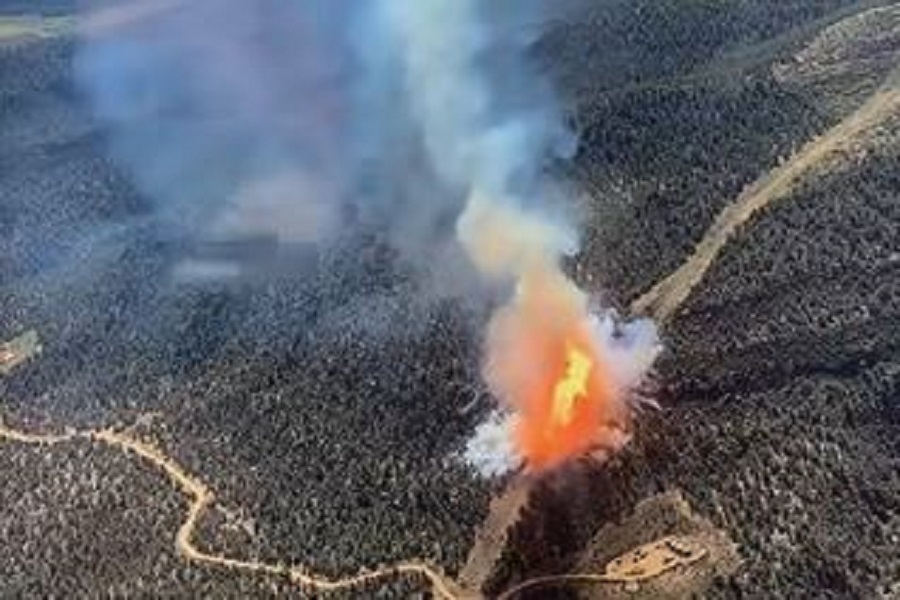
Two pipeline incidents occurred in New Mexico on Tuesday, one being 300 miles from the other, and the results could not have been more different. In one instance two people were killed, while in the other a natural gas pipeline was ruptured near the border with Colorado, sending flames 100 feet into the air and causing a wildland fire.
The seemingly unconnected events when considered together underscores the reality how dangerous it is to keep going with the huge pipeline system that supplies power to New Mexico’s oil and gas industry.
In Lea County down in the southeast, an industrial accident involving a pipeline turned deadly on Tuesday, October 6.
Around 1 p.m., deputies pulled up near the U.S. Highway 176 and Bootleg Road outside Eunice and found both victims already dead at the scene. Officials say it was an isolated incident—no danger to the public, no damage to any buildings, and the fire was already under control.
By October 8, officials still hadn’t released the names of the victims, waiting until families could be notified. The investigation was ongoing.
Just three hours later and about 300 miles away, another pipeline accident hit San Juan County in northwestern New Mexico. Near La Boca, close to the Colorado border, a natural gas pipeline run by Harvest Midstream ruptured, shooting flames 50 to 100 feet into the air.
The fire spread into nearby woods along the pipeline easement, sparking a wildland blaze. No one was hurt—every crew member was accounted for. Some residents briefly lost power, but service was restored soon after.
Harvest Midstream Co. stopped the flow and cooperated with the emergency responders. However, the cause of the rupture has not yet been established.
Company spokesman Jerrod T. Jones said, “Crews responded, the flow of gas to this portion of the system was stopped, and crews continue to coordinate with first responders as they address conditions in the surrounding area,” Jones said.
The authorities in both counties have emphasized that the incidents seem to be separate and not connected. Meanwhile, the local authorities and people from the company are still carrying out their investigations.
Pipelines rarely fail for just one reason
Both cases underscored the reality that pipeline incidents are by no means rare across the United States..
Analysis of data collected by the Pipeline and Hazardous Materials Safety Administration shows that the United States has had 1.7 incidents per day, or about 600 to 700 reportable pipeline incidents each year since 2010.
Texas had 37% of the reported incidents, exceeding the national average.
The incidents involved leaks, releases, fires and explosions.
There were hundreds of explosions and more than 1,200 fires between 2010 and 2024. These pipeline explosions had resulted in nearly 200 deaths, hundreds of injuries, tens of thousands of evacuations, and property damage in the region of billions of dollars.
These incidents are not indicators that pipelines are inherently unsafe. In fact, the United States has hundreds of thousands of miles of transmission pipelines and millions more miles of distribution lines, so that the number of serious incidents is still small in relation to the size of the network.
What investigators will look for
Jahan Rasty, the director of forensic engineering at Texas Tech University, has been investigating previous cases of pipeline explosions. Generally, he said, investigators typically start with some basic questions, such as digging or doing other work near the pipeline, and whether the pipeline itself is in good condition.
He stressed that pipelines should be regularly inspected in order to look for problems like thinning of the walls, corrosion and other damage.
“You’re supposed to do periodic inspections to make sure that, you know, the pipelines are maintaining their structural integrity in terms of wall thickness, in terms of corrosion, and corrosion rates must be monitored,” Rusty said.
Corrosion is one of the major long-term dangers. It can cause the pipe wall to become weaker until it is no longer able to endure the operating pressure.
However, corrosion is not the only issue. Investigators would also look for several common risk factors, including harm due to excavation or by construction close to the pipeline; corrosion of the pipe from inside and from the outside; effect of age and pressures; failures of equipment or operations; and natural forces, such as flooding and landslides among others.
In numerous instances, investigators conclude that multiple factors combined rather than one single failure causing the incident.
Two basins, thousands of miles of pipeline
New Mexico is heavily dependent on this infrastructure, particularly the Permian Basin and San Juan Basin regions. Both of these regions have extensive networks of gathering, transmission and midstream pipelines to serve the state’s oil and gas industry.
In remote areas there are many lines since regular monitoring is difficult. It is therefore especially important to carry out maintenance and inspections.
The deaths in Lea County are likely to lead to inquiries concerning worker safety, the way the site was being operated, and the circumstances surrounding the pipeline at the time the incident took place.
The fact that the San Juan County rupture brings up a different set of concerns. Though no one was hurt, the failure of a pipeline in a distant wooded region did result in a potentially dangerous wildfire, temporarily causing a disruption of power for the residents.

