


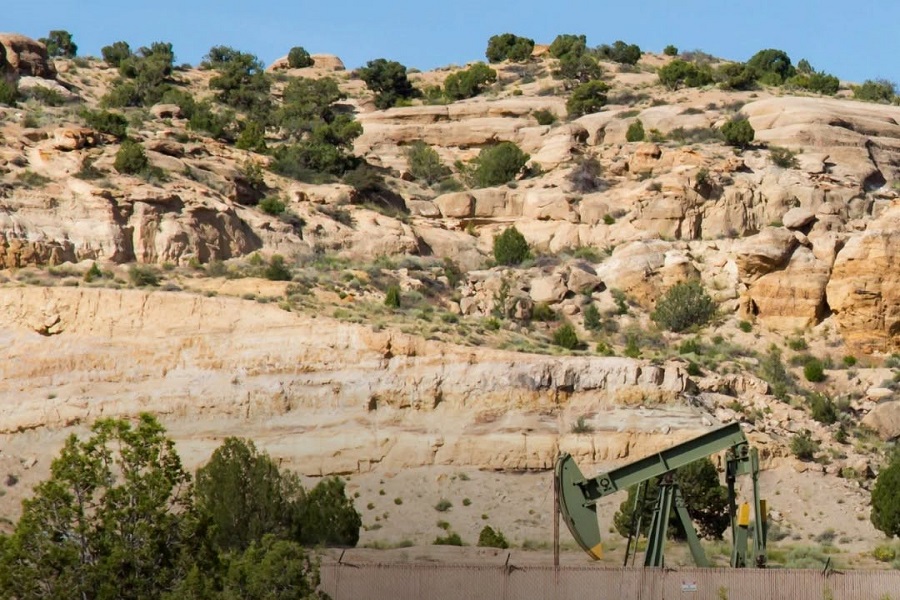
New Mexico’s abandoned wells are piling up faster than the state can clean them up, while the cost of dealing with them has soared, a new report said.
A report from the Institute for Energy Economics and Financial Analysis (IEEFA) warns that the number of potentially orphaned oil and gas wells in the state could quadruple by 2030 if current trends continue.
The report says more than 300 wells were added to the state’s inactive list in 2025 alone, roughly three times the pace at which New Mexico’s plugging program is dealing with wells. “The pace of likely orphan wells is growing three times faster than New Mexico’s well-plugging program,” analyst Trey Cowan said.
The numbers are alarming because every abandoned well can become a liability in the long run. Orphan wells are generally wells left without a financially responsible operator to properly plug and remediate them, leaking methane and other pollutants, while poorly maintained infrastructure can pose risks to groundwater, land and nearby communities.
And the price of cleaning them up has soared. Average plugging and remediation costs have risen from roughly $50,000 per well to about $250,000, according to the report, a more than 700 percent increase. This means the state could eventually face a liability estimated at as much as $1.6 billion, according to a June 2025 Legislative Finance Committee report.
The backlog keeps growing
New Mexico is already responsible for hundreds of orphan wells on state and private land.
State estimates put the number at roughly 700 to 1,000 wells, while another 1,400 inactive wells could potentially become orphaned. Thousands of very low-producing wells are also considered vulnerable to abandonment.
The state plugged a record 114 wells last year with the help of federal funding. But that pace remains far below the rate at which wells are being added to the potential liability.
The 2025 legislative report estimated the low-end cost of cleaning up the existing problem at about $700 million. Since then, remediation costs have continued to rise. The result is a race against time, with the state trying to eliminate the backlog while more wells move toward the danger zone.
At the current rate, officials could need nearly a decade just to clear the existing list, according to the IEEFA analysis. That calculation assumes, crucially, that no significant new wave of abandoned wells is added during that period.
Who pays when the oil stops flowing?
The underlying problem is not simply the number of wells. It is who remains responsible for them when production ends. Some small operators hold ageing, marginal wells that generate little revenue but can still carry substantial plugging and remediation costs.
The IEEFA report points to a pattern in which older, low-producing wells can change hands between operators before ultimately becoming inactive or orphaned.
More than one in five registered operators in New Mexico held only inactive wells last year, according to the report.
When an operator can no longer meet its obligations, the financial burden can ultimately fall on the state. That can mean taxpayer money, supplemented by federal grants, is used to deal with infrastructure created during decades of oil and gas production.
Advertisement
New bonding rules face a test
New Mexico has tried to strengthen the system.
Bonding rules approved by the Oil Conservation Commission this summer require financial guarantees of up to $150,000 for certain high-risk wells, with the aim of ensuring operators have money available for future plugging and remediation.
Industry groups have argued that the requirements could impose excessive costs on operators.
Environmental advocates, meanwhile, have argued that stronger financial safeguards are needed to prevent taxpayers from inheriting the bill.
“As the oil boom is aging and a lot of the wells are becoming low-producing, the risk is increasing,” Mandy Sackett, the lead New Mexico campaigner for environmental group Earthworks, in a statement said.
The debate gets to the heart of the problem: how much should companies be required to set aside before they drill — rather than leaving the public to pay after production ends?
Deputy Energy Secretary Ben Shelton has acknowledged how quickly remediation costs can escalate. The longer wells sit idle, the greater the potential liability becomes. “The costs can start to run away on you really quickly,” he said.
A desert littered with liabilities
Across oil-producing counties such as Eddy County, pumpjacks, tanks and other pieces of production infrastructure are a familiar part of the landscape. Some of these infrastructures eventually fall silent.
The concern is that more could remain behind as marginal wells become uneconomic to operate.
IEEFA’s analysis warns that the number of potentially orphaned wells could be four times higher by the end of the decade if current trends persist, creating not merely a bigger environmental clean-up, it would also create a much bigger financial one.
New Mexico has benefited enormously from oil and gas production. But the wells left behind after the oil stops flowing can carry a very different legacy.
The central question is whether the state can make sure companies have the financial resources to close and clean up their wells. If it cannot, New Mexico’s oil boom could leave behind a growing landscape of abandoned wells and a clean-up tab increasingly borne by taxpayers.

