

Two astronomers at New Mexico Tech played a key role in an international effort to assess the threat of an asteroid that briefly raised fears of a potentially devastating impact on Earth, highlighting how ground-based telescopes help protect the planet from space hazards.
Dr. William Ryan, senior astronomer, and Dr. Eileen Ryan, director of the Magdalena Ridge Observatory (MRO), are featured in NASA’s documentary Planetary Defenders: This Is Not an Exercise, which follows scientists as they tracked asteroid 2024 YR4 and calculated its chances of striking Earth in 2032.
The documentary, recently released on NASA+ and YouTube, offers a behind-the-scenes look at the planetary defense network that searches for potentially hazardous asteroids and determines whether they pose a danger to Earth.
Both astronomers have been NASA Hazardous Asteroids researchers since 2008. Their observations at the observatory near Socorro, New Mexico, contributed to the effort to establish the asteroid’s trajectory and assess its potential threat.
The episode illustrates a central challenge in planetary defense: an asteroid that initially appears unremarkable can become a serious concern when early observations suggest a possible collision course with Earth.
From routine discovery to planetary alert
Asteroid 2024 YR4 was discovered on December 25, 2024, by Dr. Larry Denneau of the University of Hawaii. Initially, it appeared to be one of the many near-Earth objects detected by astronomers each year.
But calculations based on its observed position soon elevated the level of concern.
On January 27, 2025, NASA reported an Earth-impact probability above 1.2%, prompting increased attention from astronomers monitoring the object. The estimated probability subsequently climbed to a peak of approximately 3.1%.
Although the odds still favored a miss, the possibility of an impact warranted further investigation. An asteroid of this class could cause severe destruction if it struck a populated area.
Scientists faced a limited window to gather observations during the asteroid’s first period of visibility. Its next favorable observing opportunity would not arrive until 2028, while the projected close approach was expected in December 2032.
The challenge was to determine the asteroid’s orbit precisely enough to establish whether Earth was actually in danger.
A mountain-top telescope joins the defense
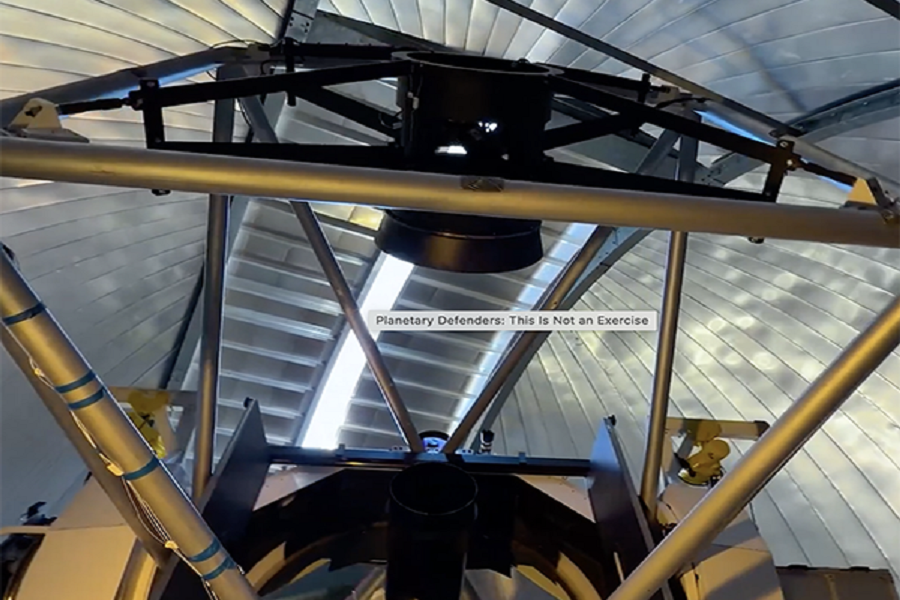
At Magdalena Ridge Observatory, the Ryans used the MRO 2.4-meter telescope to observe 2024 YR4 from January through March 2025.
The telescope collected high-precision positional measurements, known as astrometry, which helped astronomers refine the asteroid’s orbit. Researchers also gathered physical characterization data, including information about its rotation and spectral properties, to improve their understanding of the object.
The work was particularly demanding because the asteroid was extremely faint, appearing at approximately visible magnitude 24.
“The Magdalena 2.4-meter telescope is one of the largest in NASA’s Planetary Defense network and was well suited to making ground based observations of 2024 YR4, as the asteroid was very faint at visible magnitude V~24,” Eileen Ryan said.
The telescope’s capabilities were enhanced by a mirror originally built for the Hubble Space Telescope, according to the observatory’s account of the campaign.
The New Mexico team worked alongside researchers using the 4.3-meter Lowell Discovery Telescope in Arizona and other observatories around the world. Combining measurements from multiple facilities allowed scientists to improve their calculations and narrow the range of possible future trajectories.
The observations demonstrated why planetary defense depends on more than discovering an asteroid. Scientists must continue tracking it, measure its motion accurately and update impact probabilities as new evidence becomes available.
Impact probability falls to zero
The additional observations quickly changed the assessment of 2024 YR4.
On February 19, 2025, researchers lowered the estimated probability of an Earth impact to about 1.5%. The following day, the probability fell to approximately 0.27%.
Observations continued into April. By April 1, scientists had enough information to rule out an Earth impact in 2032, effectively eliminating the immediate threat.
The asteroid had not disappeared, but its projected trajectory no longer posed the feared collision with Earth.
“This was an excellent demonstration of NASA’s Planetary Defense network doing its job to assess risk via ground based observations and plan accordingly,” Ryan said.
The episode underscored the importance of communicating changing risk estimates accurately. An early impact probability is not a prediction that a collision will occur; it is an assessment that can rise or fall as astronomers collect more precise data.

