

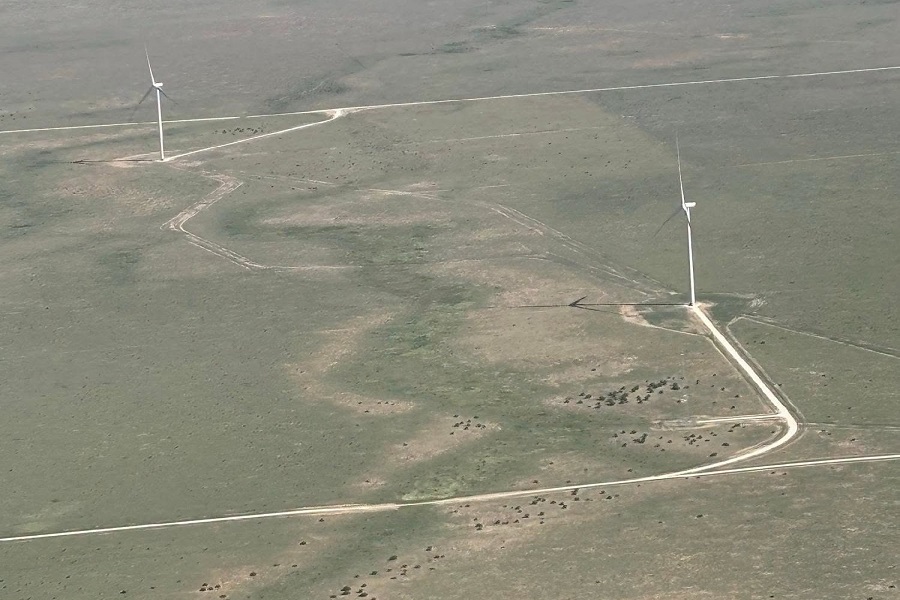
New Mexico is meeting its clean-electricity goals faster than expected, reaching a major renewable energy milestone six years ahead of schedule while preparing for a sharp increase in power demand.
New Mexico reached its goal of sourcing 50% electricity from renewables in 2024, six years ahead of the Energy Transition Act’s 2030 target, with PNM reporting 80% carbon-free generation. The state’s wind and solar resources, transmission planning, and sovereign wealth fund investments have supported this progress, offering a potential model for other states pursuing clean energy transitions.
However, challenges remain: electricity demand is expected to rise 40% by 2032, prompting PNM to propose a contested natural gas peaker plant alongside renewable additions. Additionally, delays and eligibility issues hindered financial support for workers displaced by coal plant closures, highlighting the need for better-planned transition assistance and continued attention to affordability and reliability.
The state’s progress reflects its ambitious clean energy law, abundant wind and solar resources, transmission investments, and policies designed to attract new energy technologies. But the transition also exposes challenges that could shape its next phase: maintaining reliability, managing costs, and protecting workers and communities affected by the decline of coal-fired power.
The Energy Transition Act of 2019 requires investor-owned utilities to get 50% of their electricity from renewable sources by 2030, 80% by 2040, and 100% from carbon-free sources by 2045.
The U.S. Energy Information Administration said New Mexico reached the 50% renewable energy mark in 2024. The Public Service Company of New Mexico, the state’s largest electric utility, said 80% of its electricity was carbon-free the previous year.
The results suggest that a state with a large oil and gas sector can expand cleaner energy sources while also preparing for future electricity demand.
“We wanted to set very ambitious, important targets, because we knew that this was going to help create economic opportunities and protect our environment,” said state Rep. Nathan Small, the legislation’s sponsor.
Small said the state was ahead of the 2030 target, calling that progress proof that “we can actually move more quickly.”
Renewable resources give New Mexico an advantage
New Mexico’s geography gives it a natural advantage in renewable energy development. Its vast open spaces and strong winds are well suited to large-scale wind and solar projects, while battery storage can help utilities supply electricity when generation fluctuates.
The state has also begun building the infrastructure and institutions needed for the transition, rather than relying solely on renewable energy targets.
To identify potential transmission corridors and help move projects through permitting and financing, New Mexico established a Renewable Energy Transmission Authority. Transmission is essential because the state’s renewable energy resources are often located far from the communities and industries that need the electricity.
The state government has also created a sovereign wealth fund that directs part of its oil and gas revenue toward long-term investments. Those investments include emerging technologies that could one day provide around-the-clock carbon-free electricity, such as advanced geothermal energy and nuclear fusion.
Dan West, a journalist for the Clean Air Task Force who specializes in Western state policy, said setting ambitious targets is only one part of the process.
Advertisement
“They’ve also built the institutions, the infrastructure, … and the investment environment to deliver on them,” West said.
That mix of policy, infrastructure, and investment offers a model for other states as they pursue their own energy transitions.
New electricity demand raises the stakes
New Mexico’s progress comes as electricity consumption is expected to rise by about 40% by 2032, increasing the pressure to expand generating capacity without sacrificing reliability.
PNM’s peak demand is 2.3 gigawatts, and the utility has about 5 gigawatts of installed nameplate generating capacity. In May, the utility asked state regulators to approve a new resource portfolio that includes wind, solar, and battery storage.
The proposed package includes an 800-megawatt wind project in eastern New Mexico, 240 megawatts of solar power, and 610 megawatts of battery storage, with storage capacity split between four-hour and eight-hour systems.
The proposal also includes La Luz II, a natural gas peaker plant designed to generate electricity when renewable output is not enough to meet demand.
PNM says the full package is needed to maintain reliability, especially during extended periods of cloudy weather and low wind.
Laurie Williams, PNM’s senior vice president of integrated planning and transmission development, said the resources are interdependent and that the utility can meet reliability and resource adequacy requirements only with the complete package.
The company also plans to exit its 200-megawatt share of the Four Corners coal plant in July 2031, provided its planning and regulatory processes are completed. The plant, located in northwestern New Mexico, is operated by Arizona Public Service.
However, the proposed gas plant has drawn opposition from environmental groups, which argue that additional fossil fuel infrastructure conflicts with the state’s commitment to eliminate carbon emissions from electricity generation by 2045.
In October, state regulators held hearings on PNM’s broader resource proposal and scheduled further proceedings for January to examine the gas plant specifically. A decision was expected in the second quarter of 2027.
The debate highlights a central challenge for states moving toward cleaner electricity: wind and solar can reduce reliance on fossil fuels, but utilities must still ensure power is available whenever renewable output falls.
New Mexico receives a small amount of nuclear power from Arizona, giving it a carbon-free energy source that can operate continuously. Still, technologies such as long-duration energy storage, advanced geothermal systems, and green hydrogen have not yet reached the commercial availability, cost-effectiveness, and scale needed to replace all conventional power generation.
Clean energy progress comes with economic trade-offs
New Mexico’s experience also shows that expanding renewable energy does not automatically create a smooth transition for workers and communities that depend on fossil fuels.
The state has relied on coal-fired power plants and the mines that serve them, including the San Juan and Four Corners sites. The Energy Transition Act included financial support for communities and workers affected by coal plant closures.
However, that money did not reach all displaced workers immediately.
Layoffs at the San Juan power plant began in 2020, before the plant’s scheduled 2022 closure. Funding intended to support workers was delayed by legal challenges to the financing arrangement used to fund the closure.
Advertisement
In 2022, the state’s Supreme Court allowed the financing to proceed, but the Legislature did not allocate the resulting funds until 2023.
Eligibility rules created another obstacle. The original program allowed direct payments of up to $20,000 only to workers who had lost their jobs in the previous 12 months, leaving some workers who had been laid off earlier ineligible.
In 2023, the Legislature amended the rules to include previously displaced workers. By then, however, some former employees had already left the area to take jobs at other mines and power plants.
The state later supported training, education, and apprenticeship programs, including initiatives carried out in partnership with San Juan College. In 2025, a separate Community Benefit Fund contributed $17 million toward energy transition jobs programs.
Michael Leon Guerrero, a policy adviser who has spoken with workers displaced by the San Juan closure, said the delays and changing eligibility rules made assistance harder to deliver.
Small, who also chairs the state House Appropriations and Finance Committee, acknowledged that the legal challenges contributed to “really unacceptable delays in getting state funds to workers and communities.”
The experience offers another lesson for other states: worker support should be planned, funded, and available before communities have already lost jobs and economic activity.
“It’s a good lesson learned for other states that if they’re phasing out a legacy coal plant, or in the next decade or two, a legacy gas plant, you’ve got to have policies in place and long enough runway for communities to make these transitions,” West said.
The next challenge: keeping the transition affordable
PNM’s proposed gas plant is becoming a test of how regulators will balance immediate reliability concerns with the state’s long-term climate obligations. Meanwhile, the utility’s proposed takeover by Blackstone, one of the world’s largest private equity firms, has raised customer concerns about the future direction of its energy investments.
Federal tax incentives add urgency to investment decisions. Some proposed projects could qualify for credits that reduce costs by 30% or more, depending on eligibility and deadlines. Delays in regulatory approval could complicate construction schedules and affect access to those incentives.
At this stage, New Mexico’s experience shows that measurable progress can accompany ambitious targets when policy goals are backed by investment, effective transmission planning, and strong renewable energy resources.
Reaching the next milestones, however, will require more than building wind turbines, solar farms, and batteries. The state must also manage periods of low renewable generation, respond to rising electricity consumption, and ensure that workers and communities tied to conventional energy are not left behind.
Small said other states should pursue their clean energy resources while keeping costs under control and diversifying their economies. Policymakers, he said, can “lead with clean energy, lead with climate friendly policies as you grow and diversify your economy.”