


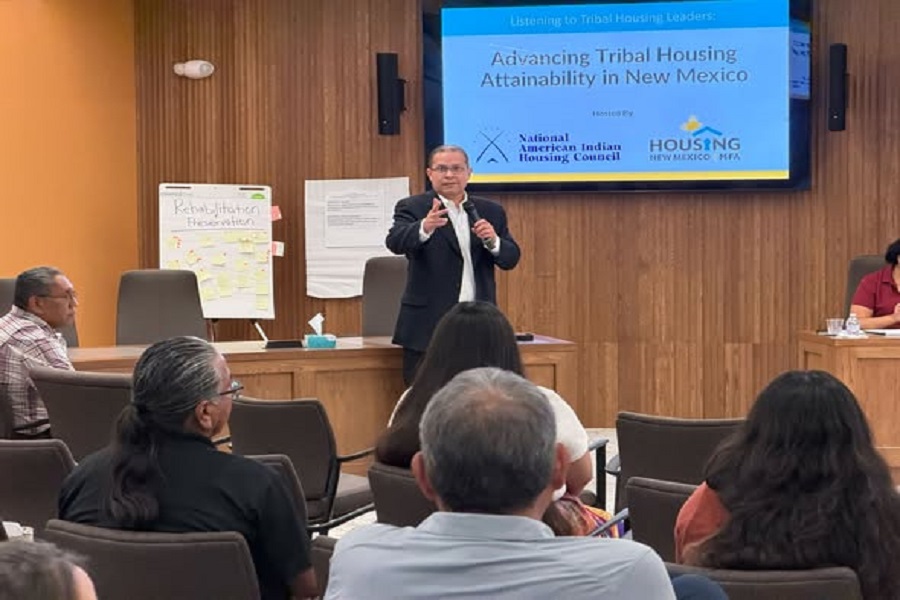
Two University of New Mexico law students found that New Mexico’s housing crisis cannot be addressed with a single, one-size-fits-all solution. Policies that may work in Albuquerque, they said, may not meet the needs of rural counties, Tribal communities, or border towns.
This summer, Will Martin and Noah Passaris, who are second-year law students at UNM, worked as housing policy interns with Bernalillo County’s Community School Innovation and Strategic Partnerships Department. The internship gave them a firsthand look at gaps in the state’s housing policies and underscored the importance of listening to communities before defining their needs.
Both interns began by studying housing challenges in rural and urban areas across New Mexico. They then interviewed housing officials, including representatives from the Governor’s Office of Housing, and traveled around the state to gather input from local stakeholders.
Based on their research, Martin and Passaris identified eight priority issues where state policy could make a meaningful difference. They also prepared recommendations and drafted proposed policy language for those issues.
Their work showed that housing policy often focuses on metropolitan areas, which can leave the specific circumstances of rural communities overlooked.
Passaris said visits to different counties showed how widely housing needs vary across the state. “The kind of housing needed in a rural county in the southeast is different from that needed in Bernalillo County and even more different from what is required in Tribal or border areas,” Passaris said.
“What surprised me the most in this summer’s project was learning how deep the need for housing reform runs in New Mexico,” he said. “We are decades behind other states in terms of policy infrastructure and coordinated response. Watching this gap close through conversations in real time made the stakes of this work feel very real, which is hard to get from a classroom alone,” he added.
State faces demand for 58,000 additional homes
The scope of the housing crisis is significant, which New Mexico is trying to solve. Housing New Mexico, the state’s mortgage finance authority, has projected that New Mexico will need about 58,000 additional housing units by 2045.
Its 2026 update to the New Mexico Housing Strategy identifies the need for a range of housing types, including apartments and smaller homes, to meet rising demand.
The strategy builds on a statewide roadmap first developed in 2022. It outlines four main priorities: increasing housing production at all income levels, preserving existing affordable housing, expanding homeownership opportunities, and improving housing stability for people experiencing homelessness or needing additional support.
State expands housing investment and homelessness programs
New Mexico has directed substantial public funding toward the housing crisis and related infrastructure needs. The governor’s office says proposed budget and capital funding for the 2026 legislative session totals more than $175 million for affordable housing and related initiatives.
The administration has also pointed to zoning reform as a way to speed up housing production and allow more homes to be built.
The governor’s 2026 priorities include proposals to increase housing supply and support homelessness programs. Those proposals are part of a broader effort to remove barriers to housing construction.
Advertisement
The New Mexico Office of Housing, a division of the Department of Workforce Solutions, says its construction investments are helping produce more than 1,000 homes in Bernalillo County and Las Cruces. Other initiatives include shelter facilities, permanent supportive housing, transitional housing, and programs for young people experiencing homelessness.
The students cautioned, however, that adding homes is only one part of the solution. Policymakers also need to consider affordability, the condition of existing housing, household incomes, and the specific needs of individual communities.
Local needs matter
Even with new investment, a statewide strategy must account for differences in housing markets and community resources.
For example, a policy designed to encourage apartment construction in a metropolitan area may not address the barriers facing a rural community, where development, infrastructure, and access to financing present different challenges.
Direct consultation with Tribal and border communities is also essential because those communities have distinct priorities and cannot be treated as interchangeable.
For Martin and Passaris, gathering local perspectives was critical to ensuring their recommendations would be useful beyond New Mexico’s largest population centers.
Their research gives policymakers an opportunity to adapt state-level reforms to different local conditions while working toward the shared goal of safe, affordable housing.

