

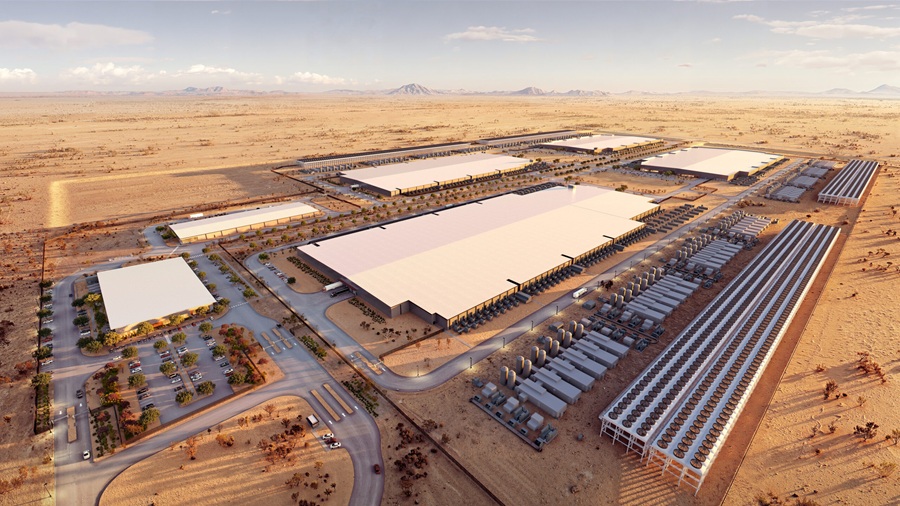
New Mexico and Texas are pursuing ambitious climate goals while also backing a wave of data center construction that could increase greenhouse gas emissions, strain water and electricity supplies, and undermine public health protections.
Major data center projects in southern New Mexico and West Texas, including developments by Oracle and Meta Platforms, are raising concerns about greenhouse gas emissions, water scarcity, and electricity demand. These facilities could undermine climate goals recently announced by New Mexico and El Paso officials, with experts warning of significant local health and environmental impacts from increased energy consumption and pollution.
The situation highlights regulatory gaps, as differing climate policies between Texas and New Mexico mean emissions from Texas-based projects can affect New Mexico communities without matching oversight. Despite these concerns, both states have offered tax incentives to attract the developments, citing economic benefits, raising questions about whether growth will outweigh long-term environmental and infrastructure costs.
Those competing priorities are especially visible along the Texas-New Mexico border, where three major data center projects are planned or under construction amid surging demand for artificial intelligence services.
Last December, New Mexico officials announced a plan to reduce the state’s greenhouse gas emissions by 2050. Also around the same time, leaders in El Paso, Texas, unveiled their own climate strategy.
But the rapid expansion of energy-intensive data centers threatens to complicate those efforts.
In Doña Ana County, just south of the border, Oracle is developing Project Jupiter, one of the country’s largest data center projects. About 20 miles away in El Paso, Meta Platforms is building another major facility, while a third data center is being considered at Fort Bliss Army post, near the Meta development.
These projects could generate millions of tons of greenhouse gas emissions each year once fully operational, according to estimates cited in the source material. Their combined emissions have been compared with those produced by more than 2 million cars annually.
New Mexico state climatologist Dave DuBois warned that the developments could offset progress made by communities working to reduce their environmental impact. “These projects are going to undo a lot of the very expensive and very meaningful work that many people are trying to accomplish,” DuBois said.
AI demand raises environmental stakes
The projects reflect a broader national trend as technology companies race to expand computing capacity for artificial intelligence, cloud storage, and other digital services.
Texas has 596 data centers operating or in development, according to figures provided in the source material. The expansion has raised concerns about electricity demand, utility bills, water availability, and air quality.
Data centers require substantial electricity to operate servers and cooling systems. Depending on how that electricity is generated, their power consumption can contribute significantly to greenhouse gas emissions. Backup generators and other on-site equipment can also release air pollutants.
Although projected emissions from the Meta and Project Jupiter facilities may be relatively low in some individual pollution categories, experts caution that even modest increases can affect communities near industrial sites. “The health impacts can be significant for local communities,” said Shaolei Ren, a professor at the University of California, Riverside.
The concerns extend beyond climate change. Increased electricity demand could put pressure on regional power systems, while water used for cooling could compete with other needs in an arid region already vulnerable to drought and extreme heat.
Those pressures are especially significant in southern New Mexico and far West Texas, where communities must balance economic development against limited natural resources.
State lines complicate climate action
The developments also highlight a regulatory challenge: air pollution and greenhouse gas emissions do not stop at state borders, but environmental policies can differ significantly from one state to another.
New Mexico has adopted legally binding greenhouse gas reduction targets, while Texas has not established equivalent statewide requirements. As a result, projects located in Texas can affect neighboring New Mexico communities without being subject to the same climate policies.
Ari Peskoe, director of the Electricity Law Initiative at Harvard Law School, said the lack of a comprehensive federal climate law has left much of the responsibility to states and local governments. “We’ve never had a national climate law passed by Congress. So, we’re left with state and local efforts that don’t always coordinate,” Peskoe said.
The gap has frustrated New Mexico lawmakers whose constituents live near large developments across the border.
Rep. Sarah Silva, a Democrat from Chaparral, New Mexico, said her state has little authority over projects being built just minutes away in Texas, even when their environmental effects could reach her constituents. “Emissions do not remain within the state where they originate,” Silva said.
The cross-border developments illustrate how one state’s economic and energy decisions can complicate another state’s efforts to meet its climate goals.
Tax incentives fuel data center expansion
Despite environmental concerns, local governments in both states have supported the projects, citing the potential for investment, creation, and economic growth.
Doña Ana County and local authorities in the El Paso area have offered tax incentives to attract the developments. They hope the region could become a growing technology hub.
Texas has also provided substantial financial incentives to the industry, including a sales tax exemption for qualifying data centers. The exemption could cost the state an estimated $3.2 billion over the next two years, according to figures cited in the source material.
In New Mexico, lawmakers rejected a similar proposal for data centers in 2021. However, the state approved separate legislation in 2025 that allows large facilities to receive comparable tax benefits under certain conditions.
The incentives reflect competition among states and local governments to attract major technology investments. But they also raise questions about whether the anticipated economic benefits will outweigh the long-term costs associated with increased energy use, emissions, and pressure on public infrastructure.
Balancing economic growth and climate goals
The data center boom presents a difficult policy choice for New Mexico and Texas. The facilities can attract investment and support jobs, but their energy demands may make climate targets harder to achieve, particularly when electricity comes from fossil fuels.
The challenge is compounded by the region’s limited water resources and the potential for pollution to affect communities on both sides of the border.
Addressing those risks will require decisions about electricity generation, water use, emissions controls, and transparency in data center development plans. Greater coordination between state and local governments could also help officials account for environmental effects that cross jurisdictional boundaries.
Ultimately, as construction advances, the region faces a central question of whether it can capitalize on the economic promise of artificial intelligence without sacrificing the climate commitments its leaders have made.