

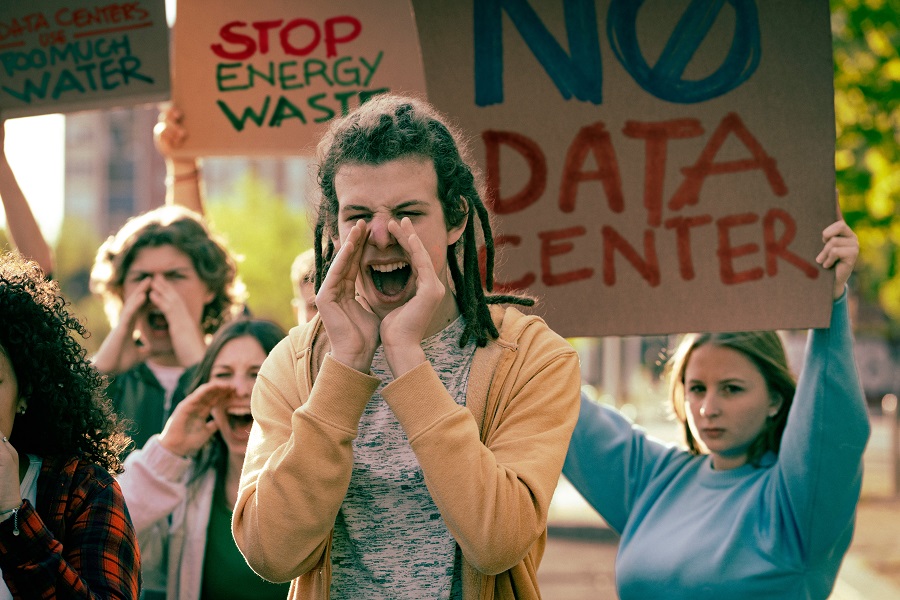
Residents of Socorro, a small New Mexico community in the desert beneath the Magdalena Mountains, are fighting what they describe as the most recent invasion of rural America by the proposed “green” data center. The proposal looks futuristic: a 10,000-acre data center powered mainly by solar energy, emerging as a major renewable-fueled computing hub worldwide.
Its proponents say the AI project could bring research opportunities, jobs, and global investment to an underperforming economic region. But in crowded town halls and ever more hostile public meetings, many residents see something else entirely — a non-transparent, water-hungry industrial project cloaked in sustainability rhetoric. “What’s bad for the environment is bad for human intelligence,” rancher and actor in the television show “Yellowstone,” Forrie J. Smith told a packed meeting at New Mexico Tech this month. Residents carrying signs that read: “Big Data Big Lie,” applauded Smith.
Green Data Center controversy
The controversy revolves around Green Data, a Canadian-linked firm whose chief executive is Jason Bak. The company executive has endorsed Socorro County as the ideal site for a sprawling AI-era infrastructure campus. He said the facility would harness renewable energy and emerging atmospheric water-generation technology. Bak, however, clarified during the March meeting, “We don’t enter into a community unless we’re wanted.”
Supporters of the project framed it as representing the next frontier of clean technology. To critics, however, it represents a familiar pattern: outside developers come into rural communities with big promises, limited transparency, and uncertain consequences. The backlash exposed an escalating national tension gripping the American West, where the astronomic growth of artificial intelligence and cloud computing is colliding with drought, land scarcity, and distrust of corporate power.
Across the state, data center projects have triggered bitter debates over water rights, electricity demand, and environmental risk. Gallup officials, for instance, delayed a wastewater agreement linked to another proposed data center after public backlash. In Doña Ana County, on the other hand, residents accused officials of fast-tracking approvals for a separate AI-related project.
But the resistance has become emotionally charged in Socorro. Residents say they first learned of the proposal in March. At the time, Bak addressed the local electric cooperative and presented plans for what he called the largest renewable-led data center in the world.
Soon afterward, opposition groups organized online. Petitions against the project gathered thousands of signatures. Residents began researching Bak’s previous ventures, questioning whether Green Data has the technical and financial capacity to deliver a project of such scale.
Entertaining ‘fantasy’ proposals
At one public meeting, Jim Ruff, a Socorro resident, accused university officials of entertaining “fantasy” proposals from a developer with no proven track record of building big data centers. Bak later acknowledged publicly that he had never personally built a completed data center. But other Green Data executives had industry experience, he claimed.
The skepticism has only grown over secrecy. Public documents revealed that Green Data and New Mexico Tech had signed a letter of intent months before many residents knew negotiations were ongoing. University president Michael Jackson acknowledged he signed nondisclosure agreements linked to early discussions. He insisted no final decision had been made.
Jackson has viewed himself as “somewhat indifferent” about whether the partnership would eventually move forward. He said the university is still assessing the environmental, technical, and economic impacts. But for many in Socorro, the very possibility of the project represents a larger fear: that rural landscapes are being turned into zones of neglect for the AI boom.
Modern data centers — particularly those powering artificial intelligence systems — need large amounts of electricity and water for cooling. Researchers warn that the rapid expansion of AI infrastructure could heighten energy demand across already strained regions.
Green Data insists its model is different. The firm says its facility would depend heavily on solar energy and atmospheric water generation instead of the traditional groundwater extraction. But many experts note that such technologies are largely unproven at the size required for hypersized AI operations.
Socorro project uncertain, for now
Residents also fear the industrialization of open desert landscapes long associated with ranching, wildlife migration, and scientific research. “You cannot replant the desert,” resident Cari Powell warned during a recent town hall meeting. “Once it’s gone, it’s gone.”
The proposed site allegedly includes areas used for explosives testing and spans near ecologically sensitive lands. Project opponents say they still have to see detailed maps, water studies, or an independent environmental evaluation. The fight in Socorro mirrors an irony noticeable across the technology industry: the race to build “green AI” infrastructure may itself become a pivotal ecological struggle of this era.
The future of the Socorro project remains uncertain for now. County officials are considering a possible moratorium on data center development while conducting additional studies. Regardless of the outcome, however, the conflict has turned this quiet community into a battleground over who bears the environmental cost of the digital age.
Many Socorro residents insist the answer cannot be decided behind closed doors. “The desert,” one protest sign read outside the university auditorium, “is not for sale.”

