

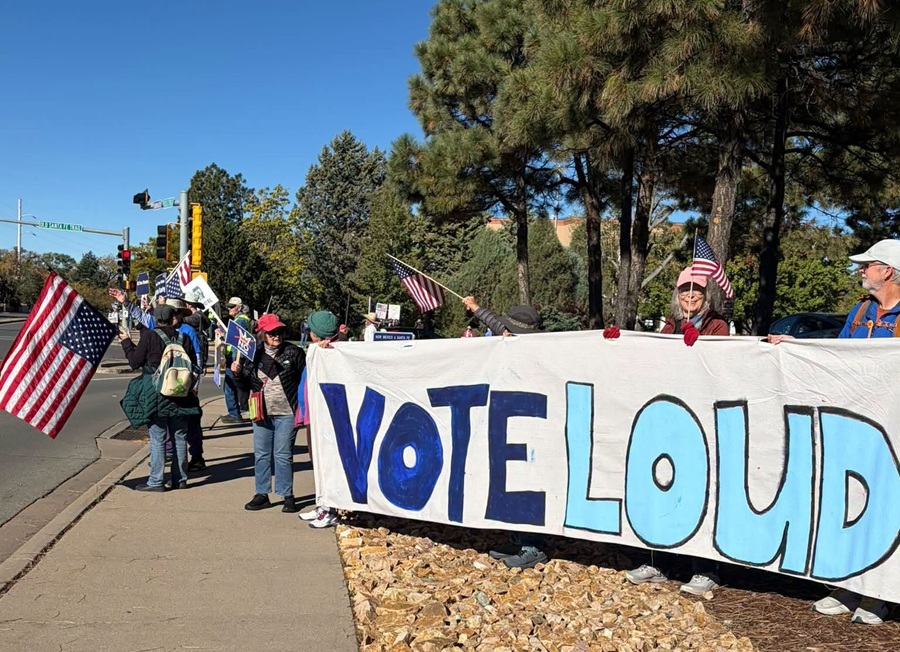
Protesters gathered in Santa Fe and Las Cruces on Saturday with a message that extended beyond opposing President Donald Trump. They urged voters to turn their concerns into action at the ballot box ahead of the Nov. 3 general election.
Rallies held Saturday in Santa Fe and Las Cruces, organized under the “No Kings: Vote Early” banner, drew nearly 1,000 participants at the New Mexico Capitol and several hundred more at Albert Johnson Park. Organizers, including Indivisible chapters, encouraged attendees to vote early ahead of the Nov. 3 general election, with some proceeding to cast ballots afterward.
Speakers and attendees cited concerns about political division, cost of living, election integrity, and federal disputes over voter registration records. Participants described voting as a meaningful way to influence government despite the outsized financial influence of wealthy donors. The events emphasized sustained civic engagement, voter registration, and early balloting over demonstrations alone.
Organizers estimated that nearly 1,000 people attended the “No Kings: Vote Early” rally outside the New Mexico Capitol in Santa Fe, while several hundred more gathered at Albert Johnson Park in Las Cruces. In both cities, demonstrators carried signs, sang protest songs, and encouraged people to vote before Election Day.
The rallies reflected a shared sentiment among participants that voting remains an important way for ordinary people to influence government, even as some expressed concern about political divisions, the cost of living, and the future of democratic institutions.
“Vote early, bank your vote, protect your vote,” said Ellen Hill, chair of Indivisible’s Santa Fe chapter, which helped organize the event.
Hill said she had already voted on the first day of early voting, Oct. 7, and wanted Saturday’s gathering to encourage others to do the same.
The rally coincided with the expansion of early voting locations across New Mexico. As of Friday, 4.3% of registered voters statewide had cast ballots either through absentee voting or early in-person voting.
Some participants describe the decision to vote as being driven by concerns about the direction of the country. Others saw participation as a way to address issues affecting their families and communities.
Hannah Wetovsky, who performed a protest song at the Santa Fe rally, said she and her husband planned to vote after the event. She described the current political climate as frightening, citing reports of people being kidnapped and growing economic inequality.
Wetovsky, a millennial, said she hopes more people in her generation will participate in the midterm elections rather than conclude that their votes make little difference.
She said the Trump administration “wouldn’t be trying to suppress the vote if voting didn’t matter.”
Election integrity was a recurring theme among speakers in Santa Fe. Some expressed concern that federal actions involving voter registration records and mail-in ballots could affect the election process.
Shari Hirst, an Indivisible organizer, encouraged attendees to vote early, arguing that casting a ballot ahead of Election Day would help protect their participation.
Will Schmidt, another member of the Santa Fe chapter, also urged voters to act early. He pointed to concerns about the administration’s handling of election-related matters and said he wanted voters to make their voices heard.
Those concerns come amid disputes between the Trump administration and state officials over voter registration records. Federal efforts to obtain voter rolls from New Mexico and other states have faced legal and administrative obstacles, while recent federal action involving California voter records has raised further concerns among voting advocates.
New Mexico Attorney General Raúl Torrez and Secretary of State Maggie Toulouse Oliver issued a voter advisory Oct. 13 outlining election information and voter rights ahead of the November election.
Hill also challenged the idea that the influence of wealthy political donors should discourage ordinary voters from participating. Referring to billionaire Elon Musk, who has contributed to Republican midterm campaigns, she emphasized the difference between the influence of an individual donor and the collective power of voters.
“But here’s the thing — he’s just one guy,” Hill said. “We’re a lot of people.”
In Las Cruces, the emphasis on participation was equally visible. After gathering at Albert Johnson Park, protesters were invited to walk to City Hall to cast early ballots. More than 50 people lined up in the lobby.
Among the attendees was a Las Cruces resident, Davena Norris. She said the line was an encouraging sign.
“I was like, great, I’d love to stand in a long line because it means that there’s a lot of people that are getting out to vote,” Norris said.
Norris said she strongly supports Daisy Maldonado for Doña Ana County Commission District 1, pointing to Maldonado’s work representing southern county residents, including on issues surrounding the proposed Project Jupiter artificial intelligence data center.
Dean Williams, another Las Cruces resident at the rally, said he plans to vote for Democrats this election after previously voting for candidates from both major parties. He said he hopes a change in congressional control could lead to greater accountability in Washington.
Williams also questioned whether rising prices would prompt more voters to reconsider their political choices.
For Laurel Brandi, the motivation to vote was closely tied to her responsibilities as a parent. Brandi said she attended the rally because she wanted to help shape a country where her 5-year-old son could grow up safely.
She pointed to concerns about school safety and said voting was one of the few practical ways she could try to influence the decisions affecting her child’s future. She had already cast her ballot on Oct. 6, the first day of early voting in the state.
“What can we do? What is there besides this, voting?” Brandi said.
Brandi said Saturday’s gathering felt different from earlier protests, with participants appearing more focused on sustained civic engagement than immediate expressions of anger.
“Less reactive and more like grinding through,” she said.
That focus on continued participation was central to the organizers’ message. Rather than limiting their actions to demonstrations, participants encouraged neighbors and fellow attendees to make sure they were registered, understand their voting options, and cast ballots before Nov. 3.
For those gathered in Santa Fe and Las Cruces, the rallies offered a public expression of political frustration, but also a reminder that the election provides an opportunity to act on those concerns.
Their message was not limited to one issue or candidate. It centered on the belief that showing up, casting a ballot, and encouraging others to participate are ways citizens can influence the decisions that shape their communities and the country.