
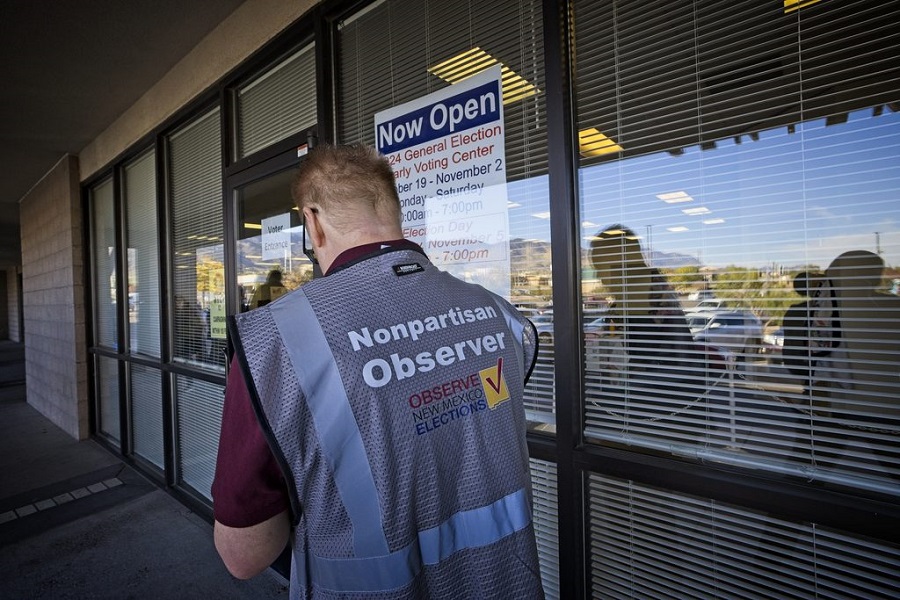
Observe New Mexico Elections (ONME) is preparing to deploy hundreds of nonpartisan observers throughout the state for the general election of November 2026, extending its monitoring initiative which included the primary elections in all counties.
The scheme is intended to allow the people of New Mexico to see for themselves how elections are carried out, with volunteers who have received training recording the procedures at polling places and then passing on their experiences to their local communities.
The ONME carries out its election observation activities with the support of The Carter Center by training members of the community to use checklists which are based on the official procedures and state law. The aim of this work is to produce independent and nonpartisan accounts of the voting process and not to promote any candidates or political parties.
After its campaign in the 2025 municipal elections—when about 105 volunteers watched people voting during early voting and on election day—the project was expanded.
For those who are organizing the elections and those who are taking part in them, the aim goes beyond just keeping an eye on the polling stations; the ONME wishes to help people gain a better understanding of how their votes are processed and of the way in which election officials carry out their duties by making the election procedures more open and by explaining what the observers see.
A 17-hour day inside a polling place
It was only during the 2025 municipal elections that Lawrence Klebesadel, who had recently retired as an engineer, realised how important election observation is.
Klebesadel had quit his job in order to become what he terms a “democracy defender”, although he never expected the job to involve packing a lunch, missing his break and staying at the polling place for 17 hours.
Sitting about four feet away from a same-day voter registration table, he watched the election officials take around 20 minutes to go through the state law in order to find out how to deal with a citizen who wanted to vote using a expired driver’s license.
The experience provided a clear insight into the kinds of decisions that election workers have to make when complying with the law and ensuring that voters can access the process.
“Every single one of those people had a passion for democracy and a passion to ensure that everybody had their privilege, right, entitlement to cast their vote,” Klebesadel said.
His situation is an example of the kind of first-hand account that ONME hopes to make more widely available as it approaches the November election.
What observers documented
The reports concerning the 2025 municipal elections were mostly reassuring, as described by the observers.
The volunteers kept records of the ballot custody procedures, of the electronic poll books and of the ballots which were printed in both English and Spanish; they also noted that the poll workers showed the voters patience and respect.
A blind voter managed to carry out the accessible voting procedure all by himself after the poll workers had set up the accessible voting booth.
The participants also mentioned the various stages of verification that are part of election administration, which gave them a better understanding of the safety measures and procedures employed at polling places.
Charlotte Hetherington, who is an independent observer with the ONME, said that there is more than simply training and procedures for poll workers which contributes to the voter experience.
The observations provided the volunteers with specific examples which they could give when their neighbours asked them about the way in which elections were carried out.
Bringing election observations back to communities
The work of ONME doesn’t stop when the polling places close, since the volunteers also share their experiences with friends, members of their family and neighbours who would like to know what takes place during voting.
Ken Anderson, having just moved from Oregon to New Mexico, stated that even lawyers and lobbyists who lived near the state Capitol were surprised to find out that neutral and nonpartisan election observation existed.
“I think there is value in making ONME more visible to show the value of neutral observation,” Anderson said.
This level of visibility would allow residents to tell the difference between their own observations and speculation and to understand the procedures that election officials follow.
It is impossible for independent observation to prove that every part of an election is free from errors, nor does it take the place of official investigations or legal supervision. However, recorded experiences can serve as an additional source of information for communities that want to find out how voting is carried out.
Improving the model ahead of November
The approach of the project has also been changed as a result of the feedback given by the volunteers.
Some of the observers who were present during the 2025 municipal elections found the judges at first rather cautious about their arrival. A participant referred to this reaction as the “hall monitor effect”, though the interactions generally got better as election day went on.
ONME has kept on perfecting its training, checklists and procedures as a result of these experiences. The organizers stated that a great many of the improvements seen in 2025 had been due to the feedback given by volunteers in 2024, while the lessons learned from the municipal elections helped to guide the preparations for 2026.
The statewide component of the programme’s observation of primary elections marks yet another stage in this process. Since hundreds of observers are expected to take part in November, ONME is preparing to broaden its activities during the general election when voters will go to polling stations all over New Mexico.
The extent of the planned deployment will cause the number of communities in which volunteers are able to record election procedures and share their experiences to rise, but the project’s final impact on public confidence will in part depend on how well those observations are communicated and understood.
For Klebesadel and the other volunteers the dedication is based on the belief that people should be able to find out about elections by means of direct and impartial observation.
When ONME is getting ready for November, its strategy is based on a basic idea: informed communities do not just need competing assertions regarding elections. They also need reliable descriptions of what takes place when voters turn up, election workers carry out their duties and the ballots move through the system.