
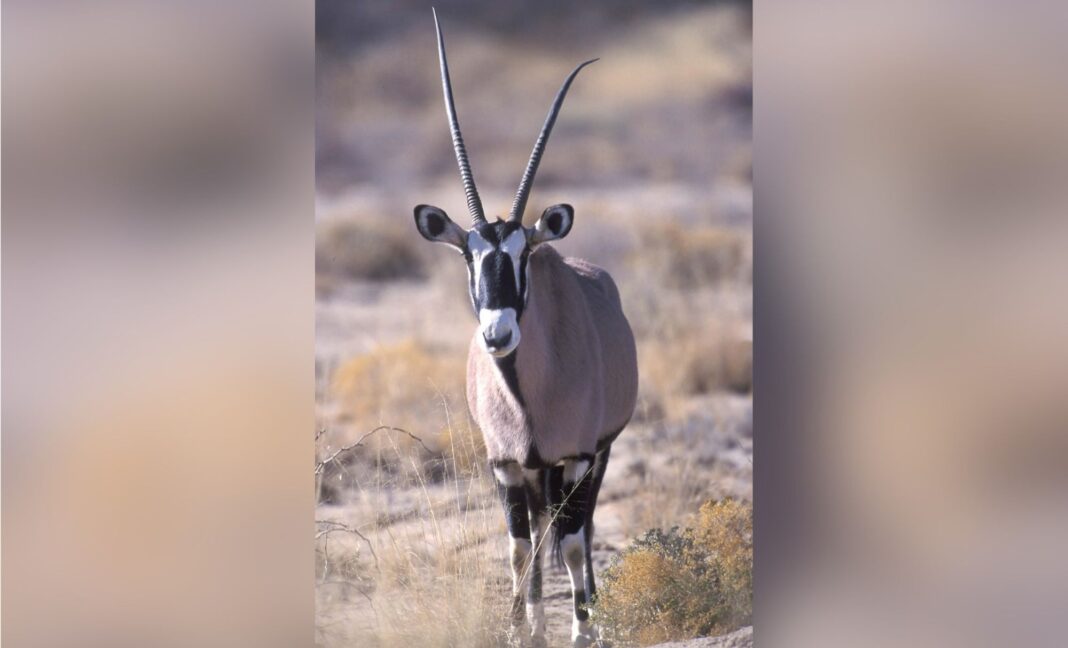
Are you familiar with gemsbok? A team of researchers from the University of Illinois Urbana-Champaign has published a study examining how far this large African antelope, also known as an oryx, could spread across the American Southwest as climate change continues, Phys.org reports. Led by Nathan Alexander, the research was co-authored by Kieran Andreoni and Robert Schooley and published in the Journal of Mammalogy.
A University of Illinois Urbana-Champaign study, led by Nathan Alexander and published in the Journal of Mammalogy, models how gemsbok (African oryx) populations introduced to New Mexico in 1969 could expand across the American Southwest due to climate change. Using sighting data and statistical modeling, researchers project suitable habitat could extend into Texas, Arizona, Utah, California, and even parts of Washington and Montana by 2100.
The gemsbok population, originating in New Mexico’s Tularosa Basin, has spread over 100 kilometers and shows advantages over native wildlife, including minimal water needs and few predators. New Mexico currently maintains 5,000-6,000 oryx through regulated hunting programs that generate significant revenue, with wildlife officials describing the population as stable and still reviewing the study’s long-term implications.
According to EurekAlert!, the researchers analyzed public sighting reports submitted through apps such as iNaturalist and compiled by the Global Biodiversity Information Facility. They used a statistical model called Maxent to map where gemsbok currently live and identify areas they could potentially occupy later this century. The model considered temperature variations, rainfall patterns, plant cover, terrain, and human population density, as stated by the nonprofit science news release platform.
The study suggests that suitable gemsbok habitat could extend beyond New Mexico into Texas, Arizona, Utah, and California. Researchers also identified isolated areas that could support the species as far north as southern Washington and Montana by 2100, EurekAlert! reported.
New Mexico is a key part of the study. The U.S. gemsbok population began here, and the researchers say changes could become apparent within decades rather than only by the end of the century.
Alexander said by email that climate models use 30-year averages, making it difficult to predict exactly what will happen over the next 10 years. He referred to the model’s nearest window, 2011-2040, which shows increased habitat suitability just south of the Sacramento Mountains. “It may start to develop a range connection into western Texas,” he said.
How Gemsbok Reached New Mexico
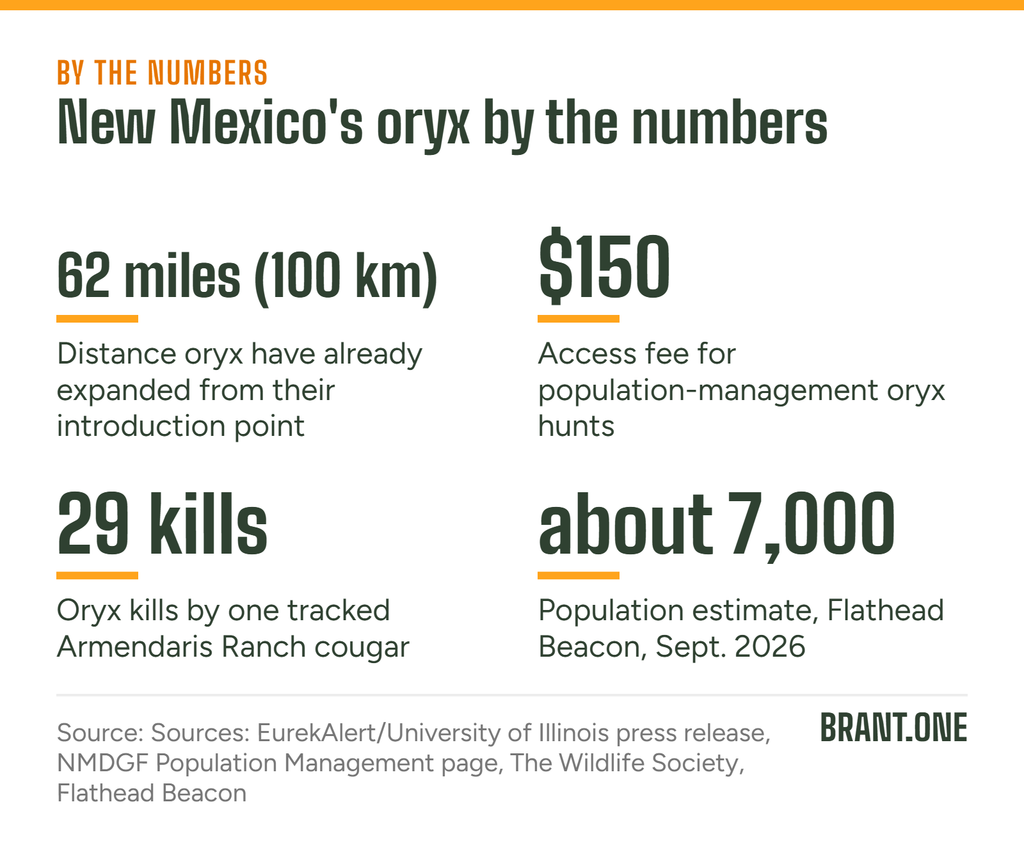
New Mexico’s gemsbok did not arrive on their own. An article from The Wildlife Society stated that in 1969, state wildlife managers introduced the animals to the Tularosa Basin to give big-game hunters a new species to pursue. Native to the Kalahari Desert in southern Africa, according to a study published in the Journal of Arid Environments titled “Exotic oryx interact with shrub encroachment in the Chihuahuan Desert,” the antelope adapted well to the basin’s dry terrain and multiplied.
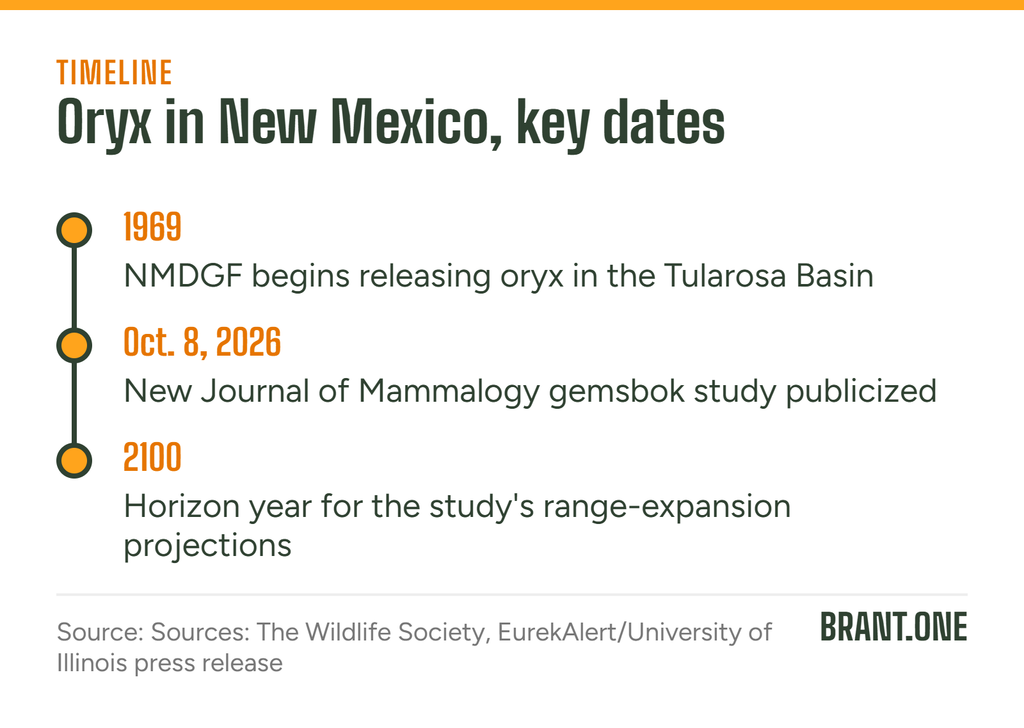
Over the years, the herd has spread more than 100 kilometers (about 62 miles) beyond its original release site, according to Phys.org.
Schooley said they have monitored some of this expansion firsthand using camera traps at the Jornada Basin Long Term Ecological Research site near Las Cruces.
Advertisement
Schooley said via email that camera photos show gemsbok numbers there have increased since 2014, surpassing those of native pronghorn and mule deer. He heads the University of Illinois Department of Natural Resources and Environmental Sciences. “They are much more abundant than native ungulates such as pronghorns and mule deer in the ecosystem,” he said.
Why Gemsbok Have an Edge Over Native Species
Gemsbok have an unusual advantage over most wildlife in New Mexico. They get all the water they need from the plants they eat, so they rarely need to drink, EurekAlert! reported.
Alexander cited findings from co-author Kieran Andreoni’s fieldwork, which showed that gemsbok stay behind even after ranchers move their cattle off a grazing allotment. “If you are ranching in an area that also has gemsbok in the region, if you pull cattle off of a range, the gemsbok will remain,” he said.
Adult gemsbok face few threats from predators in North America. Coyotes and mountain lions rarely kill them, though one cougar at New Mexico’s Armendaris Ranch killed 29 oryx, most of them juveniles, according to EurekAlert!.
Schooley said the lack of major predators makes predation less of a concern when modeling where gemsbok could spread. He added that human activity, including hunting, is more likely to limit their expansion. “Interactions with humans, hunting and otherwise, are likely to be more important than predators in limiting the spread of gemsbok,” he said.
The species can also pose risks to the livestock industry. Gemsbok in the Southwest have tested positive for malignant catarrhal fever, bovine respiratory syncytial virus, and bovine para-influenza-3, EurekAlert! reported. These diseases are a concern for cattle producers.
Alexander said researchers need more data to determine how often gemsbok come into contact with cattle and pronghorn. He said GPS collars could help track the animals’ movements.
Oryx Hunting and Population Control
New Mexico has an established hunting program to keep oryx numbers under control. The state offers hunts at White Sands Missile Range and the Jornada Experimental Range, according to the New Mexico Department of Wildlife.
Darren Vaughan, communications director for the state wildlife department, said by email that New Mexico residents pay $185 for an oryx license, while nonresidents pay $1,623. Hunters must also pay White Sands Missile Range a separate $185 access fee.
He said the department offers either-sex licenses that allow hunters to take any oryx. It also holds hunts for broken-horned oryx, open to both male and female animals.
Orrin Duvuvuei, the department’s big game program manager, estimates that New Mexico has 5,000-6,000 oryx statewide. He said about 3,500 live on White Sands Missile Range.
The department works with White Sands staff to conduct annual aerial surveys and estimate the oryx population. They last surveyed the animals in August 2026. Duvuvuei said the population has remained stable in recent years because of liberal hunting seasons.
Oryx hunting also generates significant revenue for the department. License sales brought in about $1.3 million during the 2025-26 license year, accounting for part of the department’s $30.2 million in total license revenue, according to Chad Nelson, the department’s assistant chief of licensing operations.
Advertisement
What the 2100 Projection Signals
The study’s authors presented their findings as a long-range signal, not an immediate call for wildlife managers to take action.
Schooley said a fair amount of suitable gemsbok habitat is currently unoccupied, and that under climate change it should grow more connected over time. “In the near term, we expect gemsbok will continue to increase in abundance and spread to new areas in New Mexico, but there remains uncertainty about the exact direction and rate,” he said.
Alexander said the research could help managers identify areas to monitor as gemsbok move into new territory. He identified the area south of the Sacramento Mountains as a monitoring site. “Further, if gemsbok ever wind up west of I-25 through a random event, we now have an idea of what that might mean broadly,” he said.
Meanwhile, NMDOW has not yet taken any action based on the study’s findings. Vaughan said the agency is still reviewing the research. He added that any changes to oryx hunting rules would come during the state’s regular four-year cycle of big game license numbers.
“At this time, the Department adjusts license numbers up or down based on population trajectories, management goals and constituent desires. This four-year cycle enables the Department to change license numbers in response to changes in big game populations,” he said.