

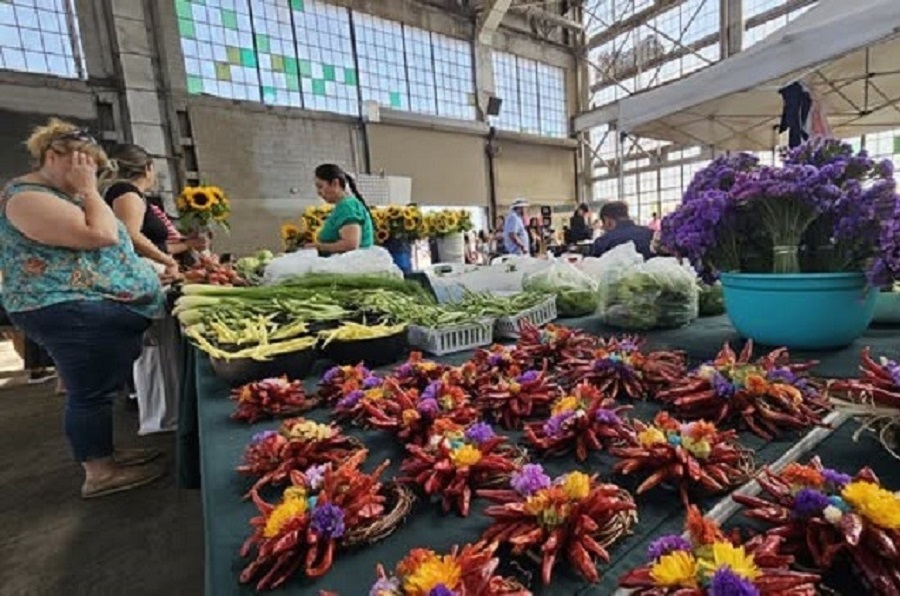
Shoppers packed their canvas bags with blue corn, leafy greens, and fresh herbs on a bright Sunday morning beneath the sprawling steel canopies of Albuquerque’s Rail Yards Market. But behind the colorful display of produce and lively crowds, many of the farmers who sustain one of New Mexico’s popular local markets say farming economics are becoming increasingly difficult.
Rising fuel prices and drought are squeezing the profit margins as growers begin another market season marked by climate stress and inflation. Gas prices have climbed past $4 a gallon in parts of New Mexico. Even in one of the nation’s top oil-producing states, residents are under mounting financial pressure.
New Mexico, according to data from AAA cited in a recent New York Times report, has the steepest increase among neighboring states. The average prices are climbing by $1.18 per gallon — from $2.61 to $3.79 — between mid‑February and mid‑March. The increase outpaced Arizona, Colorado, Nevada, and California.
Cynthia Emeanuwa, owner of EMS Farms, said every trip to market has now become a heavier financial burden. Emeanuwa has sold her produce in the Albuquerque area for more than 20 years. She also regularly transports fruits and vegetables to nearby communities like Belen.
Gas prices have turned a routine expense into a heavier burden. “Our gas used to be like $1 something, $1.99 from here to $2.99,” she said. Now, for her to go to Belen and come back costs about $50.
Statewide, farmers are grappling with the pressures of higher operating costs and worsening drought conditions that scientists say are showing up more and more in the Southwest. Fuels underpin operations from field to market. — from tractors and irrigation pumps to transporting the farm produce to the markets.
Patrick West, owner of Whole Nest in Albuquerque’s South Valley, describes water scarcity as becoming just as concerning as fuel costs. West raises blue corn, a traditional crop with deep cultural roots in the South Valley.
Many farmers in the South Valley depend on private wells or long-held irrigation water rights to sustain crops during dry periods. “It’s basically your water, and it’s not metered,” West said. “I think most farmers in the South Valley here either use wells or they have water rights where they can irrigate.”
Moreso, higher gas prices have forced difficult business decisions.“We’ve had to bring up prices a little by little,” West said. “We try to keep it fair.”
Emeanuwa approached the situation differently. She absorbed much of the financial hit herself, hoping to keep fresh produce affordable for working families. “Even though we lose money from gas, we pray and we wish that things will get better,” she said. “At the meantime, we just keep the prices the way they are so people can afford to buy our produce.”
The struggles experienced by local farmers have highlighted the increasing role of community-based food programs in Albuquerque. The Rail Yards Market, a non-profit community market operating under a 501(c)(3) designation, has become more than a place for weekend gathering. It is emerging as a key support system for small producers squeezed by higher prices and climate uncertainty.
To encourage participation, the Rail Yards Market charges raw produce growers only $5 per Sunday booth fee. It also teams up with Albuquerque officials and Bernalillo County’s Area Agency on Aging to hand out free boxes of produce to low-income seniors caring for children.
The market says 75 percent of revenue from veggie box sales goes back to participating farms, while the remaining revenue supports operations. Organizers have also channelled more than $150,000 in assistance dollars into local food purchases, including SNAP, WIC, and Double Up Food Bucks
Many vendors describe those programs as providing crucial stability during uncertain times. The Rail Yards Market will remain open every Sunday through October, providing both local goods and support for farmers facing mounting challenges.

