Home Blog Page 88

New Research Supports Family-Focused Treatment for Babies With Opioid Withdrawal

0

Opioid use during pregnancy has become a growing public health concern. It affects thousands of newborns who experience withdrawal symptoms shortly after birth. These infants often require medical treatment and extended hospital care to manage a condition known as Neonatal Opioid Withdrawal Syndrome (NOWS). Now, researchers have discovered that involving families more closely in a baby’s care may help improve recovery. It may also reduce the need for medication. In fact, recent studies have shown that family-focused treatment for opioid-exposed babies can lead to better outcomes.

Researchers at the University of New Mexico Health Sciences Center studied babies exposed to opioids during pregnancy. They evaluated the role of family-centered care in their recovery, with particular attention to family-focused treatment for opioid-exposed babies.

The team evaluated a treatment approach that encourages parents to actively care for newborns experiencing Neonatal Opioid Withdrawal Syndrome (NOWS). This condition occurs when infants experience withdrawal after exposure to opioids in the womb, and family-focused treatment for opioid-exposed babies is becoming an increasingly recommended strategy.

Scientists released the findings in 2026 as part of ongoing research on treatment options for opioid-exposed newborns.

The research took place at the University of New Mexico Health Sciences Center in Albuquerque, New Mexico, United States.

Researchers aim to develop safer and more effective treatments that reduce the need for medication in infants with NOWS. Therefore, family-focused treatment for opioid-exposed babies is a primary consideration in current research.

However, recent studies done at the University of New Mexico Health Science Center have found further evidence supporting the use of a family-based treatment technique. This technique is aimed at helping infants suffering from neonatal abstinence syndrome. This condition is caused by maternal exposure to opioids.

Doctors normally use medications and a longer stay in hospitals in order to provide treatment for infants diagnosed with this disease. Nevertheless, the researchers suggest that family-based techniques can be more effective. These approaches may provide the necessary results.

The treatment technique includes several steps, such as skin-to-skin contact, swaddling, breastfeeding if applicable, and providing the child with a comfortable environment. As a result, children undergoing treatment feel better. Additionally, their parents become actively involved in helping them recover.

The authors state that this therapy can significantly decrease the intensity of withdrawal symptoms. It can also minimize the necessity of using medicine in certain situations. Moreover, hospitals that use this technique have noted reduced time spent in the hospital. They have also seen better bonding between parents and their babies.


Lifestyle Changes That Reduce Plastic Use May Cut Exposure to Harmful Chemicals

0

Plastics have become a common part of everyday life—from food packaging and kitchen containers to personal care products. Many people rely on these materials because they are convenient, lightweight, and widely available. However, scientists are increasingly raising concerns about the chemicals that plastics may release into food and the human body.

Now, a recent study suggests that simple lifestyle changes—such as reducing plastic use in daily routines—may help lower people’s exposure to potentially harmful chemicals.

The researchers conducted an experiment with over 200 adult volunteers, with the goal of evaluating the effects of lifestyle modifications on exposure to plastics. In addition, they aimed to explore strategies to reduce chemical exposure to plastics.

The study sought to investigate whether avoiding contact with plastics in food containers, kitchen utensils, and personal care products can decrease the body’s exposure to plastics.

The study was released on April 21, 2026.

The research was conducted in Perth, Australia, among participants in the PERTH trial.

The scientists aimed to investigate whether lifestyle changes could reduce human exposure to harmful chemicals in plastics.

In a recent study published in Nature Medicine, researchers found that reducing exposure to plastic in food, diet, and personal products can lower people’s exposure to various chemicals associated with plastic.

People could ingest plastic-associated chemicals when they eat packaged foods or use products stored in plastic containers. Additionally, they may ingest them when they apply products containing plastic components.

These included eating foods with minimal contact with plastic packaging and using kitchenware made of materials other than plastic.

The result was a noticeable reduction in the exposure to some of the chemicals. In seven days, there was a reduction in phthalate and bisphenol A among those who had altered their diet.

Kick Off Summer with New Mexico United – Tickets Now Available

0

Up for some summer fun? This one’s for you.

New Mexico United, the state’s professional soccer team, is once again inviting the Albuquerque Public Schools community to come together. Join the celebration as the school year ends and summer begins. 

APS Education Appreciation Night 2026 with New Mexico United happens on Saturday, May 23. Each ticket purchased through this link donates $4 to the APS Education Foundation, supporting innovative programs for students.  

The match against Charleston Battery begins at 7 p.m. at Rio Grande Credit Union Field at Isotopes Park. APS families can arrive early for a College & Career Fair starting at 5:30 p.m. This is the first-ever College and Career Fair at a United game.

The career fair showcases Goal 3. It ensures students explore post-high school options and graduate ready for the college or career of their choice.

Through the activity, students can explore opportunities and job seekers can connect with Albuquerque’s largest employers.

More than 20 educational and business representatives will be on hand. These include UNM, CNM, Sandia National Labs, APS Human Resources, Dion’s, and trade unions. 

APS students can win prizes by visiting college, business, and union representatives and collecting signatures on their passport. APS board members will be there to hand out the passports and connect with families.

The district will highlight students and staff throughout the night. Students from East San Jose Elementary and Washington Middle School will receive recognition for earning bilingual seals.

April Community Leader Spotlight: Lindi Rodrigues Walsh

In our ongoing effort to focus on community and local stories in New Mexico, Brant One is starting a new piece to highlight Community Leaders once a month. 

We want to tell stories to inspire and give a shout-out to those working hard among us in our community. 

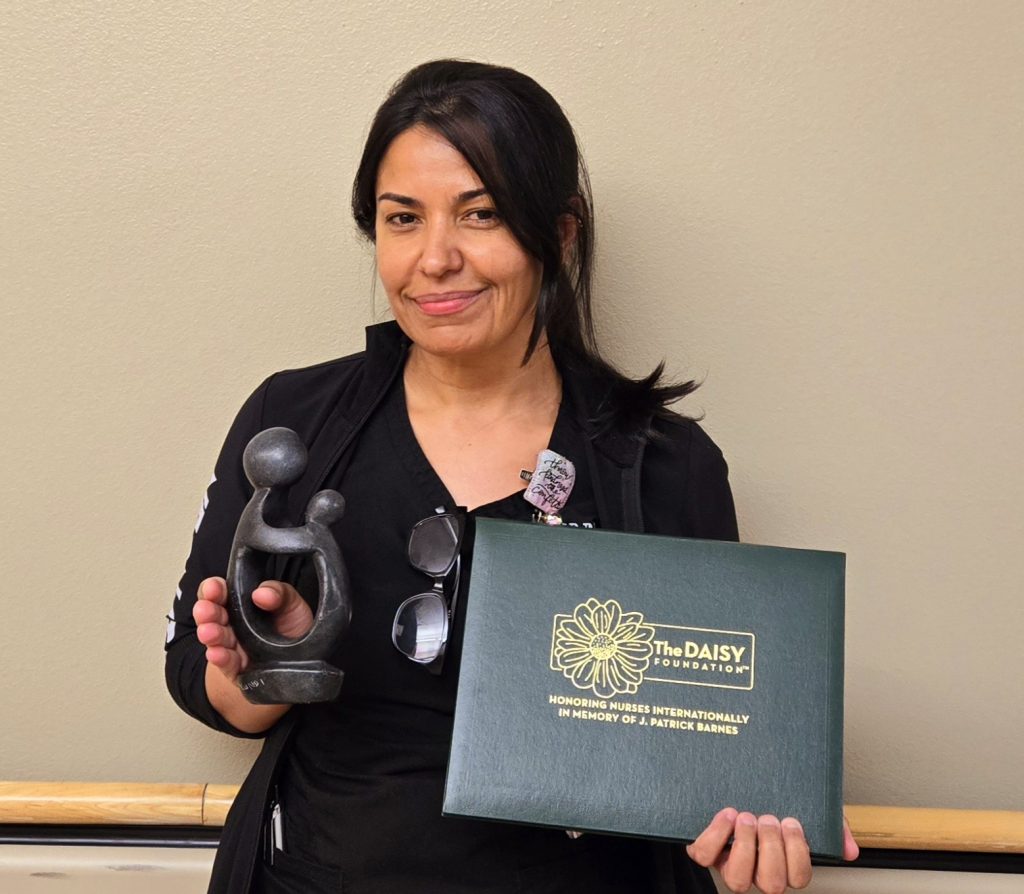
April’s Community Leader Spotlight is on Lindi Rodrigues Walsh, a Registered Nurse at UNM Hospital. 

Lindi works in the Newborn Intensive Care Unit (NICU). She got her license almost 8 years ago, and has been working in the NICU for 7 years. However, she hadn’t initially planned on working in the NICU. 

Becoming a Registered Nurse

“Before becoming an RN,” Lindi said in an interview, “I was just a mom.”

She had her first child in Brazil, and moved to the US in 2006, while pregnant with her second child. She didn’t speak much more than basic English: “Just introducing myself and asking for water,” she said. “After my second child, I had to go to school.” 

Moving to a place like New Mexico from Brazil, the easiest language transition might be from Portuguese to Spanish, but Lindi refused to take the easy route. “I wanted to be involved in the culture of the country,” she said. “When my English was good enough, I started taking pre-reqs for nursing.” 

When she began taking pre-requisites, Lindi wanted to be a midwife. “I decided to go to nursing school, it’s just the route people usually take.” Then, she wanted to go to be a labor and delivery nurse, and be involved in the birthing process that way. 

Later, during her capstone, the final assignment to apply nurse schooling to real life practice, she realized that becoming a labor and delivery nurse may not be the path she was looking for. 

“I had 6 weeks following a nurse for 12-hour shifts, and I realized that labor and delivery nurses were not really 100% about the babies. I decided that it was not for me, so I decided to go to pediatrics.”

What Makes a Great Nurse

I asked Lindi what is most important to her in giving care. She said that language differences and mis-translation can create a real barrier in the healthcare system. 

“Because I was a patient before who did not speak English, when I see families who don’t speak English, I try my best, and I try my best with everyone, but especially the ones whose English is not their first language.” 

Her own experience gives her a perspective on language barriers that other nurses might not pick up on. “I see that happen many many times that translation gets lost. I use an interpreter, and I will say something in English, and sometimes they don’t convey the full meaning of what I’m saying to families, and I’m lucky enough to understand most of Spanish so I can ask them to clarify. I can understand just how difficult it is when you have somebody giving you care and you cannot pass on your concerns and you’re not totally understood.”

In January 2024, Lindi won the DAISY Award for Extraordinary Nurses, and since then has been nominated several times. She was nominated by a family whose baby was born with a Congenital Diaphragmatic Hernia (CDH), and had to stay in the NICU for 50 days. 

“Lindi made a huge impact on our family’s experience and hardship; she was trustworthy and the only nurse I ever felt comfortable leaving my baby alone long enough without me or my husband present to grab a bite to eat or take a nap.” (Taken from Lindi Walsh | DAISY Award.) 

The DAISY Award is an international program created in honor of J. Patrick Barnes. The award is intended to recognize and celebrate nurses for their care and kindness. More about the award is on their website, The DAISY Award.

Lindi with her DAISY Award, image from https://www.daisyfoundation.org/daisy-award/honorees/lindi-walsh

Lindi Rodrigues Walsh would like to thank her kids for being so patient when she was in nursing school. She thanked her husband for supporting her, and she thanked the many nurses at UNM Hospital who trained her: “When you start the job you know nothing, you have the basics of nursing school, and they have to train you and they’re not even paid for that, and I’m very grateful for all the amazing nurses that helped me to become the nurse I am today.” 

Do you know someone who deserves a spotlight? Let us know! Email [email protected] or complete our form to nominate a Community Leader for Spotlight. 

Olivia Woodard is a journalist for Brant One News. She can be reached at [email protected] or on Instagram at @brantonenews.

Fire Danger Returns on New Mexico Starting Wednesday

0

Winds will pick up across New Mexico starting Wednesday, bringing several days of high fire danger through the end of the week.

It was a hotter Tuesday across New Mexico, with temperatures climbing into the 70s and 80s for more areas. The winds have remained light to calm today as a weak ridge of high pressures moves overhead.

Although the stretch of lighter wind will be brief, windier weather develops Wednesday afternoon as southwesternly winds will gust at 25 to 45 mph across New Mexico while relative humidity stays low, which will bring high fire danger statewide, with its greatest concern for Albuquerque into northern and eastern New Mexico.

Temperatures will climb into the 70s and 80s again, which is unseasonably warm for this time of the year.

By Wednesday night, winds will ease but even stronger winds are expected Thursday afternoon as westerly winds will gust 35 to 55 mph.

A cold front will also move into the state from the northwest, bringing a slight drop in temperatures across northern New Mexico.

Fire danger will remain high statewide, with a corridor of even greater concern along I-40 in eastern New Mexico.

On Friday, winds will be lighter, but its gust could reach 40 mph in parts of the state. Fire danger will not be quite as high, but will remain elevated.

A similar pattern is observe and will continue into Saturday with breezy to locally windy conditions.

Stronger winds will return Sunday afternoon, with gusts up to 55 mph possible and as humidity will be slightly higher, which should help limit the fire danger somehow.

A few spotty showers and thunderstorms are possible on Sunday particularly across Western, northwestern, and northern New Mexico.

Is Labor Offloading Aging Health Costs Onto the States? Debate Raises Fiscal Concerns

0

Policy experts, labor economists, state governments, and federal policymakers in the United States are debating the issue.

The discussion examines whether labor-related funding systems shift healthcare costs for aging populations from federal programs to state governments. The concern focuses especially on long-term care and public health services.

Lawmakers and analysts raised the issue during fiscal policy discussions in 2026 as healthcare costs continue to rise.

The debate centers on the United States, where both federal and state governments share responsibility for healthcare financing.

Experts worry that demographic aging and labor-based financing could place a heavier burden on state budgets.

Many policy discussions now focus on whether labor funding models move aging-related healthcare costs from the federal government to the states.

The article also examines how governments allocate healthcare costs associated with aging populations. As life expectancy increases, demand for healthcare and long-term care services also grows.

This rising demand places additional pressure on healthcare funding systems.

In the United States, the federal government funds some healthcare programs, while states manage and finance others. Some experts argue that the current system may gradually shift more costs to state governments.

As a result, concerns about fiscal sustainability for states are increasing. States with larger elderly populations may face greater financial challenges.

U.S. Senate Reviews Health and Human Services Budget Proposal for FY 2027

0

Representatives from the U.S. Senate and Health and Human Services Secretary Robert F. Kennedy Jr. attended the HHS budget hearing 2027 to deliberate on the budget proposals made by the agency.

During the session, senators reviewed the budget estimates and justifications for the department for fiscal year 2027. The HHS budget hearing for 2027 provided an opportunity for a detailed examination of these figures.

Lawmakers held the hearing on April 21–22, 2026, as part of their review of the federal budget for the upcoming fiscal year. Furthermore, the HHS budget hearing for 2027 served as a critical step in the legislative process.

The discussion took place at the Dirksen Senate Office Building, where congressional committees regularly hold government oversight hearings. Notably, this venue has historically hosted major sessions, including the 2027 HHS budget hearing.

These hearings help lawmakers evaluate whether agency spending meets the nation’s needs and priorities. On that note, the 2027 budget hearing for HHS played a vital role in assessing financial allocations.

Meanwhile, the United States Senate Committee on the Budget questioned officials about the Department of Health and Human Services’ 2027 spending plan. Senators focused on funding priorities and policy goals during the HHS budget hearing 2027.

Overall, the hearing examined the administration’s budget proposal for the United States Department of Health and Human Services. While outlining funding plans for the next fiscal year, the 2027 HHS budget hearing was pivotal for setting priorities. The proposal includes about $111.1 billion in discretionary budget authority for public health programs, research, and social services.

During the hearing, senators also questioned department leaders about the proposal’s impact on major healthcare programs. In particular, topics relating to Medicare and Medicaid were prominent in the 2027 HHS budget hearing.

Additionally, such hearings play a key role in the federal appropriations process. For example, the HHS budget hearing regarding 2027 gave lawmakers the chance to review spending plans before Congress approves the final budget.

Doctors Intervene as Patients Bring AI-Generated Health Misinformation

Many of these cases highlight the growing concern about AI-generated health misinformation.

Physicians have found themselves needing to intervene when patients consulted them because of wrong health information provided by an artificial intelligence system. These interventions often relate to AI-generated health misinformation.

This revelation was made in April 2026 amid a growing trend of using AI-enabled software to answer health-related queries. This trend raises the risk of AI-generated health misinformation.

The survey covered Canadian doctors but is relevant worldwide regarding health misinformation driven by artificial intelligence. In particular, the spread of AI-generated health misinformation has become a significant topic in global healthcare discussions.

Patients have begun consulting AI tools for quick health information. At times, these tools provide inaccurate information that needs clarification.

In fact, according to a recent study, more than half of doctors today find themselves intervening because their patients received misleading information from AI-generated advice.

According to the survey, 97 percent of respondents reported that their patients encountered misleading or inaccurate health data online. They required intervention to counteract actions based on such false information. Moreover, medical professionals explained that this was likely due to the increasingly widespread use of AI-based health information tools among people.

In fact, it is possible to explain the rise of the phenomenon mentioned above. As AI technology becomes more prevalent among users seeking medical advice online, many people today turn to various AI-powered chatbots or platforms before visiting a physician. Nevertheless, it is important to keep in mind that these technologies may sometimes provide people with misleading health data.

According to medical experts’ recommendations, people should not rely solely on AI for their health but should visit a healthcare provider to verify the information.

Panel Prepares Next Steps in New Mexico’s Behavioral Health Reform Rollout—What to Expect

0

State officials are scheduled to map out the next steps of a comprehensive reform of behavioral health services. The key panel will meet this week to advance implementation of a landmark reform law.

The New Mexico Health Care Authority (HCA), in coordination with the Administrative Office of the Courts, will convene the fifth meeting of the executive committee formed under the Behavioral Health Reform and Investment Act (Senate Bill 3).

Here’s what to expect from the meeting:

Defining the rollout structure.

Committee members are set to shape and organize the state’s new region-based behavioral health system. They will also tackle how services will be distributed and managed across different areas.

Setting timelines and priorities.

Officials are likely to outline the next steps in implementing the new system. They will also define key milestones and the sequencing of reforms so that agencies can start translating policy into practice.

Coordinating across institutions.

Representatives from multiple branches of government and stakeholders composed the committee. The discussions are expected to focus on aligning the roles of agencies, courts, and community partners in delivering services.

Expanding access to care.

Likely to remain the focus of the panel’s deliberations is how to improve access to mental health and substance use treatment, especially in underserved communities.

The legislature passed Senate Bill 3 to address the deficiencies in behavioral health care. But as the committee meets again, attention increasingly shifts from legislation to execution—where the pace, coordination, and decisions will determine how quickly reforms are felt on the ground.

The meeting is scheduled from 1 pm to 3 pm on Thursday, April 23, in Santa Fe, with a virtual attendance option. It is open to the public. Officials are encouraging stakeholders and residents to participate as the state moves from policy to action.

Nuclear Ambitions in New Mexico Face Legislative Roadblocks

0

New Mexico’s bid to position itself as a leader in nuclear energy is facing a legislative hurdle. The resistance from some lawmakers persists even as they acknowledge the need for more power and cleaner energy sources.

Speaking at the “Nuclear in New Mexico” conference on Tuesday, Democratic Rep. Meredith Dixon said the state has all the potential to be the leader “in all things nuclear energy,” referring to recent investments and the state’s access to national laboratories. She conceded, however, that the support from lawmakers and the public remains a roadblock.

The Clean Energy Association of New Mexico hosted the conference. It comes following renewed industry interest in New Mexico’s uranium deposits, and a growing pushback from communities and local officials. The state has hundreds of abandoned uranium mines, many of which are still hazardous.

“We still have a long way to go with education and discussion,” Dixon said. She cited the defeat of Senate Bill 78, which she co-sponsored with four Republicans earlier this year.

The proposed measure would allow the state to classify nuclear energy as an alternative source for utilities. A narrow 5-4 vote in the Senate Conservation Committee defeated the bill.

Dixon said the outcome highlights a larger standoff among lawmakers. “I think there’s a strong recognition… of some of the legacy issues and concerns by communities,” she said. There is also growing awareness of rising electricity demand from data centers and economic expansion, the lawmaker added.

The Democratic lawmaker pointed to recent state budgets, which she helped craft as vice-chair of the House Appropriations and Finance Committee. Lawmakers have earmarked $40 million to clean up legacy uranium sites over the past two years. The 2025 budget also established a $150 million research fund under the New Mexico Economic Development Department to support advanced energy technologies, including nuclear fusion.

These efforts are part of a comprehensive strategy to build a “nuclear ecosystem” while addressing past harms, Dixon said. “[Fusion research] will go hand-in-hand with the cleanup and the building of a nuclear ecosystem here in New Mexico,” she explained.

Dixon remains unclear whether to reintroduce Senate Bill 78 in next year’s legislative session. She is hoping, however, that lawmakers will remain open to nuclear energy as a carbon-free alternative.

The lawmaker underscored advances in uranium extraction. She said modern technologies could make mining safer and less invasive, unlike in the past.

“The way that uranium is mined now is very different from what we saw in the past,” she said. “There are so many different technologies that can help us with our uranium supply that are under the radar.”