


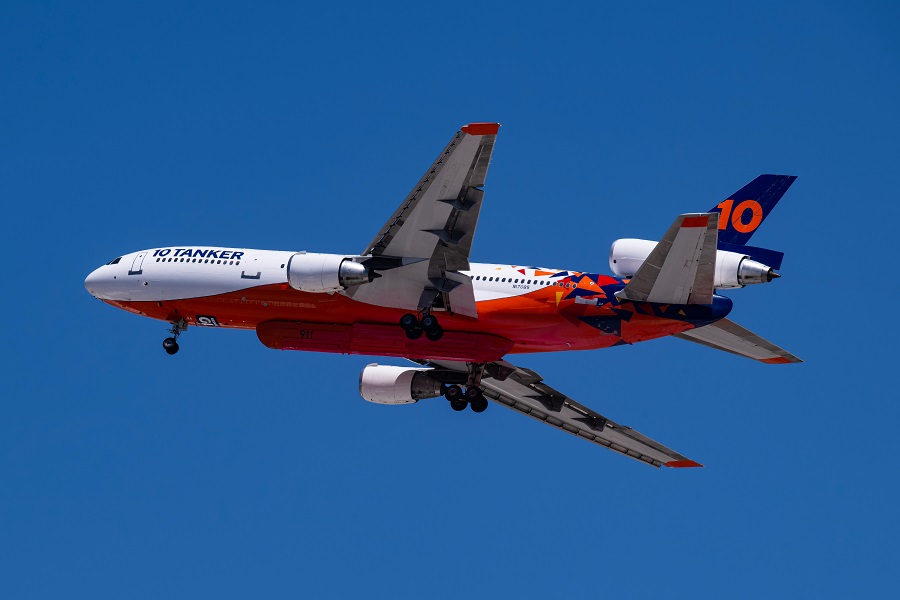
The desert air in Albuquerque International Sunport hums with an unlikely weapon in America’s fight against wildfire. A small company has transformed retired DC‑10 jumbo jets—once emblems of commercial aviation—into titans of aerial firefighting. One distressed call converts a 10 Tanker to lift off with a payload that eclipses anything else in the sky: nearly 10,000 gallons of fire retardant, sufficient to drench a mountainside in a single, thundering pass.
This week, one of those aircraft was over Arizona’s Tonto National Forest, leaving a crimson streak of Phos-Chek across the Round Valley Fire. Sparked by a vehicle fire and explosion along State Route 87 near Four Peaks, the fire threatened brush and infrastructure in rugged terrain with limited ground access. The 10 Tanker drop helped stop the fire’s progress on a 30-acre scar that could easily have grown into a far larger burn.
10 Tanker: From Passenger Jet to Firefighting Behemoth
10 Tanker Air Carrier, founded in the early 2000s and now headquartered in Albuquerque, started its operations in 2006. The company’s vision is to modernize aerial firefighting. Its founders are veterans of heavy jet operations and aircraft modifications, who saw an opportunity in decommissioned DC-10 airliners. They sought a Supplemental Type Certificate from the FAA to equip the wide-body jumbo jets with external belly tanks.
The result is a Very Large Air Tanker (VLAT) with no equals in regular U.S. service. Each DC-10-30 carries up to 9,400 gallons — approximately 35,500 liters — of retardant or water. It will take about eight seconds to release the load, creating a containment line up to a mile long and 300 feet wide. Three center-line tanks with internal baffles provide stability; filling takes only eight minutes with proper ground support.
The 10 Tanker operates with a crew of three: a pilot, co-pilot, and flight engineer. These former commercial aviators bring their experience in heavy jets to the demanding, low-level, high-stress environment of fire traffic areas. The annual training in Albuquerque and simulation flights keep them sharp for the job.
Today, the 10 Tanker fleet includes four active DC-10-30s. The original DC-10-10 prototype was decommissioned after hundreds of missions. The planes have combatted fires across the American West, flown contracts in Australia, and helped put out blazes as far as Texas.
Power, Precision, and the Physics of the Drop
A glance at a lumbering wide-body might look like it is ill-suited to the tight, smoky canyons of the West. Once, critics questioned its maneuverability. Operational experience of the aviators, however, has largely laid those concerns to rest. With firefighting missions requiring reduced fuel load, the DC-10s often fly well below their maximum gross takeoff weight, providing strong thrust-to-weight performance, tight turn radii for their size, and solid safety margins.
A drop from one of these giants equals roughly a dozen from a much smaller traditional tanker. That efficiency matters during periods of longer, hotter fire seasons fueled by drought, overgrown fuels, and climate trends. One VLAT can quickly build huge containment lines, providing time for ground crews and reducing the total flight hours required across the fleet.
Advertisement
But the work is inherently dangerous. Often, pilots fly low at 200 to 300 feet above the ground through turbulent air, smoke, and mountain passes. Coordination with aerial supervisors, lead planes, and other aircraft is both important and critical. The company stresses safety protocols fine-tuned over two decades and over a thousand missions.
A Week in Arizona: The Round Valley Response
The Round Valley Fire is a textbook example of integrated operations. An RV fire and explosion on SR 87 ignited the blaze on Wednesday afternoon. With no water sources near the site, the Tonto National Forest crews, local fire departments, elite hotshot teams, and aerial units converged in a rapid, coordinated assault. Authorities closed Highway 87 for hours. A 10 Tanker DC-10 made a low pass, its retardant plume visible in videos shared widely.
By the following day, the fire’s forward progress had stopped at around 18–30 acres. The fire reached 100 percent containment shortly after. Such rapid containment of a remote highway spark prevents the kind of multi-week megafires that have spanned the Southwest in recent decades.
Arizona has leaned mainly on the 10 Tanker in the past. The company’s aircraft responded to dozens of fires there, in one recent year, dropping millions of gallons.
An Evolving Aerial Fleet
10 Tanker is one of a few operators providing next-generation capability under U.S. Forest Service contracts. Its VLATs supplement larger air tankers, single-engine air tankers (SEATs), and helicopters. Expensive to operate, the impact of firefighting aircraft can prove cost-effective by monitoring fires promptly, particularly in the wildland-urban interface.
The company’s 2026 statistics, still early in the season, already showed dozens of missions and hundreds of thousands of gallons released. Over its history, the company has dropped millions of gallons worldwide.
Challenges remain. High-elevation sites, turnaround times, and the logistics of retardant combining delivery test even the most capable fleets. Other issues — aging infrastructure, pilot shortages in aerial firefighting, and the relentless spread of Western wildfires — frame every flight.
10 Tanker jets taxi out from Albuquerque, climb to cruise, then descend into the burning targets wherever the next call comes. Their pilots and maintainers, ground crews loading retardant under scorching sands or towering peaks, and the aircraft themselves reflect an evolution in how America defends its landscapes.

