


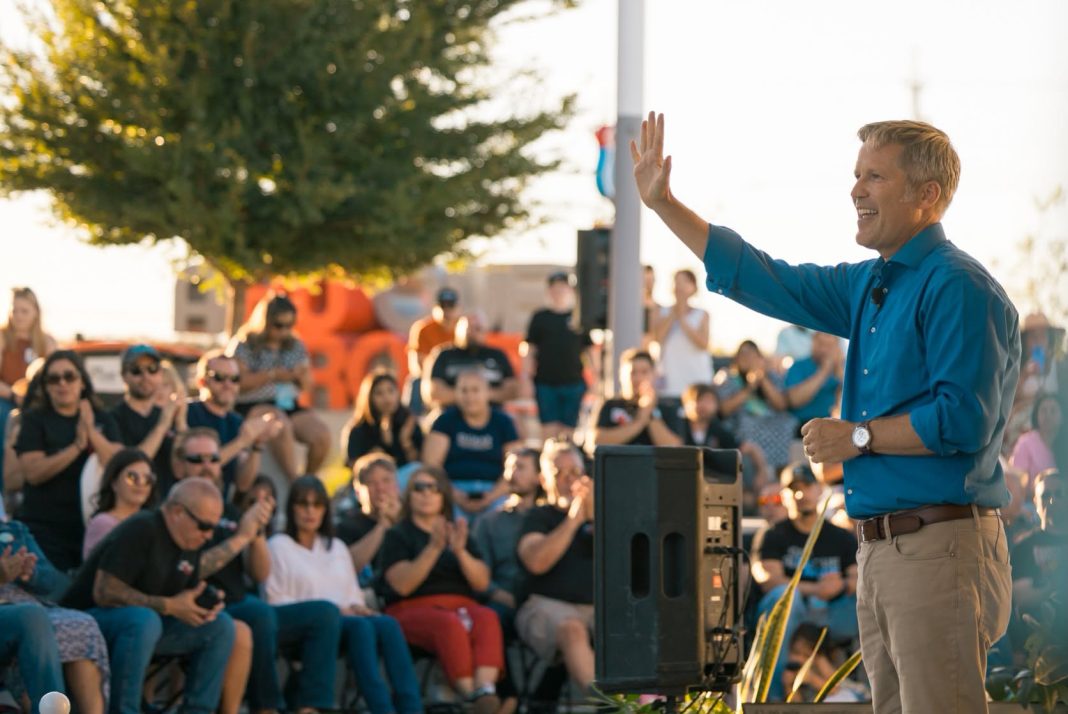
Mayor Tim Keller is pushing for an “abundance agenda” to guide Albuquerque’s future and improve residents’ lives. During his 2026 State of the City Address on August 15, Keller outlined his priorities for the city. His strategy focuses on sharing public resources, reducing government barriers, and improving services for citizens.
His speech, however, began with a disruption. A spokesperson for the mayor’s office said security immediately escorted four people out after they interrupted Keller.
“So, we’re going to talk about a lot of things including our police department. We’re going to talk about our historic anniversary Route 66 and from time to time we might have some of this, that’s OK,” Keller said.
Keller addressed what he called Albuquerque’s day-to-day challenges, including housing, food insecurity, public space use, and public safety.
How Keller’s Abundance Agenda Aims to Shift the City’s Mindset
About 350 people attended Keller’s ninth State of the City Address. There, he called for a shift in mindset from scarcity to abundance.
“It’s about a city abundance agenda that is about sharing what we have instead of protecting and hoarding it,” said Keller. “It is about making your life a little bit easier each day. We’ve got to put abundance at the forefront of our public policy instead of scarcity.”
Keller said changing Albuquerque’s future starts with the abundance agenda. He said the plan would use the city’s civic muscle to get more projects done.
“None of this works if government can’t actually put your speed bump in or fix whatever’s happening outside your house,” he said.
Public Safety Initiatives
Keller said the agenda can succeed only if residents feel safe in their homes, neighborhoods, and public spaces.
“None of this strategy works if we are not safe as a community,” said Keller. “Crime is going down in Albuquerque. It doesn’t mean we feel safer, but we know the statistics are going in the right direction.”
The mayor said the Albuquerque Police Department (APD) would continue targeting violent crime and drug houses. He added that APD would also focus on businesses linked to illegal drug activity.
Keller also highlighted a violence-intervention program for high school students. The initiative will connect them with services and mentors who have lived experience, including formerly incarcerated individuals.
“It has shown for every kid in the program roughly an 80% increase in their grades and an 80% drop in any criminal activity,” Keller said.
The mayor said the program currently operates in four high schools.
Additionally, Keller emphasized the Albuquerque Community Safety Department’s (ACS) role in handling nonviolent calls. The department responds to behavioral-health, mental-health, and other situations that do not require police intervention. He said ACS has now taken 150,000 calls from the 911 system.
“Those are all calls APD did not have to respond to so they could focus on violent crime,” he said.
Homelessness Response
Meanwhile, the mayor underscored an individualized approach to homelessness. He said the strategy addresses the residents’ housing, addiction, behavioral-health, and transportation needs.
Advertisement
“We have to start treating individuals like people who have their own history and their own needs instead of just by location,” said Keller. “We have to build our system around the actual individual.”
He said the approach also provides jail diversion, transportation, shelter beds, and assistance with personal belongings.
Keller called for a new public compact to help people experiencing homelessness or addiction. He said the compact should provide meaningful support while keeping shared spaces safe and accessible.
“Public spaces have to be for everyone,” said Keller. “It is not illegal to sit at a bench in a park and it’s also not illegal to walk down the street, but it is illegal to do drugs in our parks. We have to have compassion to actually get people real help, but we also have to make sure that the public domain is there for all of us to enjoy together.”
Keller said the Gateway System of Care offers shelter and services to individuals, families, and teenagers. He said it is up and running and it takes care of 1,200 people every night in the city.
He added that ACS helps connect people on the streets and in emergency rooms with Gateway services.
“ACS is transporting almost 600 folks a month from the streets into the Gateway System,” he said. “They’re also diverting 2,000 people from emergency rooms into places like the Gateway System, where they can get the right kind of care.”
Housing Affordability and Other Priorities
Keller also addressed housing and affordability for residents seeking to buy homes or rent apartments in Albuquerque. Keller said the city’s rules have traditionally limited citizens to single-family homes. He wants his administration to manufacture homes and find easier ways to build them.
“We’re going to start by democratizing what it means to actually decide for yourself what your home should be,” said Keller. “You pick what type, and you’ll have options, choices to actually decide what home means for you.”
Additionally, Keller said his administration’s Available City Properties initiative would open vacant or underused public land for community use. Residents could lease, purchase, or use the land for housing, businesses, and community gardens.
The City of Albuquerque announced this initiative on August 13.
“There might be a 99-year lease for $1 a year,” he said. “Basically, we’re going to let you use it for next to nothing, to put our land to good use.”
Keller said certified childcare providers could use underused city buildings at no cost. He said the city also plans to open gyms, community centers, and event spaces beyond regular business hours.

