

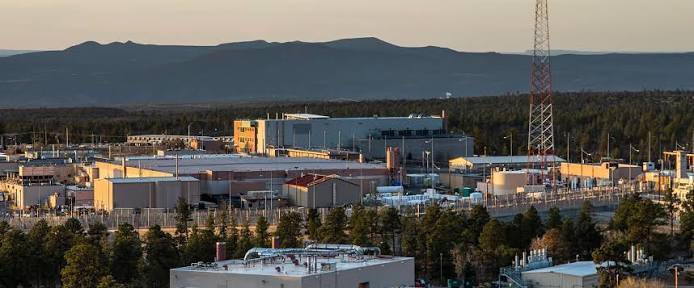
What was once a storage site for nuclear weapons has now become Los Alamos National Laboratory’s underground tunnel, where they examine radionuclides used in low-background physics experiments, and it is right above Starbucks.
Built in the 1940s, the Ice House Tunnel runs deep into a canyon and is 200 feet long. LANL said five faults located at the far end of the tunnel once stored nuclear weapons during the Second World War.
Nuclear & Radiochemistry Scientist Mitzi Boswell said that when the Second World War ended, the laboratory realized it had a considerable number of nuclear weapons and needed a place to restore them.
The first home to the discovery of the neutrino
From 1943 to 1945, some of the world’s most brilliant scientists went to Los Alamos to support the Manhattan Project. The Manhattan Project was the U.S. government’s top-secret project to create the first atomic weapons.
After World War II, Frederick Reines remained in the lab. Around 1947, he began exploring ideas that would change not just his life but also science, including the discovery of the neutrino with his colleague, Clyde Cowan.
Neutrinos are extremely elusive subatomic particles that are very difficult to observe because they rarely interact with matter.
Both initially considered whether a nuclear detonation could produce enough neutrinos to be detected, but soon realized that a nuclear reactor would provide a more practical, controlled source.
Then, in 1951, the Project Poltergeist was born to turn their theory into a reality.
Bringing the theory outside Los Alamos
However, the road to triumph isn’t as easy as it sounds. At that time, the laboratory did not have a suitable nuclear reactor for the two scientists’ needs. So Reines and Cowan decided to bring the project to Hanford, Washington, in 1953.
Hanford served as a crucial step in their experiment. They tested their detector near a reactor and learned more about how to distinguish possible neutrino signals from background radiation and other unwanted signals.
But it was not the final confirmation of the neutrino. They continued improving their experiments and moved to the Savannah River Site, South Carolina, in 1955.
Where things took a turn
They continued their experiments using large tanks of water and detectors to search for the extremely rare interactions produced by the neutrinos.
Although the odds were slim, they remained hopeful and continued their experiments.
In 1956, they observed evidence of neutrino interactions and published their findings. It was big and a breakthrough at the same time since neutrinos do not interact regularly with matter.
And in 1995, Frederick Reines was awarded the prestigious Nobel Peace Prize in Physics. His partner, Clyde Cowan, passed away in 1974, and Nobel Prizes are not awarded posthumously; only Reines received the award.
Despite only Reines receiving the award, there is no denying that Cowan’s work and contribution did not go unheralded alongside him. History records how he theorized about and discovered an elusive particle, rarely seen by the naked eye.
Research continues after 70 years
Research continues despite the discovery. Now, the laboratory has placed highly specialized detectors at the back of the tunnel, used to measure radionuclides.
Radionuclides are commonly used in very low-background nuclear physics experiments.
Neutrino physicist William Louis said there is still a lot to learn about the neutrino’s properties and behaviors. They believe the neutrino detection could lead them to still-unknown particles and to the physics behind the Standard Model.
The laboratory continues to investigate neutrinos, as it believes they will answer many questions about particle physics and the universe.

