

A spider may one day help keep the Moon base safer. Not the eight-legged kind, but the one with five legs that runs on remarkably little power and could form a web of sensors across NASA’s future lunar infrastructure.
Three Mechanical Engineering students from New Mexico Tech have designed SPIDER, a compact structural health monitoring device capable of detecting potential dangers inside space habitats, from micrometeoroid impacts to changes in temperature and humidity.
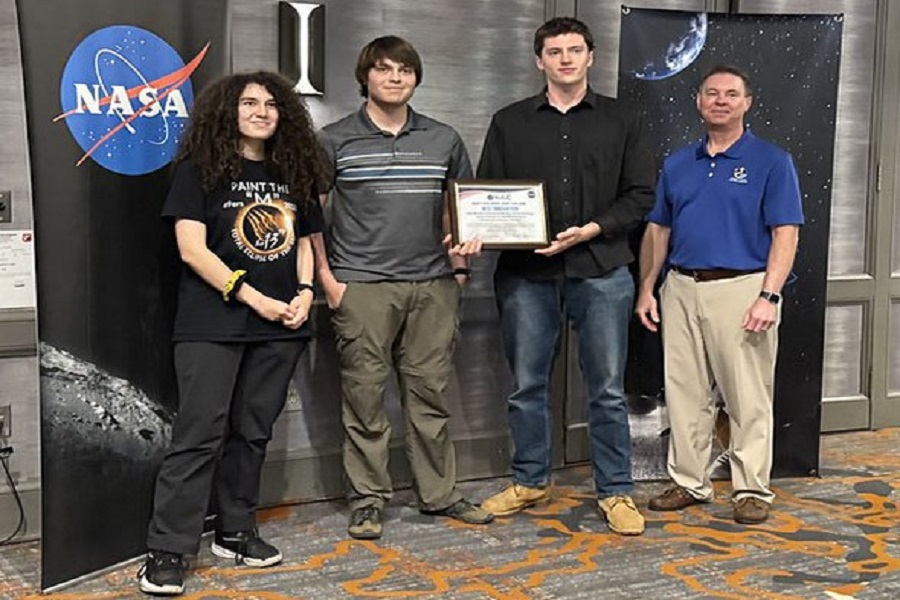
Their futuristic invention was so promising that the team won the Best Innovation Award at NASA’s 2026 Human Lander Challenge.
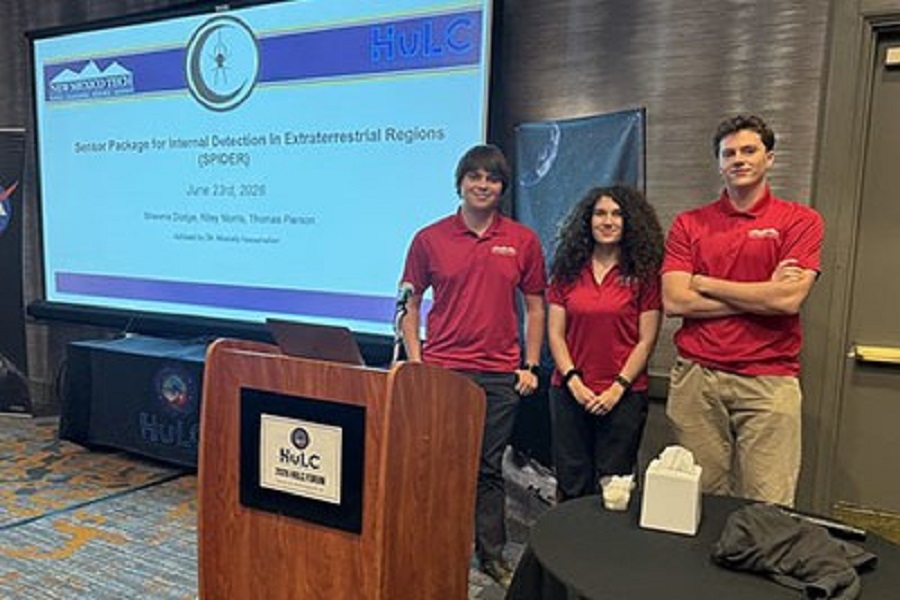
Shawna Dodge, Riley Morris, and Thomas Pierson were among just 10 teams from across the United States invited to the competition’s final round at NASA’s Marshall Space Flight Center in Alabama this summer.
They had only 25 minutes to convince NASA and industry experts that their mechanical spider belonged in humanity’s future homes beyond Earth. And they had another 20 minutes to answer questions.
“The questions were grueling!” Pierson said. But the New Mexico students were ready to defend their project, formally called Sensor Package for Internal Detection in Extraterrestrial Regions, or SPIDER, which looks like one, resembling a five-legged spider, with thin wires and sensing nodes stretching outward from a compact central body.
Those nodes could be embedded throughout space habitats, constantly monitoring their surroundings and warning astronauts when something goes wrong, detecting a tiny impact from a micrometeoroid.
Even changes in temperature and humidity could trigger an alert, while strain within critical life-support systems could also be monitored.
The students did not stop there. They envision developing not just one SPIDER but an entire network by 2032, in which multiple sensors could communicate with one another, sharing information and creating what the team describes as a stronger web of protection throughout lunar infrastructure.
“We placed a strong emphasis on the innovative capabilities of our sensor package and the value it could provide to future space missions, so it was incredibly rewarding to see those efforts recognized with the Best Innovation Award,” Dodge said.
The students design the project to tackle weaknesses in existing structural health monitoring technology.
NASA currently combines its Fiber Optic Sensing System, known as FOSS, with the Stanford Multi-Actuator Receiver Transduction, or SMART, layer. The systems provide reliable monitoring, but they can require significant power and offer only a limited set of sensing modalities.
Power could be precious for astronauts living on the Moon. So the New Mexico Tech students attacked the problem from there.
First, they found ways to reduce SPIDER’s energy consumption so that, instead of continuously demanding data, the device could remain in a low-power state for longer periods, reducing how often it checks its sensors.
The team also cut telemetry transmissions to once a day, increasing SPIDER’s battery life to 60 days, twice the length of a proposed 30-day lunar mission.
Advertisement
But conserving power was only half the solution. The students also found ways to generate it by incorporating photovoltaic cells into SPIDER’s central power hub.
Unlike traditional solar panels, the cells could harvest energy from LED lighting inside an enclosed habitat. A thermoelectric generator and a battery would provide additional backup, a redundancy that enables the sensor to continue monitoring its environment even if one or more power systems fail. “Working on a project with direct applications to future human spaceflight showed me how classroom knowledge can be translated into real engineering solutions,” Morris said.
But SPIDER is designed to do far more than conserve electricity. The team gave their mechanical spider multiple ways to sense trouble. Its FBG optical sensors and piezoelectrics could measure strain in life-support systems and help pinpoint impact locations.
They also incorporated colorimetric sensing. The thermochromic paint could fluoresce or change color when it detects potentially dangerous conditions. Different colors could even signal different hazards.
It took months of research, design, testing, and refinement to transform the concept into a competition-ready project. During the first stage of the Human Lander Challenge, the New Mexico Tech students were selected as one of the top 10 teams to advance and received $9,000 from NASA to support their work.
They then built prototypes, validated their sensing methods, and prepared a technical paper and presentation. ‘Each interaction strengthened both our project and our understanding of the engineering design process,’ Morris said. “It was truly a team effort, and we learned a tremendous amount from working together.”
Their work may now reach an even larger audience. The team has had a paper accepted for the 2027 AIAA SciTech Conference, where the students will present their research to the broader aerospace community.
They hope the conference will help them continue developing SPIDER and establish connections within the space industry. And NASA engineers appear to be paying attention.
“Many of the NASA engineers are interested in seeing our sensor package idea come to fruition,” Pierson said. “I learned there really is room for innovation in this field.”
NASA’s Human Lander Challenge is designed to encourage college students to develop innovative solutions for the technologies needed to return humans to the Moon and support future human landing systems.
For New Mexico Tech, the competition marked its first appearance in NASA’s Human Lander Challenge (HuLC). But the university has already developed a growing record in NASA competitions, including NASA MINDS and NASA Lunabotics.
Mechanical Engineering Department Chair Mostafa Hassanalian said such challenges give students the opportunity to take what they learn in classrooms and apply it to real-world engineering problems.
In this case, that classroom project could eventually become part of a small, five-legged sensor and a network of machines that share information across a lunar habitat.
Perhaps, one day, the project could become part of a technological web that helps protect the first long-term human communities on the Moon, because when astronauts finally build a home more than 238,000 miles from Earth, they may need every warning system they can get, even from one called SPIDER.

