

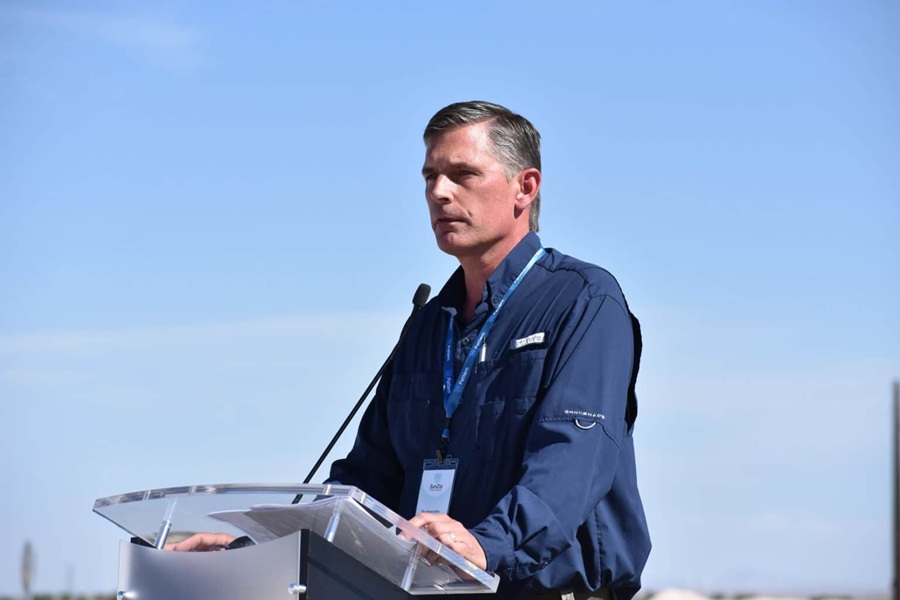
Environmental advocacy groups are criticizing U.S. Sen. Martin Heinrich for co-sponsoring a bipartisan permitting reform bill that they say undermines his long record as a champion of renewable energy and environmental protection and could harm people and places across New Mexico.
Erik Schlenker-Goodrich, executive director of the Western Environmental Law Center, said the groups feel “betrayed” by the New Mexico Democrat. As a co-sponsor of the 417-page Bipartisan American Affordability and Jobs Act of 2026, Schlenker-Goodrich argued, Heinrich “can’t honestly describe the negative impacts of the bill” while promoting it on a tour “hyping” the legislation.
“We feel betrayed by Sen. Heinrich on this bill,” Schlenker-Goodrich said in a statement. “We think he has effectively boxed himself into silence about what the harms of this permitting deal are to New Mexico and the people and places we love in this state.”
Local and national environmental organizations have accused Heinrich of trading away hard-won safeguards in a compromise with Republicans. They contend that by accelerating federal reviews and imposing tighter deadlines on legal challenges, the legislation risks weakening oversight of energy projects that could affect air, water, wildlife and communities.
Schlenker-Goodrich also said he is “perplexed” that Heinrich announced the measure just weeks before the midterm elections, when Democrats are projected to gain seats and could potentially shift the balance of power in Congress. Critics argue that waiting could have produced a bill with stronger environmental protections.
Heinrich rejected the criticism during back-to-back meetings Monday in Albuquerque with labor leaders, manufacturers and renewable energy companies. He called claims that the bill weakens environmental protections “unfounded and misguided,” saying it requires federal agencies to review projects more quickly without guaranteeing approval.
“We’re going to get to ‘yes’ faster. We’re also going to get to ‘no’ faster when a project is harmful,” Heinrich said. “And we’re going to be able to solve the climate crisis. It shouldn’t take 18 years to build a project that actually has value cleaning up the grid.”
He described the legislation, negotiated over months with Senate Energy and Natural Resources Committee Chair Mike Lee, R-Utah, and other Republican leaders, as a “very fine balancing act.”
“It was not easy,” Heinrich said before a roundtable with renewable energy executives. “It took longer than we would like, but everyone was committed to getting there. And I think we’ve come up with a really defensible product that, if we can get it passed, I think will age very well over time.”
The bill seeks to shorten the time energy projects — including solar arrays, wind farms and transmission lines — spend awaiting federal permits. It also sets additional deadlines for parties that challenge approved projects in court.
Industry representatives at the Albuquerque meetings voiced strong support.
Jeremy Turner, senior director of New Mexico development and strategy for Pattern Energy Group, said permitting delays meant the company’s 500 miles of transmission lines for its wind farms took more than a decade to complete. The company’s New Mexico turbines already generate more than 1,400 megawatts across 800,000 acres, and it has leased another 1 million acres that could produce up to 5,000 megawatts if approvals move faster.
“A reasonable timeframe for review by the federal agencies, and then also a timeframe for when people can actually challenge that decision, is absolutely imperative,” Turner said. “Without those, we’re going to continue to stay stagnant.”
The measure has drawn praise from labor unions, the American Petroleum Institute, the American Clean Power Association and groups that promote bipartisan policy. Heinrich, the top Democrat on the Energy and Natural Resources Committee, announced the bill Oct. 1 with three co-sponsors. He does not agree that waiting for a potentially more Democratic-friendly Congress in January would have produced a better bill or improved its chances of passage.
“In the next Congress, we’re still going to have the same White House; we’re still going to have the same need to build a bipartisan coalition, and frankly, we probably won’t have the same chairs and ranking members,” he said. “And some of the secret sauce in this was just the fact that we had four people who were genuinely committed to a balanced package that both sides could support.”