

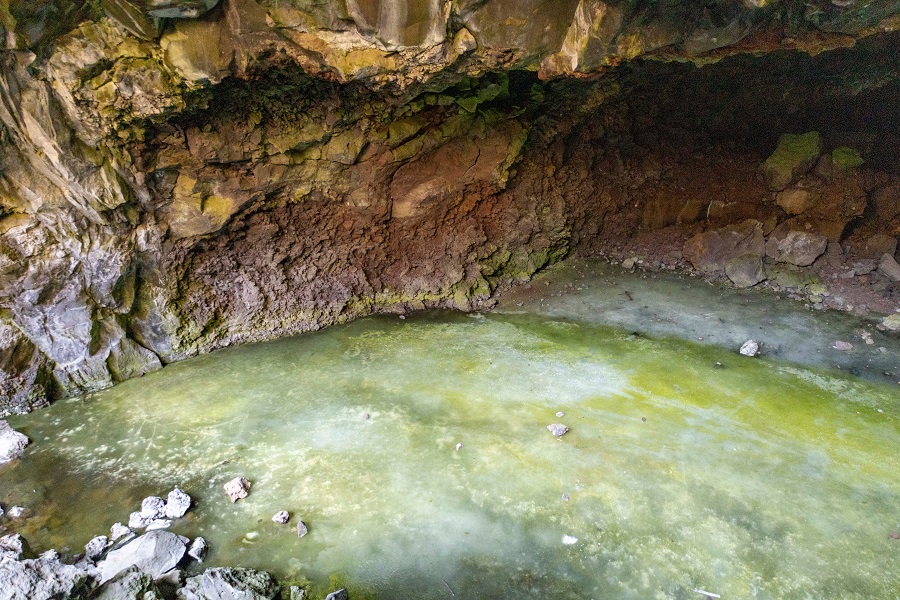
NEW MEXICO, USA – An ice cave formed by ancient lava flows is gaining attention for staying what it is amid sorching heat and dry landscapes.
The Bandera Volcano Ice Cave sits west of Albuquerque. It has a constant temperature of about 31°F (-0.6°C) even during summer.
The cave, researchers said, has stayed below freezing point for at least 3,400 years. Its ice layers can reach up to 20 feet thick. Ice Caves website cited it as one of the oldest intact ice caves in the United States.
The cave is part of a vast area of the Bandera Volcano lava field formed by volcanic eruptions thousands of years ago.
According to New Mexico Bureau of Geology and Mineral Resources, the cave is a lava tube. It was formed when molten lava flowed below the surface. Then it cooled on top, and later washed away leaving a hollow tube. The tunnel, a natural cold trap, held dense, cold air inside the tunnel limiting the entry of warm air from the desert.
Snowmelt and rainfall seeped into the cave where it froze upon contact with the icy floor, building layers of ice little by little over hundreds of years. This process explains why the cave has remained cold against the outside climate shifts.
Signs of life were found in the extreme environment. Algae grow on the ice seen as blue-green patches across the frozen floor. Environmental educator Paul Mauermann described the algae’s survival in an uploaded video at YouTube as extraordinary. He noted that the algae thrives in conditions usually associated with polar regions.
The ice cave is located near the dormant Bandera Volcano with a crater of about 800 feet deep. Its surrounding lava fields stretch for about 23 miles.
The cave has become a popular destination for visitors because of the stark contrast: sunbaked trails and icy chamber, an environment that is more of the Arctic than the American Southwest.

