

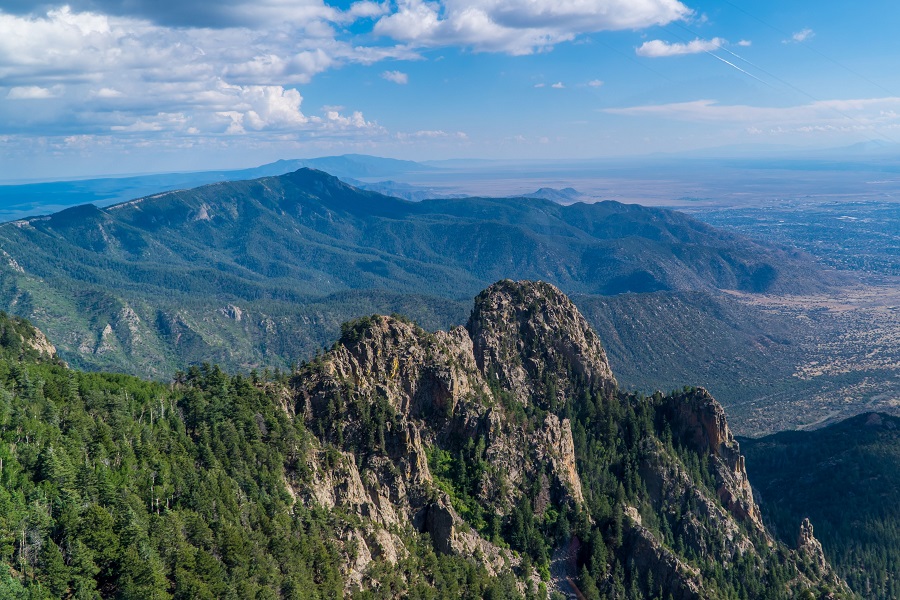
The Sandia Mountains rise like a jagged wall east of Albuquerque, postcard‑perfect in daylight but perilous in shadow. Pilots have long learned that beauty can become something else entirely for aviation: clouds, darkness, and sudden winds transform the range into a barrier that has claimed aircraft and lives.
Trans World Airlines Flight 260 on February 19, 1955, climbed out of Albuquerque’s airport bound for Santa Fe—a short hop expected to take nearly half an hour. Aboard the Martin 4-0-4 airliner were 13 passengers and three crew members. Only minutes after liftoff, in wintry conditions with low clouds, the plane slammed into a granite cliff in the Sandias. All 16 onboard perished. It remains to this day the deadliest commercial aviation disaster in New Mexico history.
Investigators later pointed to navigational error and possible instrument issues compounded by the terrain and weather. The incident, recalled by Albuquerque Historical Society Board Member Terry Owen, was a grim early chapter in a pattern that has echoed across the state’s rugged landscape for decades.
A Persistent Risk in Rugged Country
New Mexico’s vast skies, high-elevation airports, sudden weather shifts and mountainous regions — including the Sandia Mountains, Capitans and more — have created challenges for aviators over the years. Commercial airline travel remains statistically one of the safest ways to fly. But general aviation, medical transport, and flights in remote or difficult territory face significantly higher risks. Military training flights during World War II added hundreds of incidents to the historical tally.
In his research paper, Geoarchaeology of WWII Aircraft in New Mexico, USA, Adrian Hunt wrote: Several crashes occurred in mountainous terrain throughout New Mexico.
The state has witnessed dozens of documented crashes over the years; many of these cases involved small aircraft. Causes frequently cited in NTSB investigations nationwide and mirrored in New Mexico include pilot spatial disorientation, controlled flight into terrain (CFIT), weather, mechanical issues, and decision-making under constraints. Night operations and mountainous terrain have complicated these dangers.
A Modern Echo: The 2026 Capitan Mountains Tragedy
Seventy-one years after the TWA crash, another aircraft suffered a similar fate in the darkness.
A Beechcraft King Air C90 operating as a medical transport flight, in the predawn hours of May 14, 2026, lifted off Roswell Air Center bound for Sierra Blanca Regional Airport near Ruidoso. Aboard were two pilots, Keelan Clark and Ali Kawsara, and two flight nurses, Sarah Clark and Jamie Novick. No patients were listed on the manifest.
The plane crashed into the Capitan Mountains, igniting the Seven Cabins Fire in the Lincoln National Forest. All four crew members perished. Preliminary NTSB findings highlighted a confluence of factors: military GPS jamming that caused loss of GPS signals early in the flight. The agency’s preliminary report also mentioned out-of-service weather reporting and instrument approach equipment at the destination; night flight shifting to a visual approach in mountainous terrain; and an impact at approximately 9,950 feet.
“Those they lost more than just coworkers… they were family, caregivers, aviators and friends who dedicated their lives to serving others,” Trans Aero Medevac and Generation Jets said in a joint statement.
The fatal crash underscored ongoing challenges for air ambulance operations, which often fly under tight schedules and in varied conditions to support rural hospitals.
Patterns, Progress and Persistent Challenges
Four other notable incidents have dotted New Mexico’s aviation history. These include TWA Flight 260 in 1955; the Magdalena HC-130P Wing Failure in 1986; the 2007 Southwest Med Evac Crash in Ruidoso; and the F-35 Lightning II Crash near ABQ Sunport in 2024. Albuquerque has ranked among areas with higher volumes of historical crashes in some national datasets. Exact numbers, however, fluctuate with reporting and flight activity.
Aviation safety has advanced dramatically since 1955, with better terrain awareness systems, improved weather data, mandatory training, and technologies such as improved ground proximity warning systems. But New Mexico’s geography — remote airstrips, rapid shifts of mountain weather, and overlapping military airspace — could pose risks for smaller operations.
Victims’ families, first responders, and communities continue to feel the impact long after the debris is cleared. Memorial hikes, a steep climb into the Sandia Mountains, lead to the TWA site, where wreckage still exists as a somber reminder.
Federal investigators have yet to finalize reports on the latest tragedy; a question lingers. Pilots, regulators, and those who rely on New Mexico’s skies may have asked: How many warnings will the state’s mountains need to give before the aviation lessons fully take hold?
Editor: This feature depends on NTSB records, historical accounts, and official statements. Aviation incidents are investigated thoroughly to improve safety for all who fly.

