


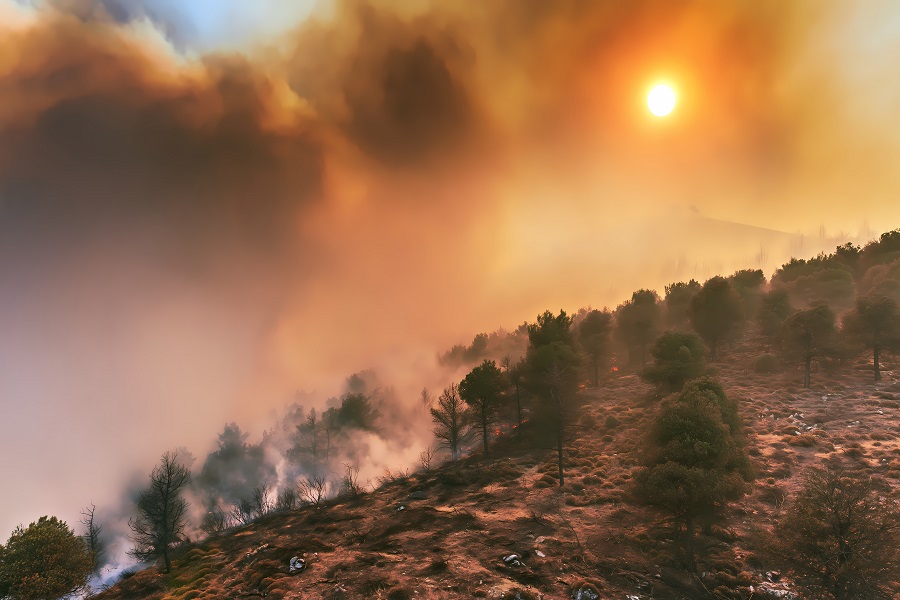
For many years, scientists have been warning that heat waves, storms, floods, and droughts are becoming more intense as the planet warms.
Now, climate experts have warned of an “extreme of extremes.” Some researchers have dubbed it the “Other Big One,” a reference to California’s feared mega-earthquake. But the recipe for a massive disturbance, scientists say, is accumulating.
And the world may not realize the danger until it is already at the door. “The risk is that people just think you are exaggerating,” said Daniel Swain, a climate scientist with the California Institute for Water Resources.
Swain likened the problem to the classic “Boy Who Cried Wolf.” This time, however, the wolf may actually be real. “Sometimes wolves are real,” he said. “If it’s outside the door, wouldn’t you want to know?”
The science behind the climate crisis is not new, as the planet began to warm more than 170 years ago.
Amateur scientist Eunice Newton Foote conducted a series of experiments in the 1850s while living in Seneca Falls, New York. She put different substances, including carbon dioxide and moist air, inside glass cylinders and exposed them to sunlight. Foote observed that the cylinder containing carbon dioxide heated more rapidly and stayed hot longer after the sun disappeared.
The planet is virtually conducting that experiment on a massive scale. Humanity has pumped enormous quantities of greenhouse gases into the atmosphere by burning coal, oil, and natural gas, resulting in a steadily warming planet.
Earth’s average temperature in 2025 was about 1.44 degrees Celsius (2.59 degrees Fahrenheit) higher than in the early 1800s, according to the data cited by climate researchers. That small increase is helping fuel more frequent and more intense weather extremes.
While hooked to the theoretical “Other Big One,” some disasters have already become catastrophic.
Consider these climate events. Australia’s devastating “Black Summer” fires of 2019 and 2020 burned about 19 million hectares or more than 46 million acres. A catastrophic flooding in 2022 left roughly one-third of Pakistan underwater. Hurricanes Helene and Milton battered the southern United States in 2024, leaving a trail of destruction.
Those disasters are only part of the picture. There have also been deadly floods in Texas, catastrophic wildfires, ripping through Los Angeles neighborhoods, and Typhoon Kalmaegi, which battered parts of Vietnam and the Philippines.
As the disasters keep coming, scientists fear the world could be getting dangerously used to them.
Sarah Perkins-Kirkpatrick, a climate scientist at Australian National University, said she experienced a “come to Jesus moment” upon realizing that extreme weather would not simply disappear even if the net-zero emissions is achieved immediately.
That is because carbon dioxide does not vanish when emissions stop. It can remain in the atmosphere for hundreds of years.
Perkins-Kirkpatrick compared the situation to the familiar image of a frog slowly becoming accustomed to rising temperatures. “If we get used to bracing ourselves, are we going to notice?” she asked.
That may be one of the most discomforting questions of all. The extraordinary can become ordinary if every year brings another record heat wave, another devastating wildfire, another massive flood or another unprecedented storm,

