
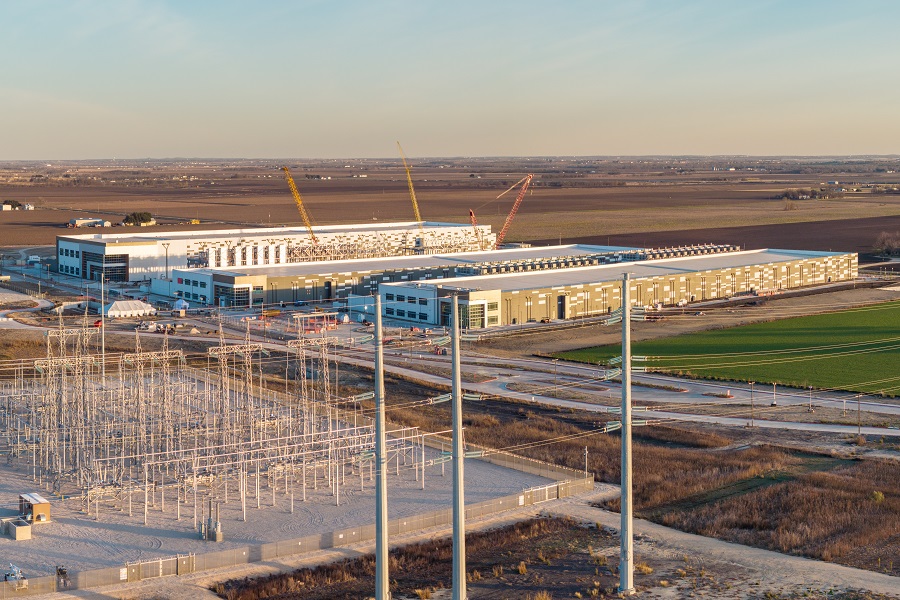


The sunbaked reaches of the Chihuahuan Desert, where pecan groves and chile fields flourish, are churning out a different kind of harvest. North of the Mexican border, bulldozers are carving through the scrubland in Santa Teresa, preparing the nearly 1,400-acre site for Project Jupiter — a proposed $165 billion artificial intelligence data center campus backed by Oracle and linked to OpenAI’s expanding ambitions.
Developers describe the project as the largest private investment in New Mexico’s history. It could bring thousands of construction jobs, hundreds of permanent technology positions, and hundreds of millions of dollars for schools and infrastructure in one of America’s poorest states. But in a region shaped by grand promises —and disappointments— many residents are asking a familiar question: Will this boom be different?
From Atomic Bombs to Data Center
New Mexico has seen volatile booms before. The Manhattan Project brought the atomic age from secret laboratories in Los Alamos. Oil and gas wealth from the Permian Basin has filled state coffers, only to recede as global markets crashed. Federal investments in Los Alamos and Sandia National Laboratories have given the state prestige and scientific achievement. Prosperity has been uneven, however, leaving behind environmental scars and communities still struggling with poverty and brain drain.
Now that artificial intelligence is driving an insatiable demand for computing power, the state is placing another bet — this time on data centers and digital infrastructure — hoping it can deliver the economic diversification that generations of policymakers have pursued.
But the stakes are high.
New Mexico lags behind nationally in per capita income and among the highest in poverty, with rural counties especially vulnerable. Young scientists and engineers trained at the state’s universities only to leave for opportunities in Texas, Colorado and California. Oil and gas revenues, while lucrative, are cyclical, leaving the state’s finances vulnerable to swings beyond its control.
“The economic benefits are real,” State Economic Development Department Division Director Mark Roper said. He added that data centers have been a “financial boon” for the state, referring to Meta’s facility in Los Lunas, which he said boosted the population, increased tax revenue, and spurred growth for other businesses in the area. He said Project Jupiter could deliver massive economic gains for the region and the state if completed.
Construction of the data center could employ as many as 4,000 workers, with up to 1,500 permanent jobs paying between $75,000 and $100,000 annually. The project also promises $360 million in payments for schools and infrastructure, $50 million to improve the water system, and yearly contributions to county government.
Pecans Need Water, Not Data
New Mexico’s scientific legacy helped define the nuclear era. But the shift to artificial intelligence carries a certain symbolism: harnessing new technologies once again, not for weapons but for economic resilience.
The desert, however, imposes its own limits. Environmental groups, farmers and nearby residents have raised their apprehensions about the project’s immense appetite for electricity. Plans call for as much as 2.5 gigawatts of power — eclipsing New Mexico’s current capacity. Earlier proposals involving natural gas-powered microgrids aroused fears that the data campus could become a major source of greenhouse gas emissions.
Developers have since revised their plans. They proposed fuel cells, closed-loop cooling systems and the reuse of agricultural water rights to reduce both emissions and water consumption. But skepticism persists.
Lawsuits have challenged Doña Ana County’s approval process and the issuance of industrial revenue bonds tied to the project. Farmers worry that the complex may compete demands on Rio Grande water supplies at a time when drought and interstate obligations are already tightening access.
As they say in Doña Ana County, pecans need water, not data. “I have a little plot of land out here, grow some pecans,” says Eddie Estrada, a weekend farmer who works at the state capital. “I had 28 trees, but due to the water shortage many of them died.”
Others wonder if the jobs promised by the developer will truly benefit local residents or the complex will function as an isolated technological enclave with only limited ties to the surrounding community.
State officials and business leaders argue that modern efficiencies and specialized infrastructure can mitigate those risks. Similar facilities elsewhere, they note, brings no catastrophic consequences. Turning away such investment, they argue, would leave New Mexico trailing behind competitors like Texas and Arizona in the race to build the infrastructure powering artificial intelligence.
A Question of Identity
Beneath the noise lies a larger question about identity. New Mexico’s story has long been shaped by extraction — uranium, oil, natural gas — and by federal agencies that brought prestige without always delivering prosperity. The data center represents a new kind of economy, anchored on invisible streams of information rather than barrels and minerals. Still, it is dependent on very tangible assets: land, water, and electricity.
Project Jupiter appears to be more than a development proposal as state lawmakers debate new policies for the industry amid growing skepticism. The project has become a test of whether New Mexico can finally translate technological promise into lasting prosperity.
Outside Santa Teresa, where heat shimmers above the desert floor, that question of prosperity feels less abstract than immediate. The state has spent generations balancing isolation with innovation; the data center that may soon hum beneath the desert sky could define whether its future will be brighter than its past.