
The New Mexico State University Agricultural Science Center at Farmington secured a $500,000 grant to address food concerns in local communities. This funding will support the center in continuing its work with Navajo communities by advancing food sovereignty and related health issues.
The center recently received a grant from the National Institute for Food and Agriculture. The grant supports a project titled “Seeds of change: Training elementary educators to implement the Yéego! Healthy eating and gardening program.”
At least 60 elementary school teachers serving Navajo students in Arizona, New Mexico and Utah will receive training over the next three years. This is to increase their knowledge and skills in healthy eating and gardening practices in their classrooms. The program uses Yéego!, a Diné word that translates to work hard and persevere to guide its approach.
“Navajo communities are working to increase food sovereignty and address related health disparities such as childhood obesity and diabetes. However, they face unique challenges,” said Kevin Lombard, research director for the NMSU Agricultural Science Center at Farmington.
“Fresh fruits and vegetables are difficult for families to access on the Navajo Nation due to their high cost and the need to travel long distances to purchase them.”
How the Program Benefits Navajo Communities
Lombard said Navajo families have expressed interest in growing their own fruits and vegetables. However, they face harsh growing conditions, lack of water, and limited knowledge of how to maintain gardens, especially around schools.
Elementary schools play a major role in teaching Navajo children about healthy eating and gardening while sustaining cultural traditions. However, teachers often lack the knowledge and skills to incorporate these topics into their curricula. Some are also unfamiliar with technologies like drip irrigation, greenhouses, and hydroponics used in school campus gardens.
“Our project team and the science center have over 20 years of experience in collaborating with Navajo community partners to address food sovereignty and health inequities,” Lombard said. “We bring expertise in agriculture, gardening, health, and education that strives to respect regional cultural values.”
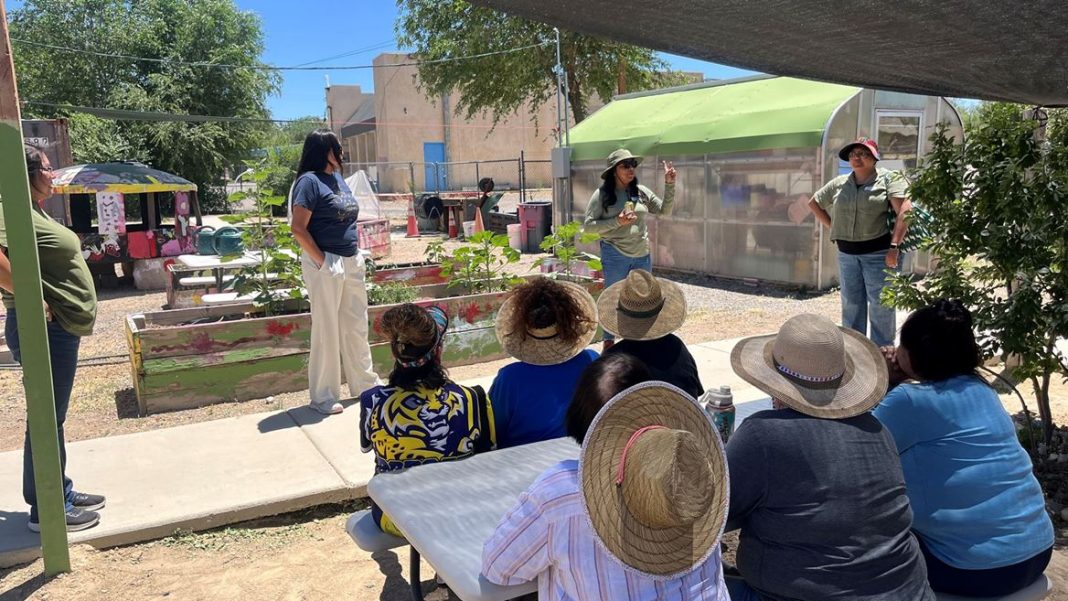
Lombard said he expects the program to reach more than 1,500 Navajo youth over three years. He also expects it to increase gardening and healthy eating behaviors among participants. To achieve this, the center will hold workshops on how to deliver the Yéego! Healthy Eating and Gardening curriculum in classrooms.
The program will recruit teachers from 86 schools in the Navajo Nation and neighboring towns with significant Navajo student populations. Selected educators will participate in the workshops and receive travel reimbursement and a stipend to attend. The first cohort completed the Seeds of Change program earlier this month.
The Yéego program was developed and rigorously tested by a research team from NMSU, Diné College, and the Fred Hutch Cancer Center. The team worked in collaboration with Navajo Nation community leaders. The program serves as a school-based intervention that promotes healthy eating behaviors among elementary school children in the Navajo Nation.