


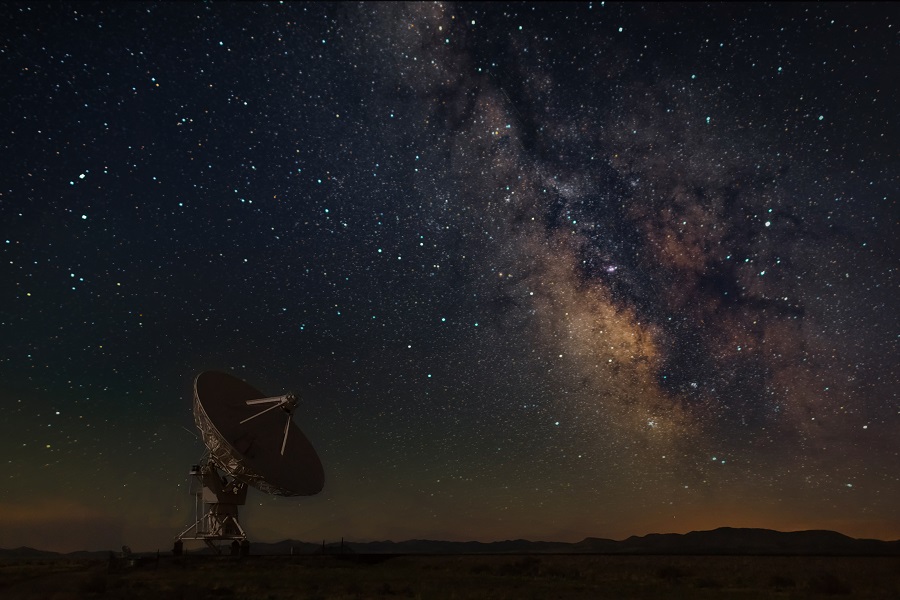
Scientists at New Mexico’s desert observatory have displayed a capability that could reshape how humanity watches an increasingly crowded frontier. They have demonstrated that a ground-based optical interferometer can decipher details of a satellite stationed 22,000 miles above Earth. The feat comes at a crucial moment in the modern space age.
Governments and private companies launch thousands of satellites into orbit every year, crowding the skies above Earth with communications platforms, navigation systems, military assets, and commercial space vehicles. Knowing exactly where those satellites are, what condition they are in, and what they are doing has progressed from mere technical curiosity into an urgent strategic need.
Researchers at the Magdalena Ridge Observatory Interferometer (MROI) declared that they had successfully secured observational data from a communications satellite in geostationary orbit. The achievement marks a breakthrough in using an optical interferometer to investigate a human-made object at such great distances.
Geosynchronous satellites occupy an orbital lane roughly 35,786 kilometers, or about 22,236 miles, above Earth. At that distance, their orbital period matches Earth’s rotation, enabling them to remain fixed over the same longitude. That orbital lane hosts many of the world’s most critical assets, including communications and weather satellites.
Novel Use of Optical Interferometer
Until recently, many considered obtaining information about those satellites from the ground to be beyond reach. But the MROI team accomplished what was impossible through optical interferometry, a technique that combines light collected by a vast array of telescopes. Together, these telescopes serve as a single giant “virtual telescope,” achieving an angular resolution impossible for traditional instruments of similar size.
“This is a moment highlighting long-term development efforts,” said Dr. Van Romero, professor of physics at New Mexico Tech and principal investigator for MROI. “There has long been skepticism that a ground-based optical system could resolve a man-made object in geosynchronous orbit. This evaluation provides data indicating that it can be done.”
Over the years, astronomers have used interferometry to study distant stars and galaxies, but employing the technique on satellites orbiting Earth posed a different challenge altogether. “Many in the astronomy community believed this was not possible,” said Dr. Michelle Creech-Eakman, MROI project scientist and professor of physics. “Others have attempted it previously. This evaluation provides data on both the instrument and the underlying technique.”
The implications may reverberate far beyond scientific prestige. Modern satellites are becoming sophisticated, equipped with expansive solar arrays, sensitive antennas, and, in some cases, maneuvering systems. Some analysts at the Modern War Institute warned that next‑generation spacecraft might feature concealment and possess adversary‑interference capabilities.
In that environment, tracking a satellite’s orbital coordinates is no longer enough. Military planners and commercial operators need to know whether a satellite has exhibited anomalies or configuration changes. “We want to quickly assess a satellite’s position and orientation — and understand its behavior,” Romero said. “This is an evaluation toward providing that level of insight.”
Low-Earth Orbit Transformation
The critical nature of this mission continues to intensify. Large satellite constellations of hundreds or even thousands of spacecraft have transformed low-Earth orbit, while vital infrastructure has crowded the geosynchronous belt. Collisions, technical malfunctions, and intentional disruptions present risks with far‑reaching global impacts.
Advertisement
That scenario makes precise monitoring a cornerstone of space security and economic resilience. Such capabilities strengthen space domain awareness among governments. Commercial operators, on their part, can deploy high‑resolution imagery to diagnose technical issues, evaluate aging spacecraft, and guide decisions on insurance, servicing, and replacement.
Previously, researchers noted that it remains unclear whether the optical interferometer can produce usable satellite images at such vast distances from the ground. “We have now gathered data showing that the technology works,” Romero said.
Wider Horizon
But the scientists behind the project see a wider horizon. The same technology that may help monitor crowded orbital lanes could also transform astronomy itself. Creech-Eakman said future expansions of the observatory’s telescope array could eventually produce real-time images, creating moving pictures of deep-space events. “With this level of resolution, we will be able to measure changes across the universe in great detail,” she said. “Ultimately, we aim to produce time-resolved imaging — even ‘movies’ of distant astrophysical systems.”
The MROI is a major astronomical facility led by New Mexico Tech, in collaboration with the University of Cambridge and the U.S. Air Force Research Laboratory. It was built with expansion in mind. Additional telescopes could enhance the facility’s sensitivity and imaging precision.
The desert observatory stands at the junction of two realities of the modern era. On one hand, humanity’s dependence on space is growing. On the other, the desire to better understand the cosmos continues to deepen. The same instrument that helps scientists safeguard satellites essential to today’s world also opens new frontiers in discovery. It may provide unparalleled glimpses into some of the universe’s deepest mysteries.

