

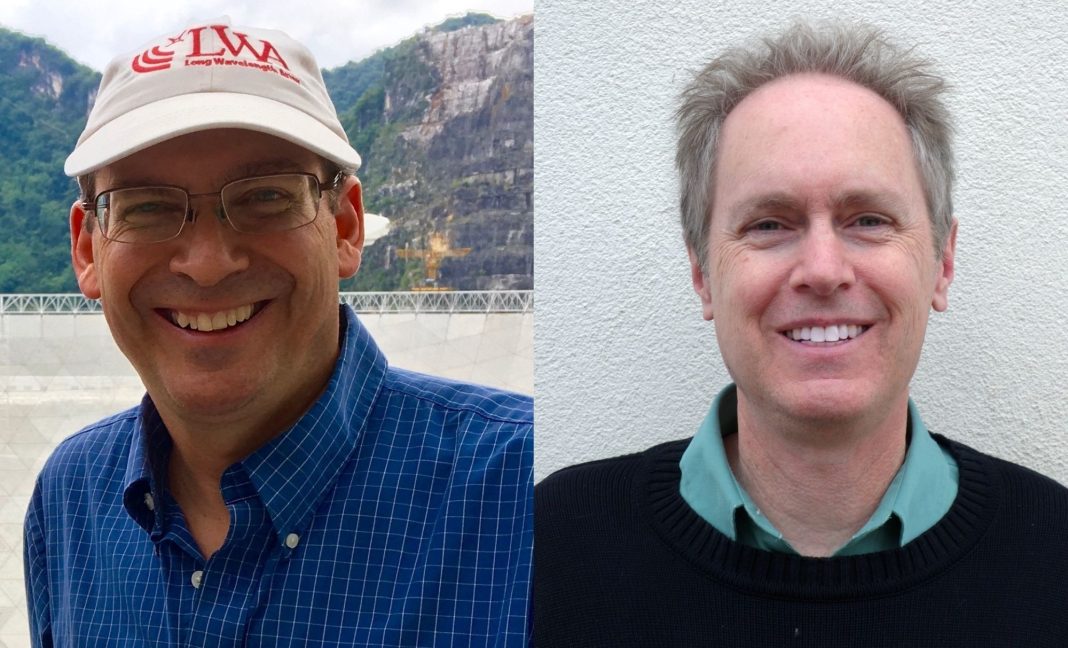
The University of New Mexico’s Department of Physics and Astronomy is set to welcome a new leadership. Starting July 1, professor Greg Taylor will assume the role of chair. He brings more than two decades of experience as a faculty member, researcher, and academic leader within the department.
This leadership transition comes as Professor Richard Rand retires from the department after three decades of service to UNM. He concludes a career that included more than seven years as department chair.
Taylor joined UNM in 2005 and currently serves as director of the Center for Astrophysical Research and Technologies. He is also the founding director of the Long Wavelength Array. Before joining UNM, he spent over a decade on the scientific staff at the National Radio Astronomy Observatory in Socorro.
His research focuses on instrumentation, meteors, space weather, pulsars, gamma-ray bursts, active galaxies and their environments. Taylor has advised 14 doctoral students and authored or co-authored more than 330 peer-reviewed publications throughout his career.
“UNM and the Physics and Astronomy Department have been very good to me, providing a supportive environment where I could develop the Long Wavelength Array telescope and work with students both inside and outside the classroom,” Taylor said. “Being named chair provides me with an opportunity to provide support in turn to all the faculty and staff that have been so helpful to me.”
Incoming Chair Taylor Outlines Priorities for the Department
Taylor said he looks forward to helping the department navigate a rapidly changing higher education landscape. He also aims to strengthen its research and teaching missions.
“I also feel that these are challenging times for our department, for UNM and for higher education in general,” he said. “I hope that my experience and connections with the national laboratories and elsewhere can help us weather the current storm.”
As chair, Taylor plans to address ongoing space challenges resulting from the closure of portions of Regener Hall. He also aims to advance efforts to replace the department’s campus observatory, which has been impacted by increasing light pollution from surrounding development.
Taylor on Rand’s Leadership
Taylor also spoke about Rand’s impact on the department and on his own career.
“Rich was my informal mentor, especially during the first several years as I was learning my way around the classroom and at UNM in general,” Taylor said. “As chair, we all appreciated his open-door policy, his steady guidance and his unfailing wit.”
Rand and Taylor have met regularly over the past several months to ensure a smooth leadership transition.
Rand’s Leadership and Legacy
During his tenure as chair, Rand guided the department through periods of significant growth and challenge. He oversaw the department’s move into the Physics, Astronomy and Interdisciplinary Science (PAIS) building and led faculty and staff through the COVID-19 pandemic. He also navigated staffing shortages, secured the department’s first endowed chair, and initiated efforts to build a new campus observatory.
“It’s been a time of great challenges and great successes,” Rand said. “The Department of Physics & Astronomy is simply extraordinary, and I can’t say enough about the exceptional research carried out here and the dedication of the faculty and our outstanding staff to its mission.”
“It’s also been so rewarding to see our students succeed and go on to all kinds of interesting STEM-related careers,” he added. “And we are poised to achieve much more so I think there should be exciting times ahead for physics and astronomy at UNM.”
Rand is an internationally recognized astrophysicist. His research focuses on gaseous galactic halos, spiral structure, interstellar gas and star formation, and the magnetic field of the Milky Way. He also studies collisional ring galaxies using radio, millimeter-wave, optical, and infrared telescopes.

