

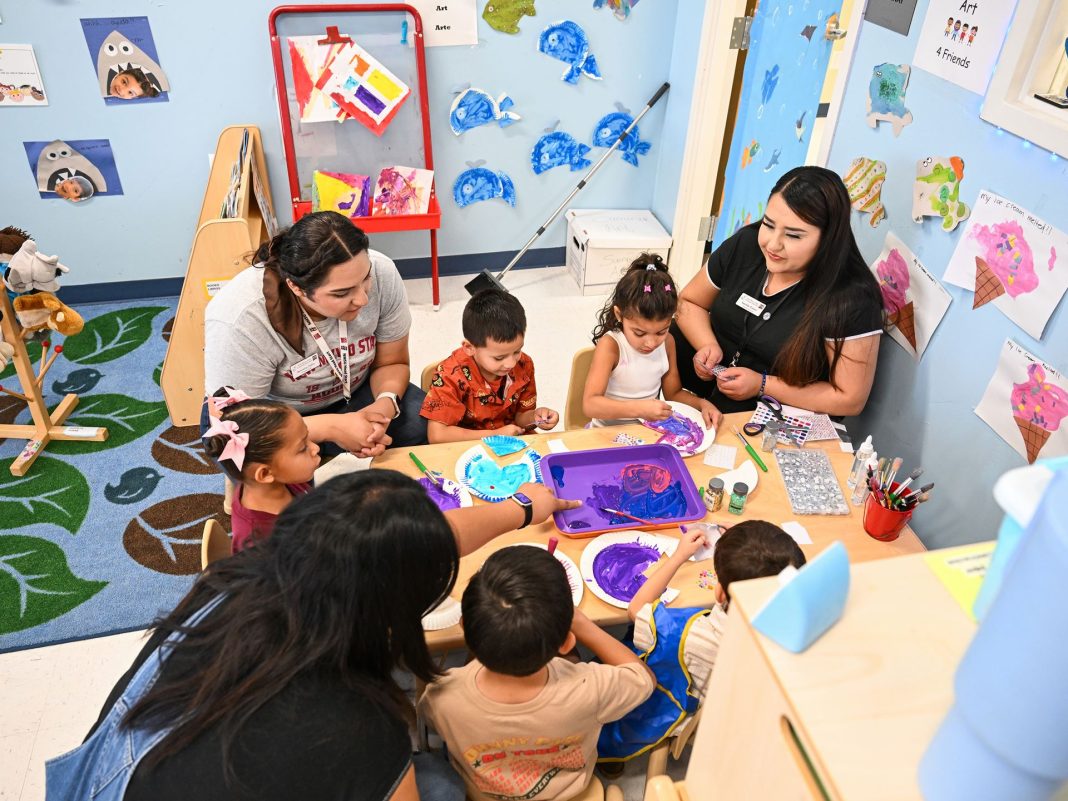
Early childhood education’s benefits extend far beyond the classroom. Research has shown that children who participate in programs such as Head Start are more likely to graduate from high school, pursue higher education, and become economically self-sufficient as adults.
For more than four decades, New Mexico State University has implemented Head Start programs in Doña Ana County, New Mexico’s second-most populous county, supporting children from birth to age 5 through early learning, developmental, health, and family well-being services.
Now, under new leadership, NMSU Head Start is working to build on that legacy, charting a new course for growth following years of enrollment challenges.
A key factor in the program’s longevity has been its close partnership with the university. Unlike most Head Start programs nationwide, NMSU Head Start operates through a higher education institution. Colleges and universities account for only a small share of the roughly 1,600 organizations that administer Head Start programs across the United States, with about 60 institutions maintaining formal partnerships.
At NMSU, the program is housed within the university’s College of Health, Education and Social Transformation, creating opportunities to integrate academic expertise, workforce development and community-based early childhood services.
That university-supported model has helped sustain NMSU Head Start for more than 41 years. However, like many early childhood programs across the country, it has faced significant challenges in recent years. Enrollment began declining in 2019 before dropping further during the height of the COVID-19 pandemic, prompting fresh efforts to strengthen outreach and expand access for families.
The Program’s Turnaround
When Zaira Falliner became director of NMSU Head Start in 2024, the federal Office of Head Start had placed the program on probation. Falliner inherited a program with low enrollment and high staff turnover. She worked closely with Dawn Gonzales, NMSU Head Start’s chief financial officer, to stabilize the program and restore federal compliance.
“The first year coming on was making sure we survived,” Falliner said. “One of our big successes in my first year was that we resubmitted our five-year grant proposal to the Office of Head Start to make sure our schools and classrooms would receive enough funding. Once OHS accepted our proposal, we got out of our probationary period.”
Ava Armstead-Cozart joined the program in 2025 as its principal investigator and an assistant professor in the College of HEST. She brought more than 20 years of Head Start experience to the role. Together, Armstead-Cozart and Falliner restructured the program and led its turnaround.
Today, they are expanding the Head Start and Early Head Start programs to meet the unique needs of Doña Ana County. They are also introducing new wraparound services for families and afterschool programs.
Enrollment also reached a new milestone. During the 2025-2026 academic year, the program sustained 99 percent enrollment. It served a record 155 students across 11 classrooms in five locations.
“Strengthening our leadership model and increasing our community engagement were pivotal to improving our visibility,” Armstead-Cozart said. “We are where we are today because of our dedicated team and support from the College of HEST.”

