

New Mexico’s enchantment often reveals itself not on the interstates but along the little roads — the winding, two-lane ribbons of asphalt that slip past adobe villages, centuries-old shrines and landscapes so vivid they seem sculpted by light itself. These routes demand that you slow down, roll down the windows, and let the high desert air, scented with piñon and sage, work its spell.
One such road, highlighted recently in local lore as a “little road to enchantment,” leads to intimate corners like Los Caminitos in the foothills of Santa Fe, where homes blend seamlessly with the rugged terrain. But the real story stretches far beyond any single calle. It encompasses the celebrated High Road to Taos, the Enchanted Circle and myriad backroads that stitch together northern New Mexico’s cultural tapestry.
The High Road: A Journey Through Living History
The High Road to Taos is roughly a 56- to 105-mile picturesque byway, depending on your exact route. It is less a commute than a pilgrimage. Departing Santa Fe, drivers turn onto N.M. 503 and then N.M. 76, then climb into the Sangre de Cristo Mountains. The “low road” hugs the Rio Grande; the high one rewards with broad vistas, forested slopes and villages that have not significantly changed since Spanish colonial times.
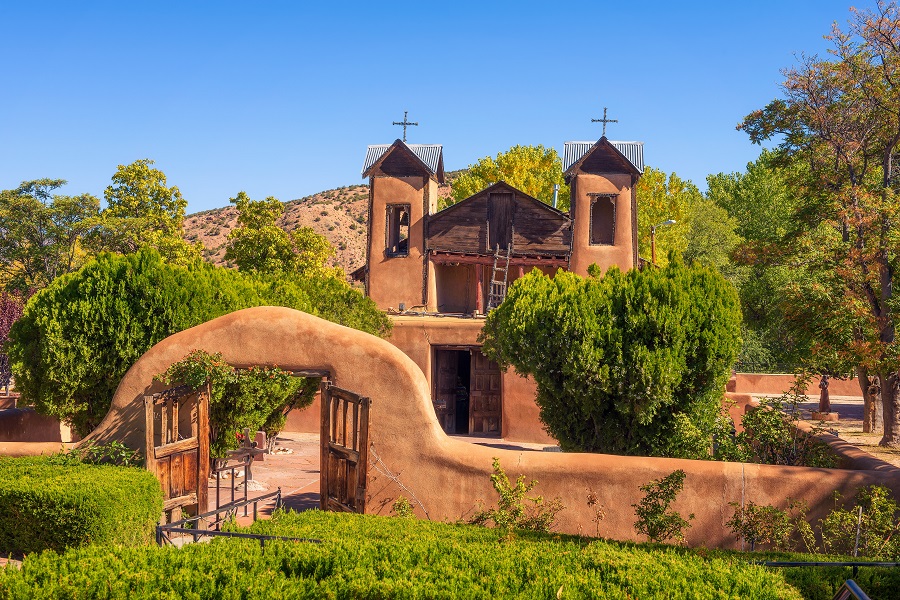
Stop first in Chimayó. It is where El Santuario de Chimayó attracts pilgrims seeking the healing “holy dirt” from a small pit inside the 19th-century adobe chapel. The church’s wooden santos and vibrant retablos speak to a faith as long-lasting as the surrounding hills. Nearby, weavers continue centuries-old weaving traditions, and the chile — fiery and earthy — at Rancho de Chimayó tastes like the land itself.
Further is where the road threads through Truchas, Trampas, and Cordova. These high-mountain villages, with their humble wood-and-adobe homes and communal irrigation ditches still in use, feel like portals to another era. Artists have long journeyed here for the light and solitude; galleries nestled into old buildings offer everything from traditional tinwork to contemporary arts inspired by the beauty outside.
The drive ends near Ranchos de Taos, known for its iconic San Francisco de Asís Mission Church, a favorite subject for Georgia O’Keeffe and Ansel Adams. From that point, it’s a short hop to Taos proper, where the pueblo — one of the oldest in North America — rises like a multi-level earthen fortress against the mountains.
The Enchanted Circle: Alpine Drama and Mountain Towns
The 84-mile Enchanted Circle Scenic Byway loops out of Taos and is an adrenaline rush for those who crave more heights. It encircles Wheeler Peak, New Mexico’s highest at more than 13,000 feet, then it passes through Red River’s old mining vibe, the high meadows around Eagle Nest Lake and the Bohemian hub of Angel Fire.
Wildflowers carpet the meadows during summer. In fall, aspens turn the slopes to gold, while winter brings world-class skiing and the gentle hush of snow. Side trips will lead to ghost towns, hot springs, and trails where the sounds are the wind and your own footsteps. This is where New Mexico earns the distinction as uniquely enchanting — vast skies, jagged peaks and a sense of scale that humbles and exhilarates.
“The High Road to Taos Scenic Byway is one of the most profound ways to experience northern New Mexico between Santa Fe and Taos,” said acting New Mexico tourism secretary Lancing Adams. “The heritage and identity of the communities along the route are evident at every stop, from centuries-old churches and historic plazas to the art, traditions, and landscapes.”
Beyond the Pavement is “More” in Enchantment
New Mexico’s enchantment goes beyond its table and its people. Green chile stew gently heats in kitchens from Santa Fe to tiny mountain cafés. Roadside stands offer fresh tamales or ristras of drying chiles, hanging like ruby necklaces from vigas. Artisans in these villages — Cordova’s wood-carvers and weavers in Chimayó — keep the heritage alive not only for tourists to appreciate but also as a way of life.
The state’s light, crystalline and ever-changing, has inspired many across generations. Drive these roads at golden hour, and you’ll know why. Adobe walls glow pink and orange; light casts its shadows long across the high desert. Even veteran travelers can’t help but pull over, camera forgotten, if only to breathe it in.
Travelers trying to find their own little road might follow local real estate tales of hidden gems like Calle Encanto properties, where modern renovations respect feng shui and native plantings. Or they might keep driving until a village square or mountain pass feels like home.
Enchantment in the state isn’t a destination on a map. It’s the willingness to take the slower path, to drift through the village plaza while church bells toll, or to watch storm clouds form over peaks older than memory. The little roads will take you there — if you allow them. Just don’t forget to fill the tank, pack snacks, and perhaps some holy dirt, and leave room in your itinerary for surprises.