Home Blog Page 101

What’s Promised versus What You’re Living: New Mexico’s Community Solar is Still Years Behind

0

A study by the University of New Mexico projected that community solar projects could generate over $400,000 in labor income and create high-paying jobs within five years, among other benefits.

Five years later, however, that projection remains a promise. A closer look into the state’s community solar rollout reveals a program bogged down by regulatory delays, grid bottlenecks, and policy disputes. Only a fraction of its planned capacity is actually delivering power to residents.

A program built on promise

Gov. Michelle Lujan Grisham signed the Community Solar Act in 2021. The law provides the framework for residents and small businesses to participate in community solar projects.

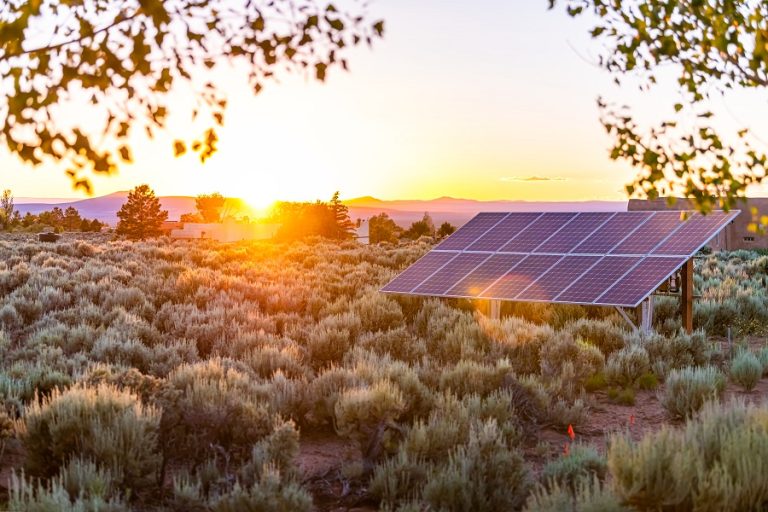
Under the law, households, especially low-income residents, could subscribe to small solar farms and receive credits on their electricity bills instead of installing rooftop solar panels. The concept was straightforward: expand access, reduce costs, and accelerate clean energy adoption.

The numbers tell a different story

State data paints a starkly different picture. Forty-seven projects were awarded in May 2023, with an expected total capacity of about 200 megawatts. Of the 47, only 12 are operational, producing 54.73 megawatts.

That’s barely over a quarter of the program’s initial target.

“It’s been a hard grind,” said Jim Desjardins of the Renewable Energy Industries Association of New Mexico, pointing to slow interconnection processes. It requires technical and regulatory steps to connect solar farms to the grid.

Beyond technical constraints, the program has faced internal turbulence.

Since its launch, community solar has undergone multiple rulemaking revisions and even a challenge before the state Supreme Court. Now, the state’s Public Regulation Commission (PRC) is preparing another overhaul of the Community Solar Program.

The delays are not only administrative. They are financial.

Federal incentives that underpinned the economics of solar development are now winding down. The law signed by President Donald Trump on July 4 removed eligibility for the 30 percent federal tax credit for direct solar purchases after 2025.

That deadline has heightened pressure on regulators. “If Commission processes do not align with investment tax credit deadlines, projects … may be unable to monetize federal incentives fully,” warned the Coalition for Community Solar Access in its filing.

Strong solar demand, weak delivery

However, interest in the program is not the problem. Developers submitted 408 proposals totaling 1.7 gigawatts when bidding opened in 2023.

Big players and local companies are ready to build. Recent announcements from developers, including Forefront Power and Standard Solar, signal continued momentum. Several projects are already powering communities with thousands of households enrolled.

Regulators are preparing to revise the rules again. But the gap between ambition and execution is becoming harder to ignore.

The UNM study laid out a vision of rapid economic gains, job creation, and energy equity. But without faster approvals, clearer cost structures, and streamlined grid access, those projections risk becoming aspirational rather than achievable.


From 50th to 20th: New Mexico Progresses in Adult Education Rankings

0

New Mexico’s investments in adult education have produced positive results. The state has lifted its national standing in adult learning outcomes to 20th place.

The U.S. Department of Education’s Office of Career and Technical Education recently published state data for the 2024-2025 academic year and ranked New Mexico 20th in measurable skill gains. This metric tracks student progress toward educational milestones such as earning credentials, improving academic skills, and advancing toward employment. 

The state climbed six spots from last year’s ranking of 26th and rose 30 places from its 50th ranking in 2019.  

“In New Mexico, we support community members with more opportunities to increase adult literacy skills and pursue career pathways through the higher education system at different stages of their lives, no matter their background. These investments are bringing results to New Mexico at a remarkable rate,” said Higher Education Secretary Stephanie M. Rodriguez. “We have made adult education more accessible to tens of thousands of New Mexicans, benefiting them, their families and our communities in countless ways.” 

New Mexico Boosts Adult Education Outcomes

This year, New Mexico continues to invest in adult education through a $20 million dollar appropriation in the state budget. The funding will be used to support adult education programs and high school equivalency testing statewide for the Adult Education Division and other associated programs.

These investments include a suite of workforce training programs in adult education that help New Mexicans achieve certifications in high-demand fields like child care or commercial driving. The programs contributed to a 44% increase in new certificates achieved by New Mexicans in 2025.  

“We will continue to meet New Mexicans wherever they are with programs that help them find and achieve new career goals,” said Adult Education Director Amber Gallup. “Students and program staff have worked hard to reach this point. Our work continues to expand accessibility of high-quality programming at different colleges throughout the state.” 

Further, New Mexico advanced on several federal adult education benchmarks. The state moved up in national rankings for measurable skill gains among English as a second language students, rising from 28th to 19th. Adult education participants securing employment after completing coursework also climbed from 32nd to 25th since 2024. 

Jose Coll Selected as New WNMU President, Vows to ‘Listen, Learn, and Collaborate’

0

Western New Mexico University (WNMU) will soon enter a new era of leadership. The Board of Regents officially appointed Jose Coll, Ph.D. as the university’s 16th president after months of selection process. 

The board appointed Coll during its hybrid session on March 1, 2026, which was available via livestream and open to the public. Regents J. Dean Reed, Keana Huerta, and John V. Wertheim, along with the university’s executive leadership team, attended in person at J. Cloyd Miler Library. Meanwhile, Regents Steven Neville and Gregory Trujillo joined online.

Coll is a U.S. Marine Corps veteran and the current Provost at Western Oregon University. The board selected him for his leadership philosophy anchored in collaboration and advocacy. 

According to a report by WNMU, he will formally begin his presidency on July 1, 2026, under a three-year contract. The agreement automatically extends for two more years upon a successful completion of his first year as president. It also includes a $310,000 salary and a comprehensive benefits package.

Coll briefly joined the meeting online. In his address to the board and the WNMU community, he emphasized a comprehensive educational experience spanning the liberal arts to the trades. He said the approach aims to meet state workforce needs while upholding shared governance. Coll expressed his deepest gratitude to the presidential search committee. He also thanked Interim President Christopher Maples, Ph.D., for his “unwavering leadership” and for providing a stable foundation for the transition.

Coll Outlines First Priorities as University President

“My first role is to listen, learn, and collaborate with all stakeholders,” Coll stated. “WNMU must engage the whole person and adapt to realities around the world. We will be a steward of regional identity and a powerful engine for social mobility.”

As WNMU’s new president, Coll said his approach to higher education engages the whole person and adapts education to real-world challenges. It aligns with WNMU’s 130-year educational philosophy.

He said that under his leadership, the WNMU community will focus on:

  • A comprehensive educational experience,
  • Meeting state workforce needs, 
  • Supporting the students,
  • And upholding shared governance. 

Before July 1, Coll plans to visit the Silver City campus several times to work on transition planning. He encouraged students, faculty, and staff to connect with him during these visits, even offering to meet for coffee. 

“If you see me walking across campus or having a coffee at a local shop during these visits, please do not hesitate to stop me. I am genuinely looking forward to speaking with you, hearing your stories, and listening to your hopes for WNMU,” he said. 

“Lastly, I want to thank the Mustang Community for welcoming my family so warmly. Cary and I look forward to making Silver City and the State of New Mexico home!” he concluded.

35-Year-Old Woman Sentenced For Two Years in Prison

Angelica Garcia, 35, an active member of Navajo Nation has been sentenced to two years in prison for assaulting and stabbing another woman.

The announcement has been made by First Assistant U.S. Attorney Ryan Ellison and Justin A. Garris, Special Agent in Charge of Federal Bureau of Investigation’s Albuquerque Field Office.

According to court records, on November 21, 2024, the Navajo Nation Police Department responded to a call at the Northern Navajo Medical Center regarding a patient with multiple stab wounds, including a wound at the back of her neck, face, arm, and abdomen.

It was later found out that Garcia was the attacker and was later located and detained.

The suspect claimed that it was only her self-defense against the victim’s badmouth against her.

During interview with agents, Garcia admitted to stabbing the victim and pleaded guilty to assault with dangerous weapon. Upon her release from prison, Garcia will be subject to three years of supervised release.

The case was investigated by The Farmington Resident Agnecy of the FBI’s Albuquerque Field Office with the assistance from the Navajo Nation Department of Investigation and Department of Criminal Investigations. Assistant United States Attorney Michael Pahl is prosecuting the case.

New Mexico’s Digital Future is On Hold: State set to receive $293M Federal Broadband Funding, But Delays in Washington Stall Rollout

0

Almost half of New Mexico’s broadband funding promised by the federal government remains frozen in bureaucratic limbo, stalling the initiatives to connect underserved communities and raising concerns over delays in the country’s largest internet expansion program.

State officials have urged the National Telecommunications and Information Administration (NTIA) to release the remaining $293 million under the program, Broadband Equity, Access and Deployment (BEAD). The program is a flagship federal initiative approved by Congress in 2021 that sought to expand high-speed internet nationwide.

‘Last mile’ projects

The funding bottleneck occurs despite federal approval of New Mexico’s plan to allocate $382 million for so-called “last-mile” projects. These connections aim to link homes and businesses to broadband networks. The state is set to receive a total of $675 million under BEAD.

But the remaining funds, allocated for nondeployment projects such as 5G infrastructure and connectivity for public institutions, are caught in what state officials describe as a federal policy standstill.

The NTIA must release these funds “to ensure New Mexico reaches its goals of broadband deployment, digital opportunity, and workforce development,” Jeff Lopez, director of the state’s broadband office, said in a statement.

The delay appears linked to pending federal guidance. The NTIA had already committed to issuing new rules for states accessing the remaining funds by early March. But there is no updates about the matter as of writing.

Broadband funding still in limbo

In a February 17 letter to NTIA Administrator Arielle Roth, New Mexico’s broadband office called for immediate action. It cited readiness to implement 31 projects involving a mix of internet service providers, cooperatives, satellite companies, and tribal communities.

The funds still in limbo are intended to support broader digital infrastructure, including connectivity for schools, colleges, libraries, healthcare facilities, and emergency services. These sectors were seen as critical to closing the digital divide.

State officials have warned that delayed federal action could slow down the progress toward universal connectivity, especially in underserved rural and tribal areas.

“Achieving universal connectivity takes more than infrastructure construction,” Lopez said. “Many support services, programs, and other projects are necessary to ensure all New Mexicans have the broadband resources to succeed.”

New Mexico’s broadband targets remain tethered to federal timelines. This situation highlights the complex interplay between funding, policy, and the urgency of digital inclusion.

Inside ‘New Mexico True Certified’: How a State-Backed Label Reshaped Local Branding—And Who Benefits

0

This year is packed with milestones — from the Route 66 centennial to America 250. And the New Mexico Tourism Department is marking its own: a decade of the New Mexico True Certified program.

The New Mexico True Certified program is touted as a success story in supporting small businesses. It was launched a decade ago by the New Mexico Tourism Department. But a closer look shows a picture beyond branding power, access, and influence.

From local request to state-backed brand

The program was born out of demand from local entrepreneurs seeking a way to distinguish their products as authentically “New Mexico-made.” In response, the state created a certification system allowing businesses to label goods as “100 percent made or grown” within the state.

State officials say the label has become a mark for trust. “Reaching the 10-year milestone really speaks to the value that the program brings to small businesses,” Acting Secretary Lancing Adams, in a statement, said. He pointed to its role in linking local producers with tourists.

At the heart of the program, however, is branding. The program allows certified businesses to display the official logo on their packaging, storefronts, and websites— signaling that the state backs their authenticity.

Producers like Worthington Farms said the label translates into consumer trust. Owner Kristen Worthington said the branding assures buyers that “Everything is sourced and manufactured here. Those things are important to a lot of people, especially since we have so many great things in New Mexico.”

Retail access: a game changer

The program began with 78 participants, including Los Poblanos Historic Inn & Organic Farm, Piñon Coffee, Noisy Water Winery, and Santa Fe Brewing Company. Late last year, it had expanded to more than 500 partners. Officials described the increase as proof of success.

Program coordinator Brandy Velarde said the certification has highlighted the state’s creative economy. “Over the past 10 years, partners of this program from all corners of the state have leveraged the New Mexico True Certified brand to show customers their product is truly made in New Mexico,” Velarde explained.

One of the program’s most significant developments is the partnership with major retailers such as Smith’s and Albertson’s. These retailers gave products bearing the certification dedicated shelf space. This kind of access can be transformative for small producers.

The New Mexico True Certified label becomes a powerful seal of authenticity, for now. But whether it levels the playing field or reshapes it remains a question that lingers beyond the celebration.

Know Anyone on the List? APS Students Recognized As National Merit Finalists

0

Their hard work has paid off. Thirteen Albuquerque Public Schools (APS) students have reached a new milestone after the National Merit Scholarship Corporation (NMSC) recognized them.

The students–12 from La Cueva High School and one from Early College Academy, earned recognition as 2026 National Merit Finalists. It is one of the nation’s most prestigious academic honors. The designation distinguishes high school seniors who demonstrate exceptional academic achievement, strong test performance, and a commitment to excellence both inside and outside the classroom.

NMSC selects finalists from more than 16,000 semifinalists nationwide, representing the top 1% of graduating seniors in the United States. These students will now compete for thousands of scholarships to be awarded this spring.

Below is the list of the district’s finalists, according to APS:

From La Cueva High School
Hiro Jau
Ally Jones
Pranav Joshi
Joseph Kerlinsky
Yu Liu
Nathan Lupinetti
Ayla McFall
Reyhan Rahim
Rubaina Reza
Anna Richardson
Aubrey Stuart
Giles Yarrington

From Early College Academy
Galen Yane

Students completed a rigorous application process to become finalists. They demonstrated strong academic records, earned high SAT or ACT scores, wrote an essay, and secured a recommendation from a school official.

According to APS, this recognition reflects not only the students’ dedication and hard work. This also shows the support of their families, teachers and school communities.

What Scholarships Will They Compete For?

The program will offer three types of National Merit Scholarships in the spring of 2026. 

Every finalist will vie for one of 2,500 National Merit® $2500 Scholarships, awarded based on a state representation. Approximately 150 corporations and business organizations will provide about 830 corporate-sponsored Merit Scholarship awards. These scholarships go to finalists who meet their specified criteria, such as children of the grantor’s employees or residents of communities where sponsor plants or offices are located. In addition, about 150 colleges and universities are expected to finance some 3,600 college-sponsored Merit Scholarship awards for finalists who will attend the sponsor institution. 

The 2026 National Merit Scholarship winners will appear in four nationwide news releases starting April and ending in July. These scholarship recipients will join approximately 389,000 other distinguished young people who have earned the Merit Scholar title.

What Does Cesar Chavez’s Legacy Mean Now? Officials Urge a Reckoning as Sexual Abuse Allegations Emerge.

The New York Times has documented allegations of sexual abuse against Cesar Chavez that sparked outrage across New Mexico. State officials are demanding accountability and pressing for his name to be stripped from schools, public buildings, and other institutions that honor him as condemnation mounts.

Dolores Huerta, co-founder of the United Farm Workers (UFW), is at the center of this whirlwind. Huerta, for the first time, publicly recounted alleged incidents of abuse involving Chavez.

In a statement published by the NYT, Huerta claimed she was “manipulated and pressured into having sex” in one instance and “forced, against my will” in another. Both incidents resulted in pregnancies. The children, she said, were later raised by other families.

Huerta, now 95, said she kept her ordeal private for decades to protect the farmworker movement she helped build.

“I carried this secret for as long as I did because building the movement and securing farmworker rights was my life’s work,” she said, adding that she came forward after learning others had also suffered abuse.

She also recounted incidents involving younger victims. “The knowledge that he hurt young girls sickens me… My heart aches for everyone who suffered alone and in silence for years,” the ninety-five-year-old Huerta said.

Political leaders demand accountability

New Mexico Governor Michelle Lujan Grisham described the allegations as “shocking and horrifying,” backing calls for a full investigation and expressing support for survivors.

U.S. Senator Ben Ray Luján labeled the accusations “horrific.” He said the abuse, particularly against children, represents “a betrayal of the values that Latino leaders have championed for generations.”

The senior US senator called for the removal of Chavez’s name from public landmarks and institutions. New Mexico House Speaker Javier Martínez had echoed the same call. Any honors tied to Chavez should be “swiftly” reconsidered, Martinez said. “This moment demands we stand with survivors,” Martínez said as he offered prayers for Huerta and those who may have suffered abuse.

Schools, streets under scrutiny

Across the state, the name of Chavez is embedded in public life. The name appeared in school names, murals, and infrastructure. That is why school districts in cities such as Santa Fe and Albuquerque are reviewing policies on renaming institutions. Santa Fe Public Schools said any decision would go through board deliberation and community consultation.

A major thoroughfare in Albuquerque—Avenida Cesar Chavez—runs through the city. The road ended near the National Hispanic Cultural Center.

Mayor Tim Keller said the city would reassess how Chavez is commemorated. He said this review will include facilities such as the Cesar Chavez Community Center. “While he has meant a great deal to many families, this new information demands we widen our lens,” Keller said.

Movement reckons with legacy

The Chávez controversy has also shaken the United Farm Workers, an institution tied to his legacy. Newsweek reported the organization announced it would withdraw from Cesar Chavez Day events.

Meanwhile, the Cesar Chavez Foundation, in a statement posted on its website, said it is working to establish a process for individuals to share experiences of what it calls “historic harm.” The foundation said it will explore pathways for repair and reconciliation.

Lobos Secure First-Round Win in NIT

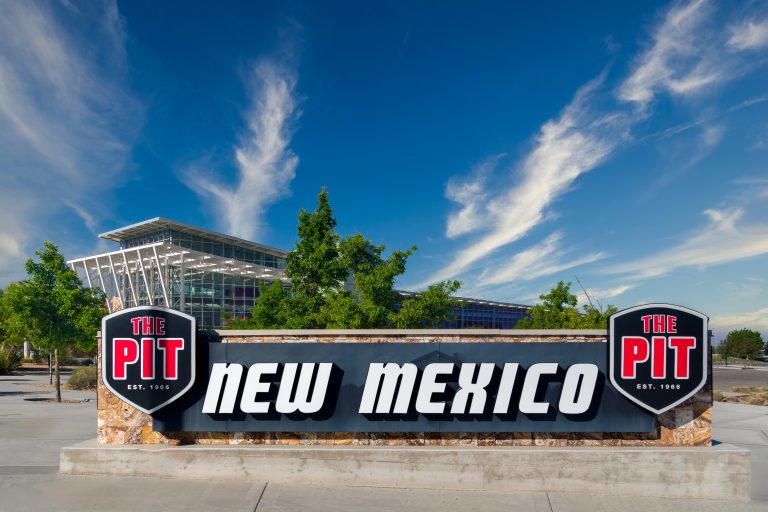
On Wednesday night, The Pit hosted the first round of the National Invitation Tournament (NIT), where the Lobos delivered a dominant performance against Sam Houston, winning 107–83 and advancing to the next round.

Following a tough semifinal loss in the Mountain West Conference tournament, it seemed unlikely that the Lobos would host another game this season. However, as the No. 1 seed in the Albuquerque region, New Mexico earned the opportunity to compete in the NIT—giving the team one more chance to showcase their hard work and determination.

The second half only widened the gap. Within the first three minutes, the Lobos extended their lead to 62–43. Although the Bearkats managed to string together a few plays midway through the half, they were unable to close the distance. New Mexico remained in control and secured a commanding 24-point victory.

Tomislav Buljan led the Lobos with 22 points and 10 rebounds, marking his 16th double-double of the season. Jake Hall also made history, setting the UNM single-season record for three-pointers.

The Lobos’ 107-point performance marks their highest scoring game in postseason play. With the win, New Mexico advances to the second round of the NIT and will return to The Pit on Sunday night to face George Washington.

CDC Report Cites New Mexico’s Measles Response—But Cases in Detention Centers Raise Concerns

The Centers for Disease Control and Prevention (CDC) cited the effectiveness of the New Mexico Department of Health (NMDOH) in containing a 2025 measles outbreak. Emerging cases in 2026, however, are continuing risks.

The CDC report comes after New Mexico documented 100 measles infections between February and September last year—the state’s first outbreak since 1996. Epidemiologists traced all but one case to a multistate outbreak originating in West Texas. That outbreak eventually spread across 31 states and remained active in some areas.

Despite the containment of the 2025 uptick, the state has reported six new measles detections this year, all clustered in detention facilities across Doña Ana, Hidalgo, and Luna counties. Health experts flagged these settings as high-risk due to overcrowding and limited access to care.

Messaging and vaccine push drive uptake

NMDOH’s “comprehensive public messaging strategy” as a key factor behind a surge in vaccinations during the outbreak period, the CDC report noted.

Data show a 55 percent increase in vaccinations compared with the same period in 2024. Between February and September 2025, over 32,890 children received measles vaccines. Adult vaccinations also increased, with 5,748 doses administered—more than triple the previous year’s numbers.

Officials attribute the increase to a multilingual outreach campaign in Spanish and English, a dedicated measles information website, social media engagement, and a public hotline that logged over 2,000 inquiries during the outbreak.

The state also deployed at least 60 mobile vaccination clinics across 11 counties, targeting both outbreak zones and areas identified by health officials as vulnerable. These pop-up clinics were set up in schools, community centers, correctional facilities, and public health offices.

NMDOH Communications Director Robert Nott said the health office leaned on partnerships it developed during the COVID-19 pandemic to expand its reach.

“One agency cannot get this job done on its own—we had to work together as a health network to provide access to vaccinations and protect the community,” Nott said.

Experts point to replicable model—but call for deeper analysis

Public health experts from New Mexico State University say the state’s response offers a potential template for future outbreaks, but stress the need for more granular analysis.

Jagdish Khubchandani told Source NM that the state’s response was executed “exceptionally well.” He cited the use of multiple outreach strategies. Khubchandani noted that such efforts were crucial amid disruptions to federal information systems.

Elizabeth England-Kennedy, however, said the state must go an extra mile by identifying which communication strategies were most effective.

“We should take a look at what happened in this case and map out the communication strategy,” she said, adding that a refined model could serve as a “blueprint” for other states.

Schools shielded, but vulnerabilities remain

High vaccination coverage among schoolchildren—at nearly 10 out of 10 (98 percent) for at least one measles shot—helped prevent outbreaks in schools.

Desiree Smith of the New Mexico School Nurses Association said New Mexico’s immunization rates kept schools open during the outbreak.

Despite federal officials’ praise over New Mexico’s response, the emergence of new cases in detention centers highlights ongoing gaps in containment strategies, especially in high-density, high-risk environments.

Health officials considered new cases in 2026 as a continuing risk. As of March 2026, the CDC said the state has documented six confirmed measles cases. Most of these cases are linked to detention centers, while the United States overall has recorded 1,362 cases across 31 areas.