
Home Blog Page 21

Solar Flares Start Small, Then Explode: New Study Reveals Avalanche-like Eruptions on the Sun

0

New observations from the European Space Agency’s Solar Orbiter show that massive solar flares can begin with subtle magnetic disturbances that rapidly snowball into violent explosions. These early changes, like an avalanche triggered by a small shift, cascade into a powerful chain reaction that continues reshaping the Sun’s atmosphere long after the flare itself peaks.

Scientists captured the details of this process during Solar Orbiter’s close flyby of the Sun on September 30, 2024. The findings, published on January 21 in Astronomy & Astrophysics, suggest that large flares are not single, unified blasts. It is the result of many smaller magnetic events feeding into one another.

Why this matters

Solar flares are among the most energetic explosions in the solar system. These explosions occur when energy stored in twisted magnetic fields is suddenly released through magnetic reconnection—when magnetic field lines snap, rearrange, and reconnect.

The strongest flares can affect Earth. It could trigger geomagnetic storms that disrupt radio communications, damage satellites, and pose risks to astronauts. Understanding how flares begin is critical to improving space weather forecasts and protecting modern technology.

Scientists have struggled to explain how the Sun can unleash so much energy in just minutes. Solar Orbiter’s observations are helping close that gap.

A rare view of the birth of solar flares

During the September 30 event, four Solar Orbiter instruments observed different layers of the Sun at the same time—from the visible surface to the hot outer atmosphere known as the corona.

The Extreme Ultraviolet Imager (EUI) captured ultra-sharp images every two seconds, revealing structures only a few hundred kilometers across. Meanwhile, SPICE, STIX, and PHI tracked changes in temperature, particle acceleration, and magnetic fields.

Together, the instruments followed the flare’s buildup for about 40 minutes—an unusually detailed look at a process that often unfolds too quickly and falls outside observing windows.

“We were in the right place at the right time,” said Pradeep Chitta of the Max Planck Institute for Solar System Research, the study’s lead author.

Solar flares: A magnetic avalanche

EUI first detected a dark, arch-shaped filament made of twisted magnetic fields and plasma. This filament has a link to a cross-shaped magnetic pattern that slowly brightened.

New magnetic strands appeared almost continuously, sometimes every two seconds. The region became increasingly unstable as it twisted and accumulated. Eventually, magnetic structures began breaking and reconnecting in rapid succession, triggering a cascading “magnetic avalanche.”

A particularly intense brightening signaled the tipping point at 23:29 UTC. Soon after, the filament tore loose and shot outward, violently unrolling as the main flare erupted around 23:47 UTC.

“These minutes before the flare are extremely important,” Chitta said. “What we saw was a large flare driven by many smaller reconnection events spreading rapidly in space and time.”

Plasma rain and extreme energy

Data from SPICE and STIX revealed how energy from the flare was deposited into the Sun’s atmosphere. X-ray emissions surged as the eruption intensified, accelerating particles to 40–50% of the speed of light—up to 540 million kilometers per hour.

Scientists also observed glowing “plasma rain,” as blobs of energized material streamed downward through the Sun’s atmosphere, continuing even after the flare subsided.

Rethinking solar explosions

The findings challenge the idea that major flares are single explosive events. They point instead to a cascade of smaller magnetic disruptions building into a powerful eruption.

“This reveals the engine driving a flare,” said Miho Janvier, ESA’s Solar Orbiter co-project scientist.

Researchers say the same avalanche-like process may operate in other flares—and even on other stars. The findings have reshaped how scientists understand stellar explosions and the risks they pose to Earth.

Workday Earnings Ahead: What Investors Should Watch

Workday Inc. (NASDAQ: WDAY), a leading provider of enterprise cloud software, will soon announce its quarterly earnings. This report will give investors a look at how the company is performing as the tech industry changes. Analysts and investors are focusing on revenue, profits, and subscription growth to gauge demand for cloud-based business tools.

Workday’s earnings reports often impact trading in enterprise software stocks. This upcoming report should reveal how the company’s spending on artificial intelligence and subscription services is affecting its financial results. Investors are also paying attention to how the economy and competition might influence profits.

Workday’s business depends on recurring subscription revenue from its cloud products, which include financial management, HR, payroll, and analytics tools. The company has grown steadily in recent quarters, sometimes beating analyst expectations and building a large subscription backlog. Analysts see these trends as key to understanding the next earnings report and management’s outlook.

What to watch before the earnings report

  • Revenue expectations: Analysts typically look for year-over-year growth in both total revenue and subscription revenue. This is an important measure for cloud service companies.
  • Profitability signals: How earnings per share (EPS) compare to forecasts can affect stock prices, especially in the software industry.
  • Subscription backlog: The amount of future contracted revenue indicates the strength of demand and suggests long-term stability.
  • AI and product strategy: Workday’s use of artificial intelligence in its platform sets it apart and could affect how investors feel about the company.

Market expectations for this earnings report depend on Workday’s recent results and analysts’ forecasts. In past quarters, the company has shown strong subscription growth and kept a healthy backlog, which investors see as signs of future success. However, Workday’s earnings have sometimes beaten estimates and sometimes missed them.

Investors also consider broader financial trends when reviewing Workday’s earnings. High demand for cloud and automation can lead to more renewals and upselling, but economic uncertainty and competition in tech might slow spending. Analysts will also consider Workday’s focus on AI and new products when judging the results and future guidance.

The upcoming earnings report will give investors a chance to rethink Workday’s value and growth outlook. If results are better than expected, it could boost confidence in the company’s subscription growth and strategy. If results are weaker, investors may adjust their short-term expectations. Either way, the report will show how Workday is addressing evolving business needs and investor expectations as 2026 begins.

Why Dividend Growth Stocks Are More Than Just Income Picks

Dividend growth stocks, companies that regularly increase their payouts to shareholders, are now attracting attention from more than just income-focused investors. These stocks are valued not only for their cash flow but also for their ability to add stability and long-term growth to a portfolio.

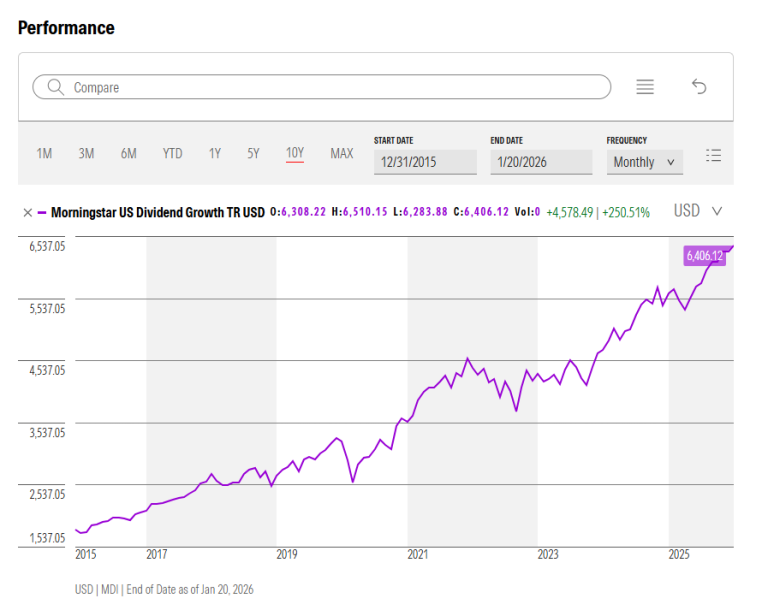
The Morningstar US Dividend Growth Index is central to this approach. It follows companies that have raised their dividends for at least five years. This index is known for stability and steady income, and it tends to focus more on value stocks than on traditional growth stocks.

Dividend growth strategies usually feature companies with steady cash flows and careful management of their money. These qualities can make the stocks less volatile during market downturns, which is attractive to investors who prefer lower risk or plan to invest for the long term.

Still, dividend growth stocks have not always outperformed the wider U.S. stock market. They often have less exposure to large technology companies and fast-growing companies, many of which do not pay dividends or have only recently started paying them. This mix means dividend growers may lag when growth stocks lead, but they can do better when the market favors defensive investments.

Key facts about dividend growth stocks

  • More than just income: Dividend growth stocks give investors access to companies that raise their payouts, but returns also come from share price gains along with higher dividends.
  • Defensive qualities: These stocks are often less volatile than the overall market, helping protect portfolios during market downturns or periods of uncertainty.
  • Value focus: Dividend growth indexes tend to lean toward value stocks and invest less in popular tech companies.

Investors need to distinguish between high-yield dividend strategies, which focus on current income, and dividend growth strategies, which aim for regular increases in payouts. Dividend growth strategies often attract those who want both income and quality, like strong finances and steady earnings, not just a high yield right now.

There are risks with dividend growth investing. As tech and growth stocks have become a larger part of the market, dividend-growth indexes can lag during tech-driven rallies. Today, some dividend growers come from sectors like financials and healthcare, and a few tech companies have also begun increasing their payouts.

For financial and investment readers, dividend growth strategies offer more than just regular cash payments. They help balance risk and return in a diverse portfolio. Knowing how these stocks perform relative to the broader market can help investors pick the right mix for their goals, whether they want income, stability, or long-term growth.

Tariffs Put Corporate Profit Margins to the Test as Companies Invest to Protect Earnings

U.S. companies are facing higher costs due to tariffs on imported goods, so business leaders are rethinking how to protect their profits. Instead of just raising prices, many are coming up with new ways to handle these challenges and keep their businesses running smoothly.

Tariffs are taxes on imported goods, so businesses pay more when they use imported materials. If companies can’t pass these extra costs on to customers, their profits decline. Tariffs can also disrupt prices, supply chains, and long-term plans. Experts say tariffs add extra costs to a value-based approach. The challenge for businesses is to manage these higher costs while keeping customers’ trust and protecting their own finances.

Why tariffs matter to company finances

  • Rising costs: Tariffs mean it costs more for companies to get the materials or parts they need from other countries. If businesses pay these extra costs themselves instead of raising prices for customers, their profits take a hit.
  • Pricing and demand: Companies might try to make up for higher costs by increasing prices, but that can turn customers away, especially since people are careful with their spending these days.
  • Investment and adjustment: To protect profits, many companies are reworking their supply chains, adding automation, or improving how they set prices. These are longer-term solutions, not just quick fixes.
  • Longer timelines: Making big changes—like moving factories back to the U.S. to avoid tariffs or finding new suppliers—can take a long time, sometimes months or more. These changes also cost money up front and can hurt short-term profits, even if they pay off later.

Business surveys and industry research indicate that many U.S. companies are already feeling the pressure from higher costs resulting from tariffs. More than half report lower profit margins, partly due to tariffs, and many expect to raise prices soon to protect profits while staying competitive.

Tariffs are also linked to larger economic trends. Companies that rely on imports are less hopeful about future revenue and job growth than those less affected by tariffs. This shows that tariffs can influence not only costs but also business outlook and investment decisions.

Tariffs affect industries differently. Manufacturers and companies that rely on global supply chains feel the cost pressures more, while those with local supply chains or strong pricing power can better handle the impact. This means trade policy, pricing, and profit management are now more closely linked in business planning.

The changing tariff situation shows how outside policy decisions can impact a company’s finances. For business and financial readers, understanding these pressures and how companies respond can give insight into business strategy, future earnings, and possible changes in consumer prices as companies deal with a more complex cost environment.

Insect-like Robots May Define the Future of Search and Rescue and Military Reconnaissance

0

Insect-like robots may soon define the future of search-and-rescue and military reconnaissance. These micro-robots could enter collapsed buildings, battlefields, and disaster zones where humans and conventional machines cannot.

During earthquakes, buildings collapse, tunnels in urban combat zones, and narrow gaps beneath rubble are places where human responders and conventional machines struggle to operate. But the new research paper published in an open-access scientific journal suggests that bionic mechanical insects — tiny robots modeled after real insects — may offer a practical way forward.

In a study, researchers in China examine how to design and control bio-inspired micro-robots to move efficiently through confined, unpredictable environments, with potential applications in search-and-rescue operations and military reconnaissance.

Learning from insects

The researchers turned to insects — specifically cockroaches — instead of wheels or tracks. Insects are known for their ability to move quickly, recover from obstacles, and survive in harsh environments.

By studying insect gait and body structure, the team developed mechanical designs that allow small robots to crawl, turn, and stabilize themselves on uneven terrain. These features are difficult to replicate with larger robots, which often require open spaces to function effectively.

The goal, the researchers say, is not to replace human responders or soldiers. It is to provide early access and situational awareness in places too dangerous or too small for people.

Insect-like robots built for tight spaces

The robots described in the study are designed to be lightweight and compact, using advanced materials and precision components to reduce size and energy consumption.

Movement is driven by piezoelectric actuators, which enable fast, precise leg motion while consuming minimal power — a key requirement for long missions in disaster zones or for surveillance operations. Sensors help the robots adjust their movement as terrain changes, allowing them to navigate debris, slopes, and unstable surfaces.

The study also explores intelligent motion-control systems that combine biological movement patterns with modern control algorithms, improving stability and adaptability.

Implications for disaster response

Access is often the biggest challenge in search-and-rescue operations. Entering unstable structures can put responders at risk, while delays can cost lives.

Micro-robots could be deployed ahead of rescue teams to explore collapsed buildings, locate trapped survivors, and assess structural conditions. Because of their size, multiple units could be sent in at once, helping responders build a clearer picture of conditions beneath the rubble.

Researchers caution, however, that these systems are still in development and are not yet ready for large-scale deployment.

A new layer of military reconnaissance

The same characteristics that make mechanical insects useful in disaster zones — small size, low power use, and adaptability — also raise interest in military contexts.

Insect-like robots could gather information in confined spaces without exposing soldiers to immediate danger. This is especially important in urban warfare and surveillance. Their insect-like movement may also make them less noticeable in certain environments.

The study does not directly address policy or ethical concerns. Experts, however, have increasingly warned that advances in autonomous and semi-autonomous systems will require clearer rules on deployment, accountability, and civilian protection.

Insect-like robots are still early, but moving fast

The research demonstrates promising prototype performance. But significant challenges remain, including durability, control reliability, and mass production.

Still, the direction of development reflects a broader trend in robotics: smaller, smarter systems designed to operate where humans cannot.

Climate-related disasters are becoming more frequent, and conflicts are increasingly moving into dense urban environments. These developments may make technologies like bionic mechanical insects part of the tools governments and responders rely on — raising both new possibilities and new questions about how such systems should be used.

A Fresh Take on a Local Greek Coffee Shop and Market

0

If you’re looking for a local, fresh, and healthy coffee shop to try in Albuquerque, Meraki Coffee and Market exceeds expectations. 

The name Meraki, according to their website (https://www.drinkmerakiabq.com/), is a Greek word with no direct English translation. The word in Greek describes the “love and attention you put into your food, drink, or anything else you may prepare for others.”

The quality of their coffee, pastries, and food is intended to reflect the value and care that the name describes. They use only natural ingredients, no sugar substitutes, additives, or bleached flours. Everything is housemade, including syrups for coffee and cocktails.

While Meraki Coffee and Market closes at 3 in the afternoon, the building is uniquely attached to a fine dining Greek restaurant called Dorthea (https://www.dorotheafinegreek.com/) that opens when the coffee shop closes. The two sister businesses have separate entrances, but share dining areas and tables.

I stopped by Meraki at around noon on a Saturday, so customers eating breakfast and friends catching up were trickling out. They have an extensive menu, with espresso drinks, tea lattes, morning cocktails to drink, and pastries as well as lunch and breakfast items prepared to order. 

I tried their White Cinnamon Mocha, an espresso drink that can be served hot or iced (pictured in the above photo), and a raspberry scone. Both tasted deliciously fresh and sweet, and I have to say that the two complimented each other well. 

This is not a cafe review, though it seems impossible to highlight Meraki without singing their praises. As an avid cafegoer, as well as a long-time barista, I’d definitely recommend Meraki as a local option to try, and I would love to try their sister Dorthea as well.

Meraki Coffee and Market and Dorthea Fine Greek share an address, located at 5900 Eubank Blvd.

How Texas families can soon avail of the state’s education savings account

0

In May 2025, Governor Greg Abbott approved the use of taxpayer funds for families seeking private school education for their children.

According to KSAT.com, at least $1 billion was allocated by the state for the school vouchers program, enabling families to utilize public money as payment for private school tuition and other school fees. 

Eligible students are entitled to approximately $10,500 per year for educational spending. Meanwhile, students with diagnosed disabilities and families with incomes below five times the federal poverty threshold are given top priority for funding.

With applications set to open on Feb. 4, 2026, Inga Cotton of the School Discovery Network guides families through the process. 

Cotton, founder and executive director of School Discovery Network, said that the Texas Education Freedom Accounts (TEFA) program is broader than a traditional voucher. “It’s more like a health savings account where you can use it for multiple purposes, not just tuition.”

She is encouraging families to visit the official TEFA webpage and find schools that have opted in to accept these funds. 

“It’s important to research and apply to multiple schools to increase your chances of placement,” Cotton advised.

Here’s a quick guide on the application process:

  • Families are required to complete two separate processes: (1) apply for and gain acceptance at their chosen private school and (2) apply for TEFA funding through the state program.
  • They should prepare these documents before the state application opens on Feb. 4:

previous year’s tax return; proof of disability documentation (IEP) if applicable; and other household income verification.

The coverage of TEFA funds includes private school tuition, school uniforms, transportation, meals, school supplies, tutoring services, educational equipment, and reading intervention programs. 

If the full amount is unused, families may save remaining funds for future years, roll over money for high school expenses, or use it for additional educational services.

These are the dates to remember: Feb. 4 – March 17 (application window opens); Spring 2026 (April-May) (families notified of acceptance); and July 2026 (first payments available in accounts).

The program is set to be reviewed during the 2027 legislative session, with data on student performance and program participation collected to guide future funding decisions.

A Strong Start to 2026: What Top-Performing ETFs Say About Market Trends

Wall Street rang in 2026 on a high note, with the stock market climbing and several ETFs off to a strong start. Defense funds, in particular, got a boost early on, thanks to the U.S. operation that ousted Venezuelan leader Nicolas Maduro in January. It’s a reminder that what happens on the world stage can quickly ripple through the markets, affecting how different funds perform.

According to Nasdaq, on January 20, 2026, the S&P 500 slipped 0.06%, the Dow Jones Industrial Average dropped 0.2%, and the Nasdaq Composite declined by 0.7%, reflecting the influence of global developments, sector movements, and evolving policy expectations on investor activity.

One major trend in early 2026 is more investment in defense. Geopolitical tensions, especially after the US removed Venezuelan leader Nicolas Maduro in January, pushed defense stocks higher. Increased global defense spending and new conflicts added to this momentum. The iShares US Aerospace and Defense ETF—which invests in leading US defense and aerospace companies—has gained almost 10 percent this year. This shows how political and military events can directly impact certain industries and related funds.

Gold has once again proven to be a safe-haven asset. According to RTTNews.com, gold prices reached a record high in January as escalating tensions between the US and Iran drove investors toward the stability of gold ETFs like the SPDR Gold Trust. Hopes for interest rate cuts and continued central bank buying have also made gold more attractive for the long term. For new investors, this highlights why it’s important to diversify across different asset types to manage risk.

According to CoinDesk, the CoinShares Bitcoin Mining ETF has been the worst-performing ETF of the year so far, down 43 percent. This fund invests in companies involved in Bitcoin mining. Bitcoin itself rose about 4 percent, helped by hopes for easier monetary policy from the Federal Reserve and a pro-crypto approach from the Trump administration. More interest from big investors and talk of possible US Bitcoin reserves also added to the positive outlook.

The REX Drone ETF, which invests in companies specializing in drones and unmanned aerial vehicles, kept pace with the broader defense sector. For everyday investors, this means headlines about drones are more than just tech hype—they’re moving real money in the market. Meanwhile, the Roundhill Meme Stock ETF also saw an uptick, suggesting that *etail investors are still chasing trends and viral stocks, as in past years. These funds can sometimes deliver eye-popping gains, but it’s important to remember that big rewards often come with big risks, especially for those new to the market.

Another standout this month was the YieldMax MRNA Option Income Strategy ETF. This fund takes a unique approach, aiming to generate income by selling call options on Moderna shares. When Moderna’s stock price jumped after raising its revenue forecast, the ETF’s yield got a boost. But for most people, strategies like this are complicated and carry extra risks—another reminder that big numbers don’t always mean a safer bet.

The Global X Blockchain ETF also surged nearly 30 percent as companies tied to blockchain bounced back. Part of the excitement comes from hopes that interest rates will fall soon, and from a growing sense that digital assets are becoming more mainstream. For investors, it’s a reminder that markets don’t move on numbers alone—stories, sentiment, and headlines can all play a role.

The ups and downs of the market aren’t just about numbers—they’re influenced by what’s happening around the world, the choices leaders make, and even the mood on Wall Street. The way ETFs performed this month shows that understanding the market means more than reading earnings reports or staring at charts. It’s about knowing what people are hoping for, what worries them, and what they believe might happen next. If you’re watching your investments, remember: keeping up with the news and world events can matter just as much as crunching the numbers.

Student Loan Caps Poised to Slash Billions From U.S. University Tuition Revenue

U.S. universities may lose a large amount of tuition revenue because new federal student loan caps for graduate students could lead to fewer enrollments, recent research shows. These changes, part of President Donald Trump’s student lending overhaul, will take effect in July and could change who can access graduate education.

Researchers warn that the policy could leave tens of thousands of students unable to pay for advanced degrees, especially in fields with high tuition. This could lower tuition income for universities, which are already facing financial challenges.

A study by American University and the Federal Reserve Bank of Philadelphia estimates that up to $10 billion in current graduate student aid would go over the new borrowing limits. Over 160,000 students may face funding gaps, and some may not be able to find other ways to pay. If students drop out or delay their studies, schools could lose not only tuition paid by loans but also entire enrollments.

The new loan limits come at a time when universities are facing several challenges. Federal grant funding has been reduced, legal challenges against colleges have increased, and stricter visa rules have led to fewer international students. A recent college survey found a 17 percent drop in new foreign student enrollment, making budgets even tighter.

Under the administration’s “One Big Beautiful Bill” Act, graduate students in professional programs such as law and medicine will be limited to $50,000 in federal loans per year. Other graduate programs, such as nursing and business, will have a cap of $20,500 per year.

What’s changing and why it matters

The reforms aim to slow the growth of federal student debt, which has risen sharply over the past 20 years. However, education researchers warn there may be unintended consequences:

  • Lower borrowing caps may price students out of graduate programmes with high tuition fees.
  • Private loans, often the alternative, typically carry higher interest rates and stricter credit requirements.
  • Lower-income students may be disproportionately affected due to limited access to private financing.
  • Universities could lose tuition revenue if enrolment falls rather than shifts to private lending.

The Department of Education argues that the new limits will help restrain tuition inflation and reduce long-term debt burdens. According to the Education Department, 95 percent of nursing students borrow less than the annual loan limit and will not be impacted by the new caps, and the policy does not affect undergraduate programs. However, higher education experts caution that the changes could discourage people from pursuing graduate study, especially in fields with widely varying salaries. Some say a more targeted approach, such as linking loan limits to expected income by profession, would better balance access and debt control.

Schools that offer degrees no longer considered professional have raised concerns. Business and nursing schools are requesting that their programs be reclassified so they can qualify for higher loan limits. They warn that less access to loans could hurt workforce development.

Industry groups are also worried about wider effects on the job market. Nursing associations warn that limiting graduate education could make staffing shortages worse and reduce access to patient care. According to a report from The Washington Post, a plan from the Trump administration that could limit access to some student loans has angered a coalition of nursing and other health care organizations, who are concerned about the policy’s impact on students. Officials say the changes are needed to limit federal spending and encourage schools to keep costs down.

With the July start date coming soon, universities, students, and lenders are preparing for changes. It is still unclear if the new loan caps will lower debt without reducing graduate education, and the outcome is important for both students and schools.

How Student Loans Can Disappear From Your Credit Report and What It Means

Student loans often remain with borrowers long after graduation, and many people are unsure when they will disappear from their credit reports. Unlike other debts, student loans have their own timeline, which depends on whether the loan is still active, has been paid off, or has gone into default.

This topic is important now because millions of people are resuming payments after the pandemic pause and reviewing their finances.

Credit reports affect whether you can get a mortgage, car loan, or credit card, so it helps to know how long student loan information stays on your report.

Student loans do not just disappear from your credit report after a certain number of years. If a loan is still active and has not been paid off, discharged, or forgiven, it can remain on your credit report indefinitely.

After you pay off a student loan, it usually stays on your credit report as a closed account for up to 10 years. This is normal for credit bureaus, even if you made all your payments on time. A long record of on-time payments can help your credit score during this time.

Trouble starts when you fall behind on your loans. Late payments and defaults are reported separately from the loan itself. According to federal rules, most negative marks, like missed payments or default status, are taken off your report after a certain period.

Important credit reporting rules to remember

  • Active student loan accounts remain on a credit report until they are paid off, forgiven, or discharged.
  • Loans paid in full typically remain on your credit report as closed accounts for up to 10 years.
  • Late payments and defaults are usually removed from your credit report seven years after the first missed payment that led to delinquency, even after negative marks are deleted.

This difference surprises many borrowers. Even if a default note is taken off your report after seven years, federal student loan debt still exists and can be collected through wage garnishment or tax refund seizure. Collection rules depend on your state and lender. Some private lenders may stop reporting old debts, but you still legally owe the balance.

Credit experts point out that student loans are unusual because they can show up on your credit report for decades without hurting your score, as long as you pay on time. Issues usually come from missed payments, defaults, or an inconsistent payment record.

If you’re starting payments again after the pandemic pause, it’s important to understand this difference. Making regular payments helps you avoid new negative marks, and fixing defaults through rehabilitation or consolidation can boost your credit, even if you still owe money.

With repayments starting up again across the country, student loans will likely stay on many credit reports for years. Knowing how credit reporting works helps you make smart choices, protect your credit, and plan for big financial steps. In short, student loans don’t just go away over time—their effect on your credit depends on how you handle them.