

Sunday, February 8, 2026
41.6 F
Albuquerque

Solar Flares Start Small, Then Explode: New Study Reveals Avalanche-like Eruptions on the Sun

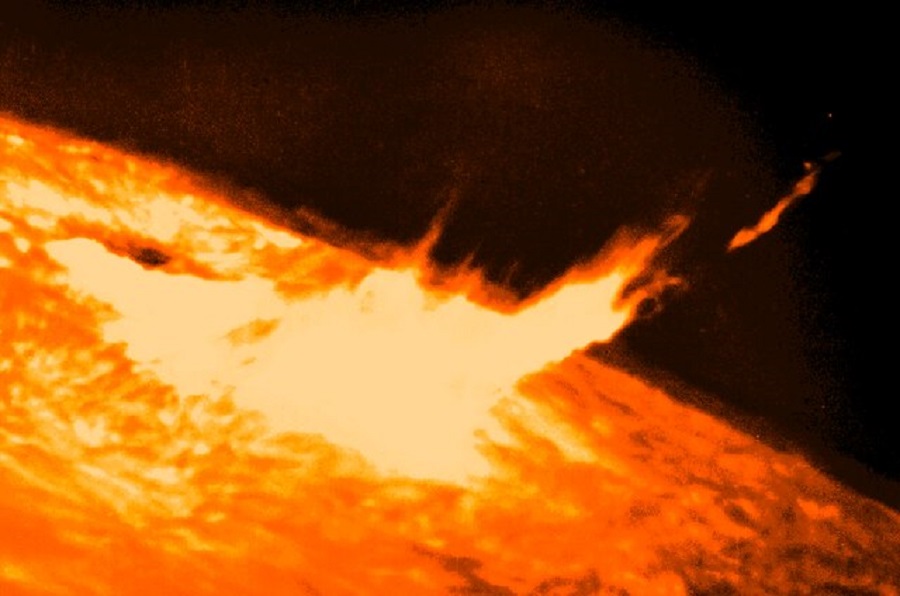
New observations from the European Space Agency’s Solar Orbiter show that massive solar flares can begin with subtle magnetic disturbances that rapidly snowball into violent explosions. These early changes, like an avalanche triggered by a small shift, cascade into a powerful chain reaction that continues reshaping the Sun’s atmosphere long after the flare itself peaks.

Scientists captured the details of this process during Solar Orbiter’s close flyby of the Sun on September 30, 2024. The findings, published on January 21 in Astronomy & Astrophysics, suggest that large flares are not single, unified blasts. It is the result of many smaller magnetic events feeding into one another.

Why this matters

Solar flares are among the most energetic explosions in the solar system. These explosions occur when energy stored in twisted magnetic fields is suddenly released through magnetic reconnection—when magnetic field lines snap, rearrange, and reconnect.

The strongest flares can affect Earth. It could trigger geomagnetic storms that disrupt radio communications, damage satellites, and pose risks to astronauts. Understanding how flares begin is critical to improving space weather forecasts and protecting modern technology.

Scientists have struggled to explain how the Sun can unleash so much energy in just minutes. Solar Orbiter’s observations are helping close that gap.

A rare view of the birth of solar flares

During the September 30 event, four Solar Orbiter instruments observed different layers of the Sun at the same time—from the visible surface to the hot outer atmosphere known as the corona.

The Extreme Ultraviolet Imager (EUI) captured ultra-sharp images every two seconds, revealing structures only a few hundred kilometers across. Meanwhile, SPICE, STIX, and PHI tracked changes in temperature, particle acceleration, and magnetic fields.

Together, the instruments followed the flare’s buildup for about 40 minutes—an unusually detailed look at a process that often unfolds too quickly and falls outside observing windows.

“We were in the right place at the right time,” said Pradeep Chitta of the Max Planck Institute for Solar System Research, the study’s lead author.

Solar flares: A magnetic avalanche

EUI first detected a dark, arch-shaped filament made of twisted magnetic fields and plasma. This filament has a link to a cross-shaped magnetic pattern that slowly brightened.

New magnetic strands appeared almost continuously, sometimes every two seconds. The region became increasingly unstable as it twisted and accumulated. Eventually, magnetic structures began breaking and reconnecting in rapid succession, triggering a cascading “magnetic avalanche.”

A particularly intense brightening signaled the tipping point at 23:29 UTC. Soon after, the filament tore loose and shot outward, violently unrolling as the main flare erupted around 23:47 UTC.

“These minutes before the flare are extremely important,” Chitta said. “What we saw was a large flare driven by many smaller reconnection events spreading rapidly in space and time.”

Plasma rain and extreme energy

Data from SPICE and STIX revealed how energy from the flare was deposited into the Sun’s atmosphere. X-ray emissions surged as the eruption intensified, accelerating particles to 40–50% of the speed of light—up to 540 million kilometers per hour.

Scientists also observed glowing “plasma rain,” as blobs of energized material streamed downward through the Sun’s atmosphere, continuing even after the flare subsided.

Rethinking solar explosions

The findings challenge the idea that major flares are single explosive events. They point instead to a cascade of smaller magnetic disruptions building into a powerful eruption.

“This reveals the engine driving a flare,” said Miho Janvier, ESA’s Solar Orbiter co-project scientist.

Researchers say the same avalanche-like process may operate in other flares—and even on other stars. The findings have reshaped how scientists understand stellar explosions and the risks they pose to Earth.

Hot this week

Is New Mexico Really Last in Education? New Data Challenge Rankings

New Mexico still ranks near the bottom in national K–12 education rankings, but recent state data show improvements in reading proficiency and mixed results across education levels.

UNM Anderson Receives Donation from Thorntons for Healthcare Leadership Scholarship

Graduate students at UNM Anderson School of Management gain a new opportunity after Maribeth and Chris Thornton’s donation to establish a Healthcare Leadership Scholarship.

New Mexico $47M Transport Funding for Safety, Climate, and Communities: Why it Matters

Nearly $47 million in transportation funding from the New Mexico Department of Transportation goes beyond roads and bridges. The projects touch daily life—making streets safer, strengthening public transit, cutting emissions, and helping rural and Tribal communities close long-standing infrastructure gaps.

School-Based Health Centers (SBHCs) Help More New Mexico Students, NMDOH Reports

New Mexico school-based health centers (SBHCs) assisted nearly 20,000 students to stay healthy and in class during the 2024-2025 school year.

Childcare Advocates Press New Mexico Senate to Protect Wage Hikes Amid Budget Standoff

Childcare advocates are calling on New Mexico senators to retain proposed wage increases for early childhood educators, warning that low pay could drive workers out of the profession as lawmakers debate funding for universal childcare.

Topics

Is New Mexico Really Last in Education? New Data Challenge Rankings

New Mexico still ranks near the bottom in national K–12 education rankings, but recent state data show improvements in reading proficiency and mixed results across education levels.

UNM Anderson Receives Donation from Thorntons for Healthcare Leadership Scholarship

Graduate students at UNM Anderson School of Management gain a new opportunity after Maribeth and Chris Thornton’s donation to establish a Healthcare Leadership Scholarship.

New Mexico $47M Transport Funding for Safety, Climate, and Communities: Why it Matters

Nearly $47 million in transportation funding from the New Mexico Department of Transportation goes beyond roads and bridges. The projects touch daily life—making streets safer, strengthening public transit, cutting emissions, and helping rural and Tribal communities close long-standing infrastructure gaps.

School-Based Health Centers (SBHCs) Help More New Mexico Students, NMDOH Reports

New Mexico school-based health centers (SBHCs) assisted nearly 20,000 students to stay healthy and in class during the 2024-2025 school year.

Childcare Advocates Press New Mexico Senate to Protect Wage Hikes Amid Budget Standoff

Childcare advocates are calling on New Mexico senators to retain proposed wage increases for early childhood educators, warning that low pay could drive workers out of the profession as lawmakers debate funding for universal childcare.

On the Heel on Infant’s Death Due to Listeria Infection, FDA Will Test Infant Formula After Botulism Outbreak Sickens Dozens of Babies

The FDA is testing infant formula and key dairy ingredients after a botulism outbreak hospitalized at least 51 babies, renewing concerns over food safety, oversight, and the risks facing infants and pregnant individuals.

Clear Horizons Act: How New Mexico’s net-zero bill might affect you and your household budget

New Mexico lawmakers are set to introduce the Clear Horizons Act, a net-zero framework that would formalize statewide emissions targets and expand planning and reporting requirements. The central consumer question is cost: how compliance, grid investment, and fuel-market exposure could translate into utility bills and price volatility. What happens next in committee—and later in rulemaking—will determine whether “affordable energy” claims show up in measurable household outcomes.

A Fun Way to Learn: NMSU Unveils ‘Market Set Go!’

The New Mexico State University (NMSU) Cooperative Extension Service has released “Market Set Go!,” an educational game that teaches food safety in a fun way.

Related Articles