Home Blog Page 35

Child Care in New Mexico Now Costs More Than College

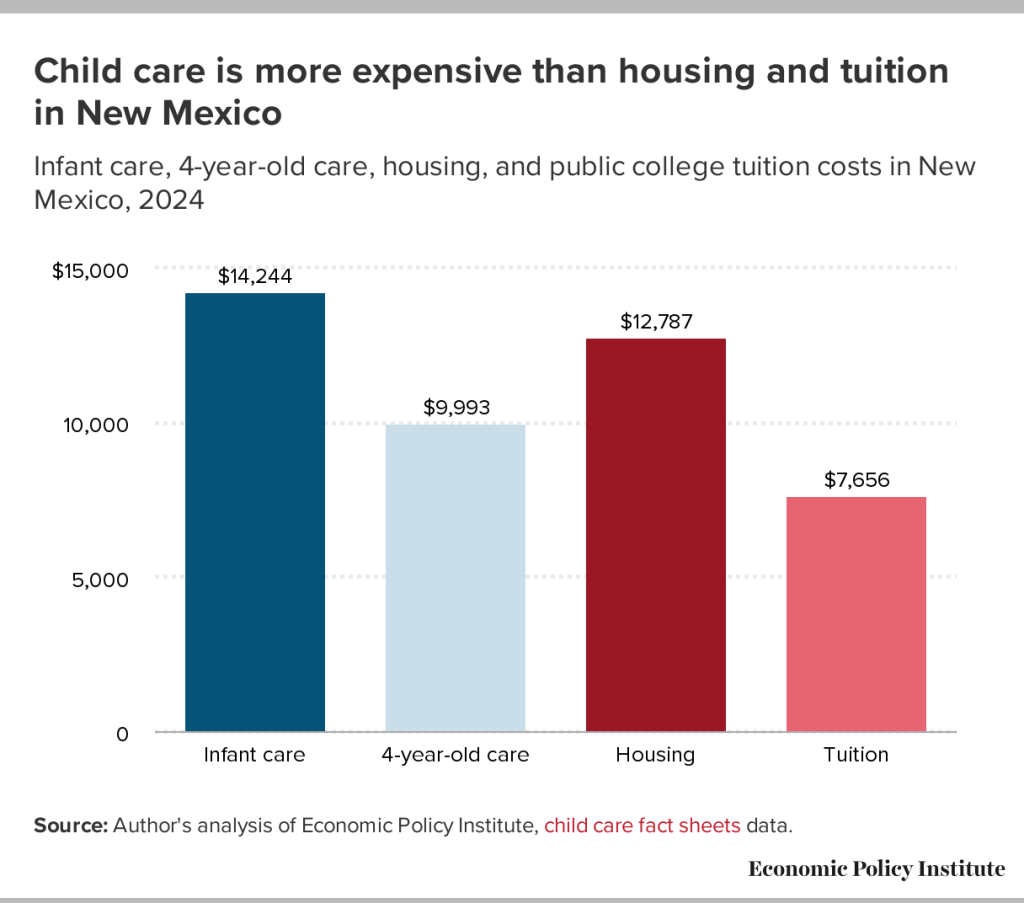
Parents in New Mexico face a stark financial reality: keeping their infant in child care for a year costs more than sending a college student to a four-year public university in the state.

According to the Economic Policy Institute, infant care in New Mexico averages $14,000 annually, about $1,167 each month. That is 86 percent higher than what families pay for in-state college tuition. For parents earning minimum wage, the math gets even harder. They would need to devote 64 percent of their entire yearly income just to cover child care for one baby.

The federal government considers child care affordable when it accounts for no more than 7 percent of household income. By that measure, most New Mexico families are paying far beyond what experts say is sustainable.

The cost drops somewhat as children age. Care for a four-year-old runs about $9,993 per year, still a significant chunk of most family budgets. But for parents with infants and toddlers, the financial squeeze can force impossible choices about whether to stay in the workforce at all.

Early Learning Gets Priced Out

The consequences reach beyond family bank accounts. When quality early childhood education becomes unaffordable, children miss out on critical learning experiences before kindergarten. Research consistently shows that early learning gaps tend to widen rather than close over time.

Children who arrive at kindergarten without exposure to structured learning environments often lack foundational skills in literacy, numeracy, and social interaction. Schools then face increased pressure to provide remedial support and special education services, straining already stretched resources.

The economic ripple effects hit families hard as well. Many parents, particularly mothers, scale back their work hours or leave jobs entirely when child care costs become untenable. That loss of income can create instability that affects children’s educational trajectories for years.

New Mexico Tries to Respond

State officials have taken several steps to address the crisis. New Mexico expanded child care subsidies to families earning up to 400 percent of the federal poverty level and eliminated co-payments that once created barriers for low and middle-income households. The state also raised wages for early childhood educators and secured long-term funding through a constitutional amendment.

These changes have made a real difference. More families can now access child care at no cost, removing a major obstacle to both parental employment and children’s early learning.

But gaps remain. The University of New Mexico’s Cradle to Career Policy Institute found that families still struggle to find care that matches their specific circumstances. Parents working night shifts, weekends, or irregular hours often cannot find programs that align with their schedules. Families in rural areas face limited options. Parents of children with special needs report difficulty locating appropriate care.

“More families than ever before are accessing child care and getting it for free, which is making a huge difference for them, but there’s more work to do to ensure that child care is available during the hours families need,” said Hailey Heinz, deputy director of the institute.

Transportation poses another challenge. Even when subsidized care exists, families without reliable vehicles or access to public transit may find it out of reach.

What Comes Next

Policy experts say sustained progress will require more than just subsidies. States need to calculate the true cost of providing quality care, develop compensation systems that give early childhood educators pay comparable to K-12 teachers, and create incentives for new child care providers to open in underserved areas.

The question is whether New Mexico’s current investments can evolve to meet these broader needs. Demographic shifts, economic changes, and workforce patterns all affect what families require from the child care system. Programs that work today may need adjustment tomorrow.

For now, thousands of New Mexico families continue to navigate the tension between affording child care and ensuring their children receive the early learning opportunities that shape long-term success. The state has made meaningful progress, but the gap between policy and practical access remains wide for many.

Addressing Workforce Needs: Northern New Mexico College’s Radiation Control Technician Program

Los Alamos National Laboratory needs people, and it needs them fast.

The sprawling nuclear weapons facility in northern New Mexico has added more than 6,000 employees since 2017, bringing its total workforce to roughly 18,000 today. The hiring spree is tied to a federal push to modernize America’s aging nuclear arsenal, but finding qualified workers in this corner of the state has proven challenging.

Northern New Mexico College saw an opportunity. The small public institution now runs a specialized certificate program training radiation control technicians, the workers who monitor radiation levels, run safety surveys, and make sure nobody gets exposed to dangerous doses.

The program has become something of a direct pipeline to the lab. Students learn to use detection equipment, interpret radiation data, and apply federal safety standards. Then many of them walk straight into jobs at Los Alamos, one of the few employers in the region offering six-figure salaries to workers without four-year degrees.

The college didn’t build the program alone. Los Alamos has funded faculty positions, supplied equipment and materials, and created paid internships that double as extended job interviews. Students get hands-on experience at one of the country’s premier research facilities while still in school.

For Northern New Mexico, the stakes go beyond just filling positions at the lab. The region has long struggled with limited economic prospects, and high-paying technical jobs remain scarce outside of Los Alamos itself. Training local residents for skilled work at the facility keeps both money and talent in communities that have historically seen young people leave for opportunities elsewhere.

The arrangement reflects a broader challenge facing the nuclear weapons complex as it tries to ramp up production after decades of declining investment. Labs need specialized workers, and they need them quickly. Traditional recruitment from other parts of the country is expensive and slow. Growing talent locally makes more sense, particularly for positions that require security clearances and long-term commitments.

Whether this model can scale remains an open question. Los Alamos continues to expand, and the need for technicians shows no signs of slowing. For now, Northern New Mexico College is working to keep up with demand, one radiation safety certificate at a time.

Texas Border City Declares Emergency After Cyberattack Cripples Government Systems

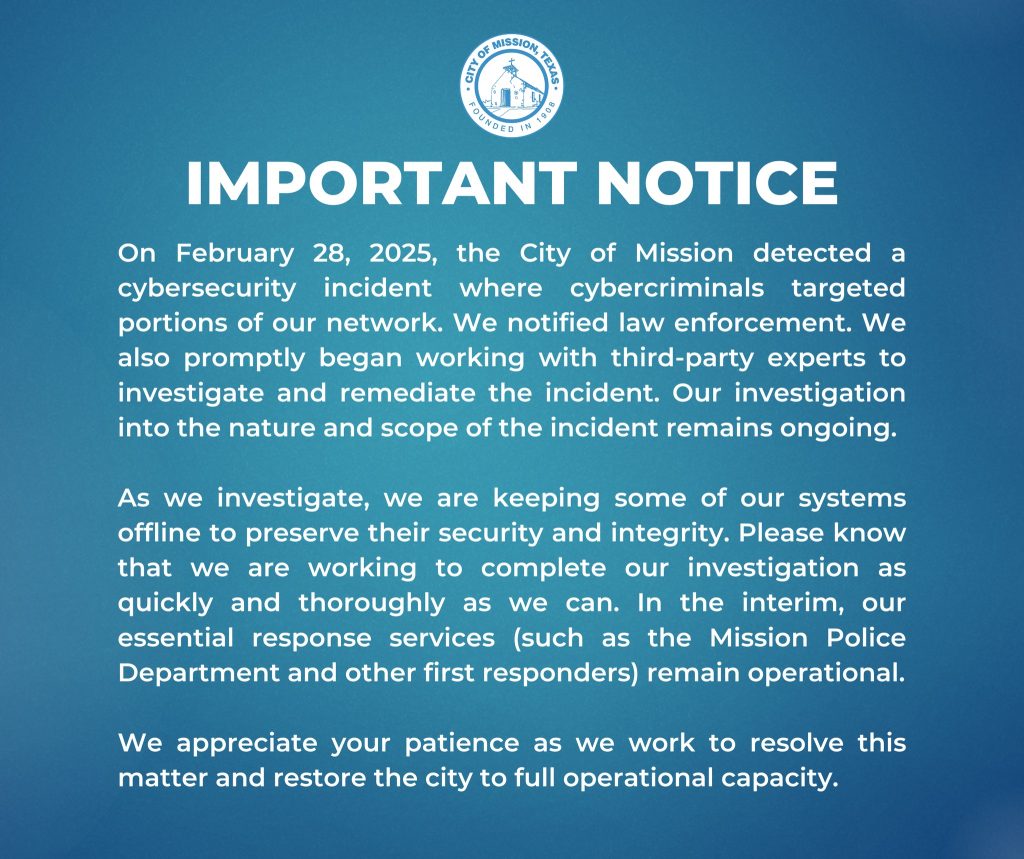
Mission, Texas, is operating in crisis mode after hackers broke into the city’s computer network late last month, forcing officials to shut down large portions of their digital infrastructure and putting sensitive health records and law enforcement data at risk.

Mayor Norie Gonzalez Garza has asked Governor Greg Abbott for help, warning in a March 4 letter that the city’s entire server system is compromised. The breach, which officials discovered on February 28, could expose protected personal and health information, as well as civil and criminal records.

Police and fire departments are still responding to emergencies, but the attack has kneecapped basic functions. Officers can’t run license plates or check driver’s licenses against state databases. Their patrol car laptops sit useless. The disruption affects how the city of roughly 88,000 people, located along the Rio Grande, handles everything from routine traffic stops to background checks.

City of Mission, TX - Government Official Facebook Page Announcement

City Manager Mike Perez said Mission is working with the Texas Department of Emergency Management to contain the damage. Officials are considering whether to seek a formal state emergency declaration, which would give them temporary authority to suspend certain regulations, including parts of the Texas Public Information Act that govern open records requests.

That move could shield the city from having to immediately release details about the attack while the investigation continues, though it also raises questions about transparency during a public crisis.

Mission joins a growing list of Texas cities hit by cyberattacks in recent months. McKinney, Coppell, and Richardson have all dealt with similar breaches over the past six months, disrupting services for hundreds of thousands of residents across the state.

The frequency of these attacks on municipal governments in Texas suggests cities remain vulnerable targets, often lacking the security resources and expertise that larger state agencies or private companies can afford.

Idaho’s House Bill 93: Expanding School Choice or Undermining Public Education?

Governor Brad Little waited until late February to put his signature on one of the most contentious pieces of legislation to cross his desk in years. House Bill 93, which creates a $50 million tax credit program for families who send their kids to private schools or homeschool them, became law despite thousands of Idahoans flooding his office with opposition.

The program offers up to $5,000 per student to cover private school tuition, homeschool curriculum, tutoring, textbooks, and transportation. Families with special needs children can claim up to $7,500. It’s not a voucher system, state officials insist. Instead, parents pay the expenses upfront and then claim a refundable tax credit when they file their state taxes.

Little framed the decision as having it both ways. Idaho can support robust public schools while giving families more educational options, he argued in a statement after signing the bill. His administration has increased public school funding by 60 percent since he took office, a point he has repeatedly emphasized.

But critics see a different story unfolding. Within hours of Little’s signature, a coalition that includes the Idaho Education Association, local school districts, and civic groups announced plans to challenge the law in court. They argue it violates the state constitution’s requirement that Idaho maintain a system of free public schools.

The numbers tell part of the story. When the House Revenue and Taxation Committee opened public comment on House Bill 93, more than 1,000 emails poured in. Ninety-four percent opposed it. Little told reporters that his office had received thousands more messages, though his staff declined to release a breakdown of support versus opposition.

The bill squeaked through the Republican-controlled legislature on largely party-line votes. In the House, it passed 42 to 28, with 19 Republicans breaking ranks to vote no. The Senate approved it 20 to 15, with nine Republicans joining all Democrats in opposition.

Representative Wendy Horman, an Idaho Falls Republican who co-sponsored the bill and chairs the Joint Finance-Appropriations Committee, has championed school choice for years. She argued that the tax credit gives families options while the state continues to pour money into traditional public schools. Little himself acknowledged the program lacks robust accountability measures, then added that he doesn’t think public schools have enough accountability either.

For supporters, the law represents a win for educational freedom. Chris Cargill, president of the Mountain States Policy Center, praised lawmakers for their leadership on the issue. The Idaho Republican Party called it a historic victory, noting that President Donald Trump had endorsed the measure.

But Paul Stark, executive director of the Idaho Education Association, sees it differently. Private schools can now collect taxpayer dollars without disclosing their curriculum, test scores, or even requiring background checks for employees, he pointed out at a press conference announcing the lawsuit. They can reject students based on religion, disability, or any other criteria. Public schools, meanwhile, have to take everyone.

The program’s financial mechanics add another layer of complexity. The $50 million cap means not everyone who applies will get funded, at least not right away. The Idaho State Tax Commission, which administers the program, has created a waiting list for families who don’t make the cut. When applications opened in January, more than 3,300 people applied within minutes.

Families earning less than 300 percent of the federal poverty level get priority, though the program is technically available to anyone. That income threshold works out to roughly $93,600 for a family of four, which covers a substantial portion of Idaho households.

The equity questions run deeper than income, though. Rural families, who make up a significant share of Idaho’s population, often live miles from the nearest private school. For them, the tax credit might be irrelevant. Meanwhile, urban and suburban families with multiple private school options nearby stand to benefit most.

Public school advocates worry about what happens when state dollars follow students out the door. Idaho’s public school budget for the current fiscal year actually shows a decrease in discretionary funding compared to the previous year, though overall spending has increased. That’s partly because student enrollment has declined slightly, reducing the number of classroom units the state funds.

The state has been investing heavily in school facilities after years of deferred maintenance left many buildings in poor condition. A 2022 legislative report estimated it would take $847 million just to bring all public school buildings up to good condition, not excellent. Little made facility funding a priority, securing $2 billion over ten years for repairs and construction.

But some education officials say the new private school program sends a contradictory message. The state pours money into fixing crumbling public schools while simultaneously creating a financial incentive for families to leave the system.

Little insists Idaho can do both. The state ranks first in the nation for return on investment in public schools, he noted, and has committed close to $17 billion to K-12 education since he took office. The tax credit program, he argued, simply expands choices without abandoning the core commitment to public education.

The lawsuit challenging House Bill 93 will test whether that vision aligns with Idaho’s constitutional obligations. Daniel Mooney, president of the Committee to Protect and Preserve the Idaho Constitution, pointed to 14 words in the state’s founding document: “establish and maintain a general, uniform and thorough system of public, free common schools.”

Those words are simple but profound, Mooney said, and House Bill 93 has no basis in them. Similar constitutional challenges in other states have succeeded in blocking private school subsidy programs. Idaho’s Supreme Court will now decide whether the tax credit survives.

For now, families are lining up to claim the money. The program went live in January with applications processed on a first-come, first-served basis. Whether it lasts beyond the next court ruling remains an open question.

Idaho Governor Brad Little recently signed House Bill 93 into law, introducing a $50 million Parental Choice Tax Credit program. This legislation offers refundable tax credits up to $5,000 per student for private schooling or homeschooling expenses, increasing to $7,500 for special needs students.

House Bill 93 was introduced to expand educational choice in Idaho by providing financial support for private schooling, homeschooling, and other non-public education expenses. It aims to make alternative education more accessible through refundable tax credits, particularly for low- and middle-income families, while promoting competition and innovation in education.

Key Facts:

  • Parents of homeschooled or private school students can receive up to $5,000 to cover expenses such as tuition, fees, tutoring, textbooks, curriculum, and transportation. For special needs students, this amount increases to $7,500.
  • Governor Little emphasized that Idaho can support both strong public schools and educational freedom, asserting that providing high-quality education remains a top priority.​
  • Critics, including Idaho’s Democratic legislators, argue that this measure may divert essential funds from public schools, potentially undermining their quality and accessibility.

Other Questions:

How Will House Bill 93 Affect Funding Allocation and Public School Resources?

The diversion of taxpayer dollars to private and homeschooling expenses raises questions about public school funding. Critics argue that such measures could reduce the resources available to public schools, particularly in rural areas where educational alternatives are limited. This shift may strain public school budgets, affecting their ability to maintain facilities, hire qualified staff, and provide extracurricular programs.

Will it Impact Educational Outcomes and Resource Availability?

Comparing academic performance between public schools and those benefiting from the new tax credits is essential. While private and homeschooling environments may offer tailored educational experiences, public schools provide standardized curricula and extracurricular activities. The reallocation of funds could widen the gap in resource availability, potentially impacting the quality of education for students remaining in the public system.

Does House Bill 93 Promote Educational Equity or Widen Disparities?

The bill’s implementation raises equity concerns, especially for low-income and rural communities. Although the tax credit is available to all families, those earning less than 300% of the federal poverty level receive priority. However, critics argue that this may still not fully address disparities, as families in rural areas may have limited access to private schooling, thereby not benefiting equally from the program.​

What Are the Long-Term Implications of House Bill 93 on Public Education Infrastructure?

The long-term effects on public education infrastructure and teacher workforce stability are significant considerations. A sustained diversion of funds could lead to decreased investments in public school facilities and resources, potentially resulting in school closures or consolidations. Moreover, reduced funding might affect teacher salaries and job security, thereby challenging the public system’s ability to attract and retain qualified educators.


Illinois House Bill 2827 Proposes New Regulations for Homeschooling

Thousands of homeschooling parents packed the Illinois State Capitol on March 6, waving signs and delivering cherry pies to lawmakers in a coordinated show of force against legislation they say threatens their educational freedom.

The target of their opposition: House Bill 2827, introduced by State Representative Terra Costa Howard, which would create the state’s first comprehensive regulatory framework for families who homeschool their children.

The proposed Homeschool Act would require Illinois families to file annual declarations with their local school districts, listing each child’s name, birthdate, grade level, and contact information. School officials may request educational portfolios at any time to verify that home instruction meets standards comparable to those of public schools. Parents would need at least a high school diploma to teach their own children.

More than 2,000 people turned out for what organizers called Cherry Pie Day, an event coordinated by Illinois Christian Home Educators. The crowd filled the Capitol rotunda, making it one of the larger demonstrations at the statehouse this session.

Critics of the bill see the measure as government overreach into family decisions. Homeschooling advocacy organizations warn that the requirements could open the door to expanded state control over private education choices.

Supporters counter that modest oversight protects children’s interests. They argue that basic documentation and educational standards ensure students receive adequate instruction, particularly when families may struggle to provide comprehensive curricula.

The bill also grants the Illinois State Board of Education authority to develop additional implementation rules, a provision that concerns opponents who fear regulatory expansion beyond the legislation’s current scope.

Currently, Illinois remains among the least restrictive states for homeschooling, with no notification requirements or testing mandates. The proposed changes would align Illinois more closely with states that maintain registries of homeschooled students.

The House Education Policy Committee will hold a hearing on HB 2827 on March 12 at 8 a.m. Families on both sides of the debate can submit witness slips or contact their representatives before the committee votes on whether to advance the measure.

Key Provisions of HB 2827:

  • Annual Declaration: Homeschooling parents must submit an “Homeschool Declaration Form” to their local school district each year. This form would include detailed information about the child, such as name, birth date, grade level, and contact information.
  • Educational Portfolio: The bill permits local school officials to request an “educational portfolio” from homeschooling families at any time. This portfolio should demonstrate that the homeschool program meets educational standards comparable to public schools.
  • Instructor Qualifications: Parents or guardians providing homeschool instruction must possess a high school diploma or its equivalent.
  • State Board Authority: The Illinois State Board of Education would have the authority to adopt additional rules necessary to implement and administer the Act.

New Mexico Legislature Advances Bill to Eliminate Fees for High School Equivalency Tests

The New Mexico House of Representatives passed legislation this week that could remove a significant obstacle for the roughly 200,000 adults across the state who lack a high school diploma.

House Bill 167, which cleared the House and now heads to the Senate, would eliminate the $145 fee for high school equivalency testing and provide funding for test preparation programs. The measure allocates $2 million from the state’s general fund to cover these costs in fiscal year 2026.

For many New Mexicans, that $145 has been enough to keep them from even trying.

“I am proud to sponsor this important piece of legislation to ensure New Mexicans receive their high school equivalency credential without facing any financial barrier,” said Representative Joy Garratt, one of the bill’s co-sponsors.

The legislation targets adults who are at least 16 years old, not currently enrolled in high school, and who have demonstrated readiness by passing an official practice test. State officials believe removing the fee barrier could boost test participation by 20 to 40 percent.

The timing matters for New Mexico’s economy. Employers increasingly require credentials that many adult workers never obtained, often because they had to leave school early to work or care for family members. A high school equivalency certificate can open doors to better-paying jobs, apprenticeships, and community college programs.

The bill routes funding through the state’s Higher Education Department, which oversees the testing program. If the Senate approves the measure and the governor signs it, the law would take effect June 20.

New Mexico isn’t the first state to consider eliminating equivalency testing fees, but it’s among those moving most aggressively to address educational attainment gaps that affect workforce development. The state has struggled with high poverty rates and lower-than-average educational outcomes compared to the national average, making initiatives like this a priority for lawmakers focused on economic development.

The Senate will now take up the bill in the coming weeks.

Key Insights of HB167

  • Eligibility Criteria: To qualify for free testing, individuals must:
    • Be at least 16 years old.
    • Not currently enrolled in secondary school.
    • Lacks a high school diploma or equivalency certificate.
    • Have passed an official practice test indicating readiness.
  • Funding Allocation: The bill appropriates $2 million from the general fund to the Higher Education Department (HED) for fiscal year 2026 to cover test and preparation costs.

NYC Public Schools Face Crisis: 35% of Students Chronically Absent as Test Scores Drop Despite Increased Funding

More than 350,000 New York City public school students missed at least 10% of school days during the last academic year, according to a recent Manhattan Institute analysis. That translates to about 35% of the city’s student body, a figure education experts say should alarm parents and policymakers alike.

The absenteeism numbers track closely with another troubling trend: declining test scores. Despite New York State pouring more money into education than ever before, math and reading proficiency rates remain stubbornly below pre-pandemic levels. Only a small fraction of 4th and 8th-graders are meeting proficiency standards in either subject.

The spending, meanwhile, keeps climbing. Governor Kathy Hochul announced $35.3 billion in total education aid for fiscal year 2025, an $825 million increase over the previous year. Foundation Aid alone got a $507 million boost. New York now spends roughly $36,000 per student annually, the highest rate in the nation.

Critics argue the math doesn’t add up. Teachers’ unions have negotiated generous benefit packages that continue pushing costs higher, they say, while student achievement lags. The state is spending more but getting less.

So what’s driving kids to skip school? The pandemic fundamentally changed how many families think about attendance. What once seemed non-negotiable now feels optional to some parents. But the problem runs deeper than shifting attitudes. Housing instability, economic pressure, and ongoing health concerns have hit vulnerable communities especially hard, making it difficult for some families to maintain consistent attendance even when they want to.

Chronic absenteeism, defined as missing 10% or more of school days for any reason, includes excused absences, unexcused ones, and suspensions. Every absence counts.

Education specialists say schools need to get tougher on attendance policies while also making classrooms places students actually want to be. That means safe, engaging environments and teachers who take ownership of keeping kids engaged. The New York City Department of Education has rolled out various programs and support services, both in schools and in the community, to get students back in their seats.

Whether any of it will work remains an open question. But with test scores falling and absenteeism rising, the city’s education establishment is running out of time to prove that record-breaking spending can translate into actual learning.

The AI Upskill Boom: How Non-STEM Professionals Future-Proof Their Jobs

The students filing into artificial intelligence courses at universities these days look different than they used to. Alongside the usual cohort of computer science majors and engineers, there are nurses hoping to understand predictive analytics, elementary school teachers curious about chatbots in the classroom, and middle managers trying to figure out what their CEO means when he talks about “AI transformation.”

This shift reflects a larger trend in the American workforce. Artificial intelligence is no longer confined to tech companies or research labs. It has moved into hospitals, schools, marketing departments, and HR offices. And workers in those fields are realizing they need to catch up.

Universities have noticed. Schools across the country report growing enrollment in AI-related courses from students with no technical background whatsoever. These are not people looking to become data scientists. They are professionals who want to understand the tools already changing how they do their jobs.

The pressure to learn comes from multiple directions. The World Economic Forum estimated last year that nearly half of all workers will need some form of reskilling over the next few years due to advances in artificial intelligence. That prediction, whether exact or approximate, has clearly resonated. People are signing up for classes.

Why the Rush?

Part of the motivation is defensive. Workers see AI creeping into their industries and worry about being left behind. But there is also genuine curiosity. Many professionals want to understand what AI can actually do, rather than what the hype suggests.

In healthcare, for example, nurses and doctors are encountering AI tools that help analyze patient data or flag potential diagnoses. Some of these tools work well. Others do not. But either way, medical professionals increasingly need to understand how the technology operates and where it might go wrong.

Teachers face a different set of questions. AI can grade essays, personalize lesson plans, and answer student questions at odd hours. Some educators see this as a breakthrough. Others see it as a threat to their profession. Most just want to figure out how to use it responsibly.

In business, the stakes are more straightforward. Companies are investing heavily in AI, and employees who understand it have an advantage. Marketing teams use AI to analyze consumer behavior. Finance departments use it to detect fraud. Human resources uses it to screen job applicants. Workers who can speak the language of machine learning, even at a basic level, are more likely to advance.

What the Courses Look Like

The classes popping up for non-technical students tend to avoid heavy mathematics and coding. Instead, they focus on concepts. What is machine learning? How do algorithms make decisions? What are the ethical implications of using AI in hiring or healthcare?

Some schools offer these courses online, recognizing that working professionals cannot always show up to campus in the middle of the week. Others have developed executive education programs aimed specifically at mid-career professionals who need flexible schedules.

The goal is not to turn a nurse into a software engineer. It is to give people enough literacy to work alongside AI tools, ask the right questions, and spot problems before they become disasters.

The Bigger Picture

This trend points to a broader reality about the modern workplace. Technology changes faster than most people can keep up with, and the gap between those who understand new tools and those who do not keeps widening.

For decades, the assumption was that workers in technical fields needed to keep learning throughout their careers while everyone else could rely on the skills they picked up early on. That assumption no longer holds. A teacher who graduated in 2010 is now working in a completely different environment from the one they trained for. The same goes for nurses, accountants, and just about everyone else.

Educational institutions and employers will need to figure out how to make ongoing training accessible and affordable. Right now, much of the burden falls on individual workers to find courses and pay for them themselves. That is not sustainable if the pace of change continues to accelerate.

What is clear is that AI literacy is becoming as fundamental as computer literacy was a generation ago. The professionals enrolling in these courses understand that. They are not trying to become experts. They are just trying to keep doing their jobs in a world where the tools keep changing.

IT-OT Convergence Opens Potential Vulnerabilities, Proactive Cybersecurity Measures a Necessity

Operational Technology (OT) systems play a crucial role in industries such as energy, manufacturing, transportation, and water management. These systems are responsible for managing everything from power grids and water treatment plants to industrial robots and building management systems.

However, nowadays, these systems pose additional cyber risks that could have major effects on critical infrastructure as they become increasingly linked to IT networks and the internet.

According to Business Wire, over the last five years, industrial cybersecurity risks have grown by 60%, and cybercriminals have mostly targeted vital infrastructure. Among other key concerns, rising ransomware, supply chain vulnerabilities, and state-sponsored assaults underscore the urgent need for improved OT cybersecurity.

The Expanding Attack Surface in OT Systems

Unlike conventional IT networks, OT systems were not first intended with cybersecurity in mind. Cybercriminals often find these systems appealing because they rely on outdated systems and lack modern security mechanisms. 

By combining IT and OT, the attack surface has been expanded, and industrial control systems (ICS) and supervisory control and data acquisition (SCADA) systems have been exposed to cyber vulnerabilities that were once contained within IT networks.

Events such as the Colonial Pipeline ransomware attack, which disrupted fuel supplies across the U.S. East Coast, highlight how combining IT and OT systems without proper segmentation and OT resilience can expose vulnerabilities and trigger preemptive shutdowns.

Traditionally, OT systems were isolated from the internet and IT networks to reduce cybersecurity risks. However, as modern industrial environments adopt connected OT to IT for remote monitoring, predictive maintenance, cloud analytics, and much more, the increase in exposure to cyber threats is much larger than before.

Other Vulnerabilities

OT systems are highly dependent on third-party vendors for hardware, software, and maintenance. Unlike traditional IT, where software can be more easily secured and patched, OT networks rely on specialized industrial components and vendors that provide critical updates, diagnostics, and ongoing support. This reliance introduces a significant security challenge—supply chain attacks.

In March 2020, hackers compromised the SolarWinds’ Orion software update process by inserting a backdoor (SUNBURST malware) into legitimate software updates. This incident demonstrated how supply chain vulnerabilities can impact OT networks by exploiting vendors and suppliers that may lack strong cybersecurity protections.

Another vulnerability in OT systems is the rapid acceptance of IIoT devices, or the Industrial Internet of Things, in industrial environments. Many IIoT devices are readily targeted by cybercriminals who use them as access points into OT networks, since many lack appropriate authentication mechanisms and are typically online and exposed.

Although IIoT enhances operational efficiency, predictive maintenance, and automation, it also expands the attack surface in OT systems. Most IIoT devices lack strong authentication mechanisms, use outdated or unpatched firmware, or employ weak or no encryption, which increases cyber risks.

Resolving the OT Cybersecurity Challenge

As IT and OT systems continue to converge in today’s industrial environment, the need for robust cybersecurity measures to protect critical infrastructure from cyber threats has never been more pressing.

As stated by Dr. Tom Holt, Director and Professor in the School of Criminal Justice at Michigan State University, “The Colonial Pipeline breach demonstrated how ransomware attacks can significantly impact supply chains, how critical infrastructure can be an attractive target for cybercriminals, and how it is a necessity to have cybersecurity systems and protocols in place to prevent and respond to these types of attacks.”

Companies have to be proactive in improving OT security to help reduce these new risks, such as:

  • Use network segmentation to isolate OT networks from outside and IT connections, reducing exposure.
  • Establish rigorous access controls, ongoing authentication, and least-privilege restrictions for every user and device in accordance with Zero Trust Principles.
  • Many OT systems use antiquated software; companies should develop a robust patching plan to address security flaws.
  • Improve issue response procedures unique to industrial operations and apply security monitoring solutions designed for OT environments.
  • Enhance supply chain security by conducting cybersecurity analyses of external suppliers and ensuring demand adheres to security guidelines.

By prioritizing security as an integral part of OT operations, industries can protect their assets, customers, and national security interests from cyber threats.

NMPED Reports Special Education Act Passed Senate, Advances to the House for Consideration

A special education bill that would create a dedicated oversight office has passed the state Senate and is now under review in the House, according to the New Mexico Public Education Department.

Senate Bill 38 cleared the Senate on February 27 with a 31-7 vote. The legislation would establish an Office of Special Education within the Public Education Department, led by a deputy secretary, who would monitor policies and enforce compliance with special education laws through site visits.

The bill would require the state to develop a statewide online system for individualized education programs, ensuring consistency across all public schools. Currently, there’s no uniform system for creating these legally required documents that outline services for students with disabilities.

Under the proposed legislation, school board members, charter school governing bodies, administrators, and staff would complete mandatory annual training on state and federal special education laws, disability-specific interventions, de-escalation techniques, positive behavior supports, structured literacy, and IEP implementation.

The bill expands special education to include gifted students, requiring schools to provide them with appropriate support alongside students with disabilities.

For early childhood services, school districts would be required to identify and serve 3- and 4-year-olds with disabilities in various settings, including homes, daycare centers, Head Start programs, schools, and community-based locations. The bill also transfers oversight and federal grant funding for early childhood special education from the Public Education Department to the Early Childhood Education and Care Department.

The legislation was introduced in the Senate on February 3 and referred to the Senate Education and Finance Committees. The Education Committee reported the bill with a “Do Pass” recommendation and amendments on February 13. The Finance Committee followed with a favorable report and additional amendments on February 20.

The bill was sent to the House on February 28 and referred to the House Education and Judiciary Committees for consideration.

Key Inputs About the Special Education Overhaul

  • Establishing the Office of Special Education (OSE) within the Public Education Department (PED), under the direction of a Deputy Secretary, will help monitor policies, ensure appropriate remedial action when needed, and oversee and enforce compliance with special education laws through site visits.
  • Establishing a Statewide Individualized Education Program (IEP) System: The OSE is assigned to design and maintain an online system for developing IEPs, thereby ensuring consistency and accessibility across all public schools in New Mexico.
  • Improved Training and Professional Development: For local school boards, charter school governing bodies, administrators, and staff on subjects including state and federal special education laws, disability-specific interventions, de-escalation techniques, positive behavior supports, structured literacy, effective IEP implementation, and student and parent engagement, mandated targeted annual training.
  • The Act broadens the scope of special education to include services for gifted students, thereby ensuring they receive the necessary support alongside students with impairments.
  • Services for Preschool-Aged Children: School districts now have to find and offer services for three- and four-year-old children with disabilities in a variety of locations, including homes, daycare centers, Head Start programs, schools, and community-based settings.
  • Transfer of Early Childhood Special Education Oversight: The Act requires the PED to transfer federal grant funds and oversight for early childhood special education from the PED to the Early Childhood Education and Care Department (ECECD), enabling a smooth transition and continuity of services for young children with disabilities.

Important Things to Know:

About Senate Bill 38

Senate Bill 38, known as the Special Education Act, aims to enhance special education services in New Mexico by establishing a dedicated Office of Special Education (OSE) within the Public Education Department (PED).

Legislative Progress

  • February 28, 2025: The bill was sent to the House and referred to the House Education Committee (HEC) and House Judiciary Committee (HJC) for further consideration.
  • February 27, 2025: The Senate passed SB 38 with a vote of 31-7.
  • February 20, 2025: The SFC also reported the bill favorably with additional amendments.
  • February 13, 2025: The SEC reported the bill with a “Do Pass” recommendation, including amendments.
  • February 3, 2025: SB 38 was introduced in the Senate and referred to the Senate Education Committee (SEC) and Senate Finance Committee (SFC). ​