

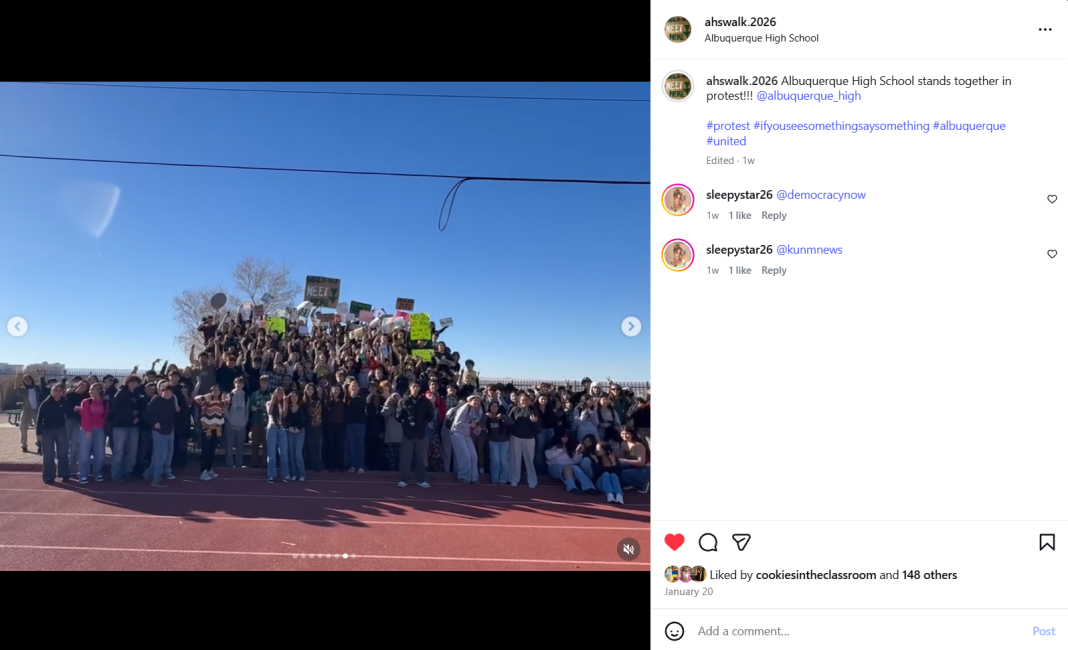
COMMUNITY FEATURE: Albuquerque High School Students Planning On Participating in City-Wide Walkout On Friday

ALBUQUERQUE, NEW MEXICO – Last Tuesday, January 20, many high schools around Albuquerque walked out of their classes in protest of recent events around the country involving federal immigration enforcement. This Friday, January 30, many are planning to do it again. Maxwell Meiklejohn, a 16-year-old junior at Albuquerque High School, helped organize the first walkout, […]

ALBUQUERQUE, NEW MEXICO – Last Tuesday, January 20, many high schools around Albuquerque walked out of their classes in protest of recent events around the country involving federal immigration enforcement. This Friday, January 30, many are planning to do it again.

Maxwell Meiklejohn, a 16-year-old junior at Albuquerque High School, helped organize the first walkout, and he has been working again with his peers to organize the walkout scheduled for Friday. However, the protest planned for Friday is intended to be a bit more of a feat, with citizens meeting in the Civic Plaza downtown.

The first walkout was initially a nationwide protest, under the title “Free America Walkout,” and word spread through social media. In an interview, Maxwell explained that he was encouraged to get involved by his mother Lauren Meiklejohn, a local community organizer who helped put together the Women’s March in the Civic Plaza.

In preparation for the “Free America Walkout”, Maxwell got together with one of his classmates, who created an Instagram post on her personal account to reach out to their other classmates and get them involved. “It just instantly got feedback,” he said, “And we were super hyped about it.”

The students made posters and banners for the walkout, and Maxwell emphasized two very large banners that they placed at the front of the school. He wanted to give students something to see: “One of the questions I get asked the most is, ‘Is this really happening?’” As an organizer and a leader, he wanted to make sure his classmates knew where to go. “I think it’s important when you’re organizing something like this to make sure that there’s physical proof for people to see as well, rather than just online.”

That Tuesday, at 2 p.m., so many students gathered by the signs to walk out of the school that Maxwell and his fellow organizers were surprised by the turnout. “The most amazing thing to me, just having that kind of experience,” he said, “was realizing how many people just need a little push or a little example to just get out there and be a part of it.”

Since that successful turnout, Maxwell and other students have been working hard to plan their walkout for Friday. This protest has also been spread as a nationwide plan, circling on social media under a post calling for a “nationwide shutdown,” and urging those who want to participate not only meet up in downtown Albuquerque, but also to refrain from working and shopping that day. Other students working with Maxwell to organize their classmates helped create an Instagram account with the handle “ahswalk.2026” to spread the word at Albuquerque High.

When asked about how high school students were planning on participating in this event, Maxwell explained that for Albuquerque High students specifically, they are planning on walking the entire way. “Our plan is to meet at 12, and then we’re going to march from the school to Civic Plaza, which is about half an hour,” Maxwell said. “We think it will be good to just be united, and represent Albuquerque High.”

He also said that they’ve been focusing heavily on coordinating safety, and have consulted outside adults for advice on de-escalation and crowd control. However, the march to the plaza itself will be just students.

“We expect hopefully as many, or some, high schools participating in this as were participating in the walkout,” Maxwell said in the interview. He also explained that Albuquerque High students have gotten in touch with students and organizers from other high schools in the city, and are planning to meet to coordinate further potential protests. “The walkout wasn’t a standalone thing, I think we’re going to try to keep the ball rolling on this, and just keep ramping up involvement.”

For Friday’s walkout and protest, the social media post includes an email address for students with questions or concerns to contact. The walkout is planned for 12:30 p.m., and students and other participants are planning on meeting in the Civic Plaza at 2 p.m.

For corrections, news tips, and any other content requests, please send us an email at [email protected].

Hot this week

UNM Steps Up to Cut Food Waste, Boost Food Access

The University of New Mexico works to turn food waste into resources that help address food insecurity on campus.

New Mexico’s Recipe for Hantavirus Risk—Climate, Deer Mice, and Country Living

More than 30 years after the Four Corners outbreak, New Mexico continues to report among the nation’s highest hantavirus pulmonary syndrome cases. Experts say the state’s ecology, climate cycles and rural living conditions have created an enduring hotspot for the rare but deadly disease carried by deer mice.

Community Solar Program Took Years to Arrive. Now the Solar Panels Are Finally Rising.

After years of delays, New Mexico’s community solar program is beginning to expand, with new projects coming online across the state. But developers and advocates say high interconnection costs and complicated billing rules still threaten the program’s long-term success.

Patient Voices Push New Mexico Lawmakers to Spotlight Healthcare Access and Affordability

New Mexico lawmakers spotlighted healthcare after hearing directly from patients, emphasizing urgent concerns about access, affordability, and workforce shortages.

Health Officials Clarify Hantavirus Risk: No Person‑to‑Person Spread

New Mexico's health officials have emphasized that the state's Hantavirus (Sin Nombre Virus) is not transmitted from person to person, which differs from the Andes virus that was responsible for an outbreak aboard a cruise ship. There have been many reports around the world about the Andes virus being transmitted by other people, and this caused people to worry about being able to contract the Andres virus from residents of New Mexico. The Andes virus is the only hantavirus known to be transmitted by another person in South America. The Sin Nombre Virus can only be contracted by contact with infected rodents, or their excrement. There are several ways to help to prevent hantavirus exposure, including disinfecting rodent nests and debris, ensuring that all points of entry into the home are sealed and practicing safe cleanup methods.

Topics

UNM Steps Up to Cut Food Waste, Boost Food Access

The University of New Mexico works to turn food waste into resources that help address food insecurity on campus.

New Mexico’s Recipe for Hantavirus Risk—Climate, Deer Mice, and Country Living

More than 30 years after the Four Corners outbreak, New Mexico continues to report among the nation’s highest hantavirus pulmonary syndrome cases. Experts say the state’s ecology, climate cycles and rural living conditions have created an enduring hotspot for the rare but deadly disease carried by deer mice.

Community Solar Program Took Years to Arrive. Now the Solar Panels Are Finally Rising.

After years of delays, New Mexico’s community solar program is beginning to expand, with new projects coming online across the state. But developers and advocates say high interconnection costs and complicated billing rules still threaten the program’s long-term success.

Patient Voices Push New Mexico Lawmakers to Spotlight Healthcare Access and Affordability

New Mexico lawmakers spotlighted healthcare after hearing directly from patients, emphasizing urgent concerns about access, affordability, and workforce shortages.

Health Officials Clarify Hantavirus Risk: No Person‑to‑Person Spread

New Mexico's health officials have emphasized that the state's Hantavirus (Sin Nombre Virus) is not transmitted from person to person, which differs from the Andes virus that was responsible for an outbreak aboard a cruise ship. There have been many reports around the world about the Andes virus being transmitted by other people, and this caused people to worry about being able to contract the Andres virus from residents of New Mexico. The Andes virus is the only hantavirus known to be transmitted by another person in South America. The Sin Nombre Virus can only be contracted by contact with infected rodents, or their excrement. There are several ways to help to prevent hantavirus exposure, including disinfecting rodent nests and debris, ensuring that all points of entry into the home are sealed and practicing safe cleanup methods.

‘You Are Not Alone’: Grief Kits Help Students Cope with Loss 

Albuquerque Public Schools received grief kits after the Rotary Club of Albuquerque and the Grief Center worked together to provide resources that help students cope with loss.

New Mexico Reopens Fight Over Toxic Oil and Gas Wastewater — Environmentalists Call It a Political Gamble

New Mexico regulators voted to revive a contentious rulemaking process that could expand the use of treated oil and gas wastewater beyond drilling sites, reigniting a fierce clash between industry advocates and environmental groups over public health, water scarcity and political influence.

Wastewater Sounded the Measles Alarm in New Mexico—Before Doctors Even Caught It

A new study shows New Mexico health officials detected measles in wastewater five days before hospitals confirmed cases, highlighting sewage surveillance as a powerful early-warning system during the nation’s largest measles outbreak in decades.

Related Articles
