

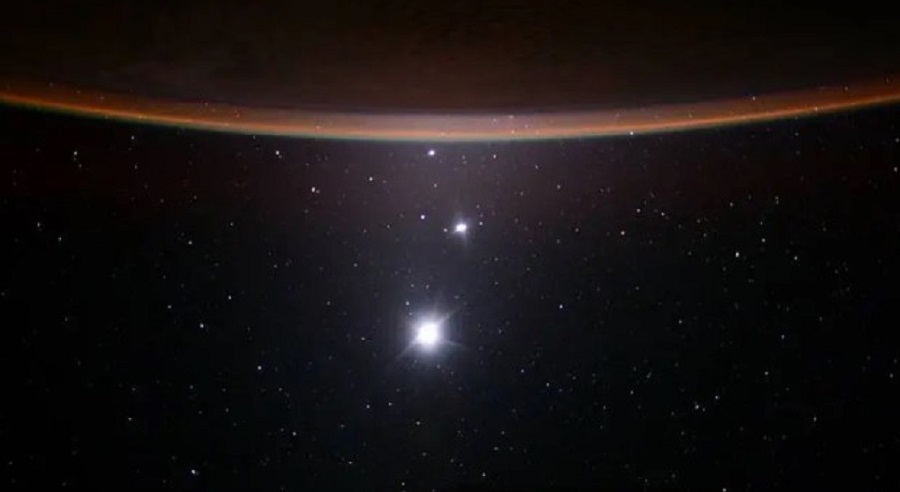
Venus and Jupiter to Dance in New Mexico Skies: A June Celestial Show Awaits Under the Dark Canopy

As summer begins, New Mexico’s pristine dark skies will host a spectacular celestial show: Venus and Jupiter in a rare close dance, a Super New Moon, and prime Milky Way viewing.

The night sky of June is preparing its own celestial show as the season’s heat blankets the high desert and mountain ranges, one that requires no more than a clear western horizon, a blanket and perhaps a pair of binoculars.

This month, the state’s popular dark skies — among the best in North America — will display a rare close encounter between Venus and Jupiter, along with beneficial moon timing, the summer solstice and chances for deep-sky stargazing.

What to expect

The highlight will be on June 8-9, when Venus and Jupiter will appear only a pinky finger apart in the western evening sky after sunset, separated by around 1.5 degrees. Mercury may join these two brightest planets in the twilight, creating a compelling planetary canvas in the constellation Gemini.

Venus passes Jupiter every 10 to 15 months. Other times, this occurs near the Sun, such as on August 25, 2027, and a conjunction on November 10, 2028, will follow before dawn in the east-southeast sky. These conjunctions are not unique, but infrequent enough to be remarkable. Venus and Jupiter shine the brightest in the sky next to the Moon and the Sun, making the sight dazzling to behold. The planets will remain very close to each other for several days, offering multiple chances to skywatchers to see as twilight deepens.

The middle of June brings even more drama. A “Super New Moon” coincides with Mercury’s greatest eastern elongation on June 15. Arguably, it will be its best evening appearance for the rest of the year. With no moonlight to wash the heavens, this is prime time for New Mexicans to search for the Milky Way’s luminous core, distant galaxies, and star clusters at International Dark Sky Parks such as Chaco Culture National Historical Park, Capulin Volcano National Monument, Clayton Lake State Park, and the Cosmic Campground.

A thin crescent Moon will later join the planetary tableu around June 16. It will add another photogenic alignment low in the west-northwest.

Summer Solstice: Shifting season

The month culminates with the summer solstice on June 21 — the Northern Hemisphere’s longest day of the year — and the Strawberry Moon on June 29, which is a micromoon. The Full Moon will appear slightly smaller and dimmer than average as it slides low in the sky, traditionally named by Algonquin peoples for the ripening of wild strawberries.

The June Bootids meteor shower peaks around June 27. Stargazers will have a chance to see a few shooting stars per hour, though the waxing moon may interfere.

New Mexico’s Celestial Advantage

Only a few places in the United States can rival New Mexico for naked-eye and telescopic astronomy. Its high mountains, dry climate, and vast stretches with minimal light pollution provide some of the darkest skies accessible to millions of Americans. Local astronomy enthusiasts, the Astronomical Society of Las Cruces and Albuquerque Astronomical Society, regularly host star parties. Other sites like Valles Caldera and Salinas Pueblo Missions usually roll out public programs.

A simple piece of advice for residents of Albuquerque, Santa Fe, Las Cruces, or rural areas. To enjoy the June evening sky, head west of city lights if possible, face a clear horizon in the hour after sunset to see the planets, and protect night vision with red lights. Apps like Stellarium can give precise local timings.

June’s skies offer that invitation: planets dancing close to each other, moonless nights for wonder, and the shifting seasons written in the stars. New Mexicans and visitors need only look up to enjoy the celestial show.

For corrections, news tips, and any other content requests, please send us an email at [email protected].

Hot this week

NMSU Awarded $500,000 Grant to Support Food Sovereignty and Healthy Eating Program

The grant will help the New Mexico State University Agricultural Science Center at Farmington pursue its goal to promote healthy eating behaviors in Navajo communities.

Greg Taylor Named Chair of UNM Physics and Astronomy Department, Richard Rand Retires

From one distinguished professor to another, the University of New Mexico’s Department of Physics and Astronomy will begin a new chapter under new leadership.

Families Are Putting Groceries on Credit Cards. Can Financial Literacy Ease the Pain of Rising Prices?

With food and utility prices straining household budgets, Albuquerque officials and community leaders are encouraging financial literacy as a tool to help families reduce reliance on credit cards and navigate an affordability crisis. Experts say better money management cannot solve inflation, but it can provide stability and help households avoid deeper debt.

El Niño Is Back — and It Could Soak New Mexico This Winter. But Don’t Get Too Comfortable.

After years of drier La Niña influences, a strengthening El Niño offers New Mexico hope for moisture relief — but also brings risks of extreme rain, flooding and unpredictable extremes in a warming climate.

Topics

NMSU Awarded $500,000 Grant to Support Food Sovereignty and Healthy Eating Program

The grant will help the New Mexico State University Agricultural Science Center at Farmington pursue its goal to promote healthy eating behaviors in Navajo communities.

Greg Taylor Named Chair of UNM Physics and Astronomy Department, Richard Rand Retires

From one distinguished professor to another, the University of New Mexico’s Department of Physics and Astronomy will begin a new chapter under new leadership.

Families Are Putting Groceries on Credit Cards. Can Financial Literacy Ease the Pain of Rising Prices?

With food and utility prices straining household budgets, Albuquerque officials and community leaders are encouraging financial literacy as a tool to help families reduce reliance on credit cards and navigate an affordability crisis. Experts say better money management cannot solve inflation, but it can provide stability and help households avoid deeper debt.

El Niño Is Back — and It Could Soak New Mexico This Winter. But Don’t Get Too Comfortable.

After years of drier La Niña influences, a strengthening El Niño offers New Mexico hope for moisture relief — but also brings risks of extreme rain, flooding and unpredictable extremes in a warming climate.

Albuquerque Installs Public Restrooms at Transit Hubs to Improve Rider Access

Albuquerque has added new public toilets at several transit hubs as part of an effort to improve public transportation amenities. City officials say the facilities will provide riders with reliable access to restrooms while enhancing the overall transit experience.

NMAA Approves New Transfer Rule for Student-Athletes

The New Mexico Activities Association has approved changes to its transfer eligibility bylaws, allowing greater flexibility for student-athletes who transfer schools. Officials say the updated policy aims to provide more options for students and families while maintaining oversight of the transfer process.

Field Expeditions Return to WNMU Marine Biology Program, Expanding Hands-On Learning

Western New Mexico University marine studies students recently traveled to San Diego to apply classroom learning in the field and document new discoveries.

Related Articles