

NMDOT Announce Progress Underway for Oñate Bridge Rehabilitation

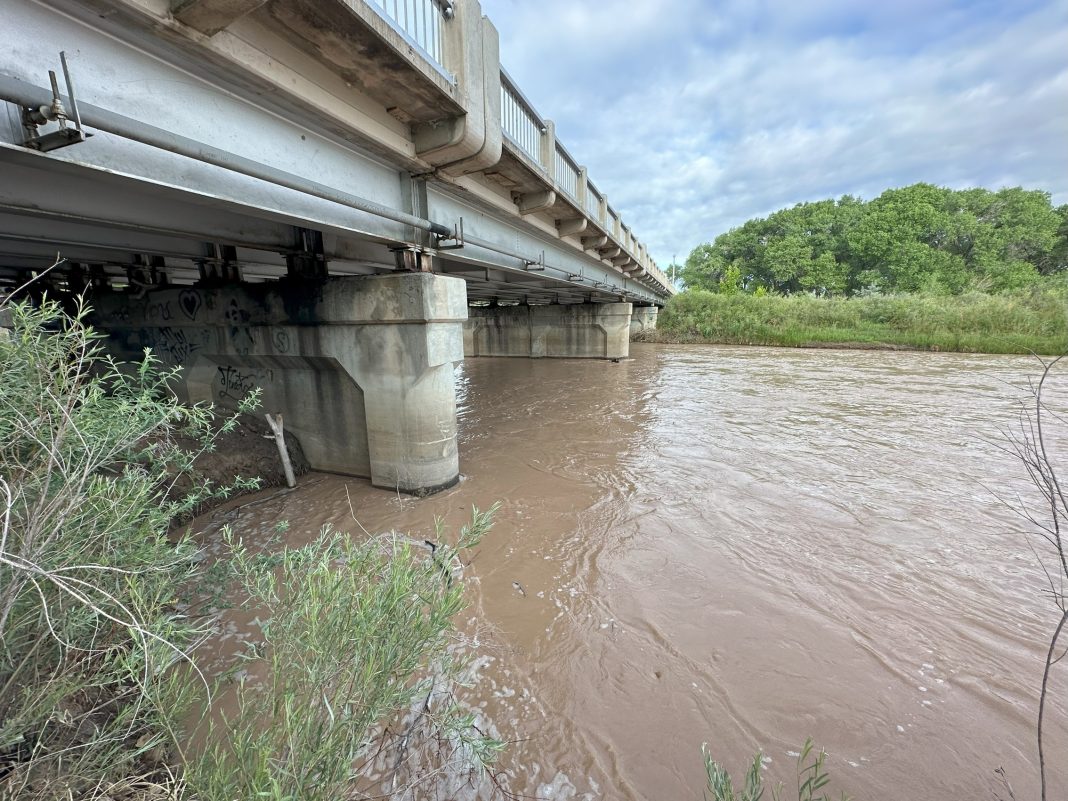
The New Mexico Department of Transportation says progress is underway on repairs to the historic Oñate Bridge in Española, which has been closed since June 7, 2025, due to safety concerns tied to erosion at one of its piers. The bridge was shut down ahead of the monsoon season after inspections and hydraulic modeling showed deterioration that could pose a risk during periods of high river flow.

Last June 7, 2025, the New Mexico Department of Transportation announced that they will need to close the historic Oñate Bridge in Española. The closure was described as a “precautionary safety measure” taken ahead of the anticipated monsoon season, due to concerns about riverbed erosion at one of the bridge’s piers that could pose a risk to residents, especially during periods of high river flow.

In its June 6, 2025, press release, the department reported that since its 2019 inspection of the bridge’s structure, it has found erosion at a pier. Further inspection in January 2025 also revealed deterioration with the bridge’s structure requiring “additional hydraulic modeling,” signaling an urgent need for action.

Transportation Secretary Ricky Serna notes in the same release that closing the bridge was “a proactive step to ensure everyone’s safety.” So, in coordination with the department’s Bureau of Bridge, Drainage, District Five, and the Federal Highway Administration (FHWA), the decision was made to officially close the Oñate Bridge for repairs.

Today, NMDOT reports progress, noting that contracts are signed, materials are ordered, and repairs are underway—with the goal of reopening the bridge by the end of April 2026.

According to NMDOT, the bridge construction will first focus on stabilizing one of the bridge’s piers affected by erosion from the Rio Grande. They will need to stabilize the site by redirecting the river away from the pier to create a dry and safe work area.

Once conditions allow, workers will level the area with sandbags before placing Class 5 riprap (large protective rock) around the base of the pier to prevent further erosion.

The final phase of construction will involve installing concrete “A-Jacks” or large, interlocking concrete structures to resist strong water flow. These “A-Jacks” will be secured together with stainless steel bands to keep them in place.

NMDOT and AUI Inc. expect the construction to take approximately 2 months to complete, once all materials are delivered and weather permits. If the timeline holds, the department aims to reopen the Oñate Bridge by the end of April 2026.

Oñate bridge closure is taking a toll on local businesses

6 months after the bridge’s closure, local Española businesses are experiencing the impact of a steep decline in customer traffic and sales. With the key crossing over the Rio Grande closed, areas such as the Paseo de Oñate, one of the city’s main commercial corridors, have seen a decline in through-traffic, which has been a vital source of customers.

Local business owners in Española reported that customers are seeking alternative routes to bypass the area entirely. This led to a significant loss of walk-in clients for local businesses.

This prompted local Española business owners to reduce staff to save costs. Some even invested in their own wayfinding signs, but the initiative is not enough, even for long-established businesses.

Apparently, the situation was not left unnoticed by NMDOT. According to the release, the department addressed the concern by installing additional signs to guide people along detour routes and reassure them that shops and services remain open.

Right now, signs are mounted on temporary posts. This solution is a safety standard as underground utility lines are still being identified and marked.

Moving the project forward

NMDOT notes that emergency funding was secured to move the project forward. The department secured $1.8 million in funding to stabilize the damaged bridge and enable the Oñate Bridge to reopen safely.

“The bridge was closed due to safety concerns, and we are currently investing $1.8 million in improvements to allow it to safely reopen. We recognize how important this bridge is to local businesses and the broader community, and reopening it is a priority we share,” Serna said in the press release.

To address the necessary updates for residents, the City of Española invited NMDOT to a town hall meeting on Thursday, February 5, 2026, at 5:30 p.m. at the Mission Convento Museum. Serna and members of his team are expected to attend the meeting, along with the project manager from AUI Inc.

For corrections, news tips, and any other content requests, please send us an email at [email protected].

Hot this week

UNM Steps Up to Cut Food Waste, Boost Food Access

The University of New Mexico works to turn food waste into resources that help address food insecurity on campus.

New Mexico’s Recipe for Hantavirus Risk—Climate, Deer Mice, and Country Living

More than 30 years after the Four Corners outbreak, New Mexico continues to report among the nation’s highest hantavirus pulmonary syndrome cases. Experts say the state’s ecology, climate cycles and rural living conditions have created an enduring hotspot for the rare but deadly disease carried by deer mice.

Community Solar Program Took Years to Arrive. Now the Solar Panels Are Finally Rising.

After years of delays, New Mexico’s community solar program is beginning to expand, with new projects coming online across the state. But developers and advocates say high interconnection costs and complicated billing rules still threaten the program’s long-term success.

Patient Voices Push New Mexico Lawmakers to Spotlight Healthcare Access and Affordability

New Mexico lawmakers spotlighted healthcare after hearing directly from patients, emphasizing urgent concerns about access, affordability, and workforce shortages.

Health Officials Clarify Hantavirus Risk: No Person‑to‑Person Spread

New Mexico's health officials have emphasized that the state's Hantavirus (Sin Nombre Virus) is not transmitted from person to person, which differs from the Andes virus that was responsible for an outbreak aboard a cruise ship. There have been many reports around the world about the Andes virus being transmitted by other people, and this caused people to worry about being able to contract the Andres virus from residents of New Mexico. The Andes virus is the only hantavirus known to be transmitted by another person in South America. The Sin Nombre Virus can only be contracted by contact with infected rodents, or their excrement. There are several ways to help to prevent hantavirus exposure, including disinfecting rodent nests and debris, ensuring that all points of entry into the home are sealed and practicing safe cleanup methods.

Topics

UNM Steps Up to Cut Food Waste, Boost Food Access

The University of New Mexico works to turn food waste into resources that help address food insecurity on campus.

New Mexico’s Recipe for Hantavirus Risk—Climate, Deer Mice, and Country Living

More than 30 years after the Four Corners outbreak, New Mexico continues to report among the nation’s highest hantavirus pulmonary syndrome cases. Experts say the state’s ecology, climate cycles and rural living conditions have created an enduring hotspot for the rare but deadly disease carried by deer mice.

Community Solar Program Took Years to Arrive. Now the Solar Panels Are Finally Rising.

After years of delays, New Mexico’s community solar program is beginning to expand, with new projects coming online across the state. But developers and advocates say high interconnection costs and complicated billing rules still threaten the program’s long-term success.

Patient Voices Push New Mexico Lawmakers to Spotlight Healthcare Access and Affordability

New Mexico lawmakers spotlighted healthcare after hearing directly from patients, emphasizing urgent concerns about access, affordability, and workforce shortages.

Health Officials Clarify Hantavirus Risk: No Person‑to‑Person Spread

New Mexico's health officials have emphasized that the state's Hantavirus (Sin Nombre Virus) is not transmitted from person to person, which differs from the Andes virus that was responsible for an outbreak aboard a cruise ship. There have been many reports around the world about the Andes virus being transmitted by other people, and this caused people to worry about being able to contract the Andres virus from residents of New Mexico. The Andes virus is the only hantavirus known to be transmitted by another person in South America. The Sin Nombre Virus can only be contracted by contact with infected rodents, or their excrement. There are several ways to help to prevent hantavirus exposure, including disinfecting rodent nests and debris, ensuring that all points of entry into the home are sealed and practicing safe cleanup methods.

‘You Are Not Alone’: Grief Kits Help Students Cope with Loss 

Albuquerque Public Schools received grief kits after the Rotary Club of Albuquerque and the Grief Center worked together to provide resources that help students cope with loss.

New Mexico Reopens Fight Over Toxic Oil and Gas Wastewater — Environmentalists Call It a Political Gamble

New Mexico regulators voted to revive a contentious rulemaking process that could expand the use of treated oil and gas wastewater beyond drilling sites, reigniting a fierce clash between industry advocates and environmental groups over public health, water scarcity and political influence.

Wastewater Sounded the Measles Alarm in New Mexico—Before Doctors Even Caught It

A new study shows New Mexico health officials detected measles in wastewater five days before hospitals confirmed cases, highlighting sewage surveillance as a powerful early-warning system during the nation’s largest measles outbreak in decades.

Related Articles