

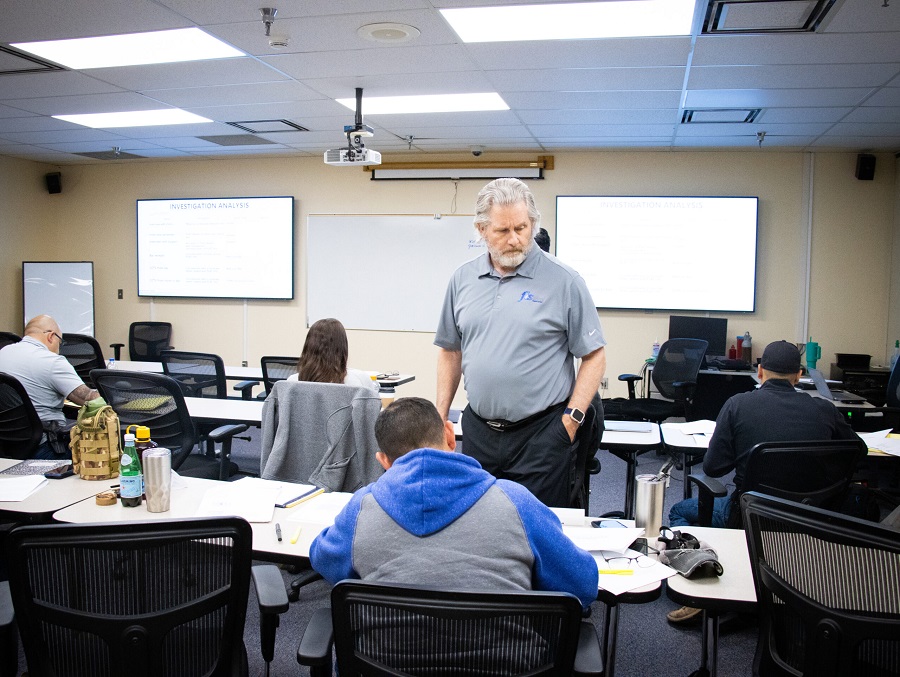
Inside a classroom at the New Mexico Law Enforcement Academy, instructors taught police officers something rare in American policing: how to listen. They are learning not to pressure. Not to intimidate. Not to force a confession. Their mentors teach them how to listen carefully enough to uncover the truth.
Twelve law enforcement professionals participated in a specialized five-day training known as the P.E.A.C.E. The Investigator Interview Course is a science‑based program that rejects coercive interrogation methods. Instead, it emphasizes systematic, non‑coercive communication to gather accurate information.
The Forensic Interview Solutions conducted the training on May 4-8. It reflects a comprehensive shift in modern policing away from confession-driven interrogations and toward evidence-based investigative interviewing.
“Our goal is gathering information to find out what actually occurred,” said Gary Patzer, a former Colorado officer with 33 years of experience. “What’s the truth? We allow people to tell their story first. And then we break it down.”
P.E.A.C.E. framework
Police officials, attorneys, judges, and psychologists designed the P.E.A.C.E. framework in the United Kingdom during the 1980s. The goal was to establish a more reliable and effective way to conduct interviews.
The method diverges from traditional interrogation methods that often emphasized extracting confessions at nearly any cost. Those approaches, critics say, contributed to involuntary confessions and miscarriages of justice that have eroded public confidence in the criminal justice system.
Patzer said the course confronts outdated assumptions that many investigators relied before. “You can’t tell if somebody’s lying by which direction they’re looking, or fidgeting,” he said. “Scientifically, that’s been debunked for years.”
Instead, instructors teach investigators to focus on memory science, rapport‑building, and a methodical interview approach.
Investigators use another component, called conversation management, for uncooperative interviewees, including suspects. Police officers learn techniques that help people remember memories more accurately by reducing stress and encouraging detailed recollection.
But in contrast to coercive interrogation models, the approach does not utilize intimidation and psychological pressure. Trainers teach police officers to present evidence and address discrepancies while encouraging ongoing dialogue. Supporters of the model say that distinction matters.
The research discussed during the course posited that while confession-focused interrogation methods often produce more confessions, some of those statements are later invalidated. P.E.A.C.E.-style interviewing, Patzer said, reduces that risk because coercive tactics often pressure vulnerable people into saying false things.
Tunnel vision
The training also attempts to address one of the common dangers in criminal investigations: tunnel vision.
Trainers warn police officers not to become emotionally committed to either one suspect or theory while disregarding contradictory evidence. Throughout the course, investigators repeated a simple principle: ABC or Assume nothing, believe nothing, check everything.
“We teach the exact opposite of tunnel vision,” Patzer said. And P.E.A.C.E. techniques do not rely on psychological pressure, intimidation, or coercion, he added.
Participants spent much of the training time in practical exercises, rotating roles as interviewer, witness, suspect, and evaluator in role-plays. Patzer stressed that the hands-on method is essential because police officers cannot master interviewing—a human skill—through lectures alone. “People don’t fully understand the method until they put it into practice,” he said.
Environment and communication
The course also emphasizes environment and communication. These are details that can substantially influence how much information people are willing or able to share.
Sometimes that requires moving someone away from a chaotic scene before talking to them. Sometimes, police officers need to explain the interview process clearly before asking difficult questions. In other times, it simply means making the environment feel less threatening.
Patzer remembered a witness interview he conducted in a relaxed setting. He said the witness later described the conversation “felt more like a therapy session than an interview.” That reaction, according to Patzer, captured the philosophy behind the training: people remember more, and speak more honestly, when they feel respected rather than cornered.
Police officers are now using the techniques taught in the course beyond criminal investigations. Forensic Interview Solutions also conducts training for professionals in human resources, auditing, threat assessment, and federal agencies, including the Federal Aviation Administration.
Mindset shift among police officers
Patzer admitted that veteran officers were trained in confession-focused policing cultures. “I had a boss at one time tell me, ‘Go in that room and don’t come out until you get a confession,’” he recalled. Adapting to the P.E.A.C.E. model can require a significant mindset shift, he said.
But more and more younger and mid-career officers, he said, are increasingly receptive to investigative methods based in psychology and science rather than intimidation. Law enforcement agencies nationwide continue grappling with public distrust, wrongful conviction cases, and demands for reform. And the shift toward non-traditional interviewing may represent something bigger than a training trend.
“The only goal in our methodology is the truth,” Patzer said. “A lot of people observe what they see on TV, and that’s what they assume is going to occur in any interview with law enforcement. We don’t want that to be the case.”

