

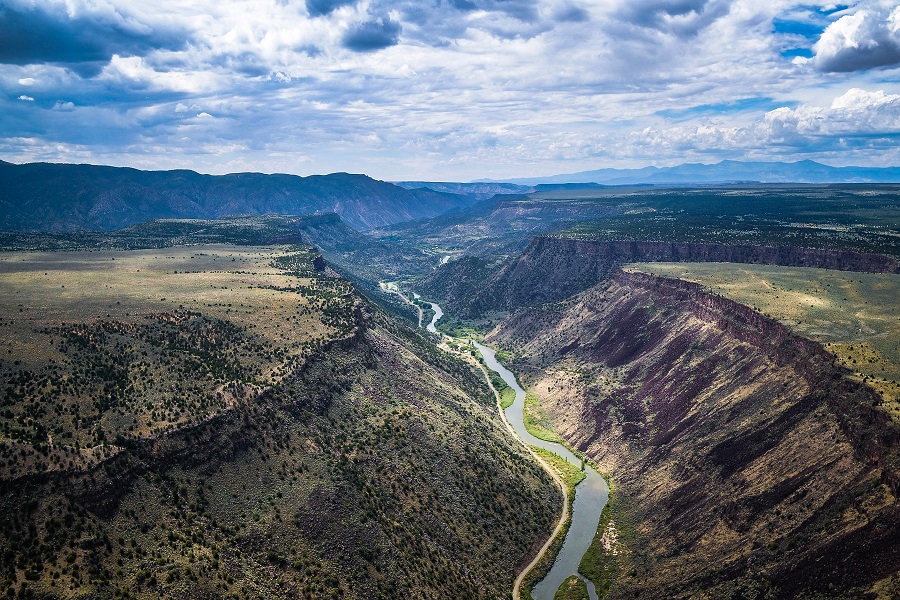
The 13-year water war over the Rio Grande threatened to become one of the most costly legal and environmental defeats in New Mexico history. Instead, state leaders this week emerged from the U.S. Supreme Court with a negotiated victory for the drought-stricken American West.
In a brief order, the Supreme Court formally accepted a settlement ending the 13-year legal battle among New Mexico, Texas, and the federal government over the management of the Rio Grande. The case carried billion-dollar risks. It matched New Mexico farmers against neighboring states and exposed the instability of water in the sweltering heat of the Southwest.
Reached after years of legal skirmishes and political brinkmanship, the settlement gives New Mexico farmers a majority share of irrigation water in the contested stretch below Elephant Butte Reservoir. It avoided what officials feared could have become catastrophic financial penalties.
Lujan Grisham: Turning point
Gov. Michelle Lujan Grisham described the settlement as a turning point for southern New Mexico communities. These communities rely on the river for agriculture, drinking water, and economic survival. “Water is the foundation of New Mexico’s agricultural economy and the lifeblood of communities across the southern part of our state,” the governor said on Thursday. “This settlement means farmers in the Lower Rio Grande can plan for the future, communities have certainty about their water supply and New Mexicans aren’t on the hook for a liability that could have cost billions.”
The settlement outlines a new formula for sharing irrigation water: New Mexico users get 57 percent, and Texas users get 43 percent in the disputed lower basin region. In return, New Mexico agreed to lessen groundwater pumping over the next decade. This concession aims to preserve river flows in an era of worsening drought.
Officially known as Texas v. New Mexico and Colorado, the lawsuit became the most controversial water war in the modern Southwest. It unveiled how climate change, population growth, and century-old water agreements are colliding across the region.
Roots of water war
The roots of the dispute hark back to the early 2000s. At the time, prolonged drought reduced flows along the Rio Grande and heightened tensions among irrigation districts, municipalities, and federal water managers. It began as local grievances, which eventually escalated into a Supreme Court skirmish. Texas sued New Mexico in 2013, alleging that groundwater pumping in southern New Mexico violated the 1938 Rio Grande Compact and deprived farmers of water down the streams legally owed to them. At one point, the damages sought against New Mexico could reach $1 billion.
Several observers believed New Mexico was losing ground. But the settlement arrived after 13 years settles everything.
“It’s a good settlement and a remarkable one for the state of New Mexico, given how the litigation was going in the early stages — not very well for New Mexico,” said Burke Griggs, a water law expert at Washburn University School of Law. “But New Mexico was able to recover and I think it’s achieved a lasting and durable settlement.”
The road to resolution was not easy. Last year, the Supreme Court voted 5-4 to reject an earlier settlement proposal after the federal government contended it ignored federal obligations and reservoir operations tied to the Rio Grande Project. The Supreme Court decision sent negotiators back to the table.
Advertisement
The modified four-part agreement completed in 2025 resolved overlapping disputes between the states and the federal Bureau of Reclamation. In the same way, the revised agreement gives New Mexico more flexibility to comply with groundwater reductions.
Under the agreement, the state must reduce groundwater pumping in the Lower Rio Grande over the next 10 years. To implement the settlement, the state Legislature approved $22.5 million for conservation projects, decommissioning of irrigated farmland, and enhanced water monitoring programs.
Practical roadmap
State Engineer Elizabeth Anderson said the settlement is a pragmatic pathway for balancing legal obligations with the economics of farming communities. “This agreement gives New Mexico the tools, flexibility and time needed to meet our legal obligations while continuing to support agriculture, economic activity and responsible water management across the region,” Anderson said.
State officials view the settlement as more than the end of a lawsuit. But it is a rare moment of stability as water has become both increasingly scarce and politically explosive.
States across the West are preparing for a water war as rivers shrink and aquifers dry up. But for now, New Mexico has prevented what could be a devastating loss, and, at the same time, it secured time to adapt to a drier future.