

The University of New Mexico is carving its place in the growing space economy in the high desert of New Mexico, where rocket testing and national laboratories have defined for decades the state’s aerospace legacy.
UNM is positioning itself — and the state — as a hub for sustainable space research, workforce development, small satellite technology, and the scientific groundwork for an Earth-Moon economy as NASA’s renewed moon program and private companies invest in satellites, orbital infrastructure and commercial spaceflight.
University officials say the effort aims to strengthen New Mexico’s role in the emerging space economy by connecting academic research with government agencies, national laboratories and private companies.
“With the talent, infrastructure, and leadership in this room, New Mexico has a real opportunity to lead in the New Space economy,” said Nancy Conrad, a former teacher and widow of Apollo 12 astronaut Pete Conrad. She was one of the resource persons of the one-day workshop hosted by UNM that gathered space research experts. “There’s no other place with this exact combination,” Conrad, who also chairs the Conrad Foundation, added.
Studying the moon
A cornerstone of UNM’s space research is the Institute of Meteoritics and its Center for Advanced Sample Analysis-Moon, or CASA Moon. The program is part of NASA’s Solar System Exploration Research Virtual Institute.
Scientists at the center analyze lunar samples from the Apollo missions while preparing for future samples expected from upcoming Artemis missions. Their research focuses on the moon’s geological evolution, including its mantle composition and volcanic history.
Charles “Chip” Shearer, a research professor and co-convener of UNM’s Sustainable Space Research Grand Challenge, has led studies investigating Apollo 17 samples. Recent study, Endogenous, yet Exotic, Sulfur in the Lunar Mantle, which Shearer is part of the research team, identified previously unrecognized sulfur isotope variations that could provide new insights into lunar geology.
UNM also hosted the NASA Exploration Science Forum in July 2025. The forum brought together researchers, students and astronauts to discuss lunar and planetary science.
A Sustainable Space Research Program
UNM’s Sustainable Space Research Grand Challenge, one of several institutional programs, seeks to expand research while supporting New Mexico’s long-term participation in the space economy.
The initiative envisions to increase research funding, strengthen partnerships with national laboratories and aerospace companies, train future scientists and engineers, and promote public engagement in space science.
The program also supports interdisciplinary projects ranging from student art inspired by lunar exploration to engineering research on microthrusters and advanced catalytic materials for future space missions. Research areas include spacecraft technologies, in-space resource utilization, space biology, cybersecurity and long-term concepts such as planetary habitation.
Engineering satellites and space systems
UNM’s engineering programs also play an important role in the university’s space portfolio. The Configurable Space Microsystems Innovations and Applications Center, known as COSMIAC, is into small satellite technologies, radiation-hardened electronics, communications systems, and developing aerospace prototypes.
Faculty members and students work on projects from initial design through flight testing, including the Radiation Hardened Electronic Memory Experiment, or RHEME, which is scheduled for deployment aboard the International Space Station.
COSMIAC sits at the intersection of academia, aerospace contractors, including Northrop Grumman and Leidos, and government agencies such as NASA, the U.S. Air Force, the U.S. Space Force, while emphasizing workforce development and technology commercialization.
UNM also offers an online master’s degree in Space Systems Engineering through its mechanical and electrical engineering departments. The program, developed with input from the Air Force Research Laboratory, is designed primarily for working professionals seeking advanced training in aerospace systems.
Supporting a statewide space economy
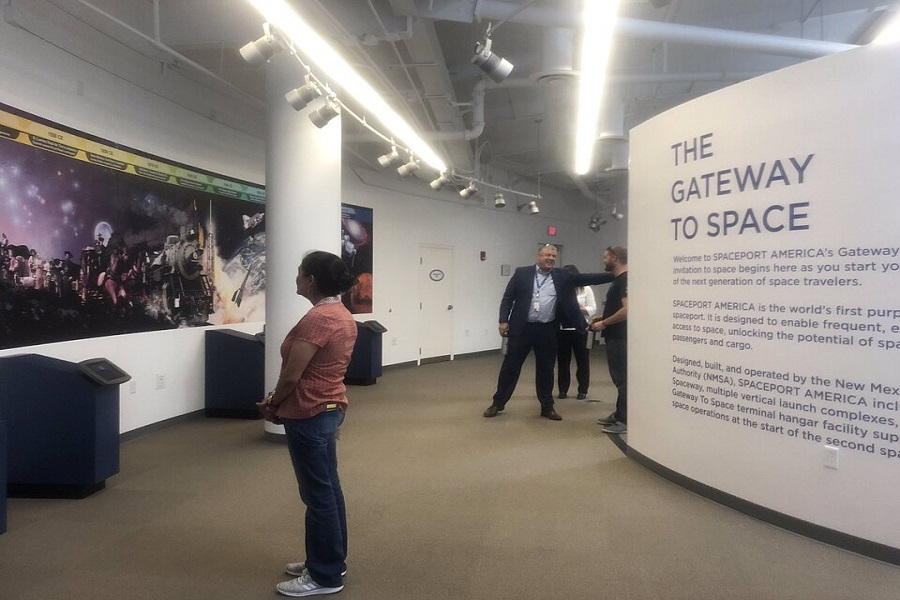
Most recent workshops, organized through the Sustainable Space Research Grand Challenge, brought together representatives from universities, national laboratories, Spaceport America and private industry to discuss strategies for expanding New Mexico’s space sector. The participants identified several advantages, including the state’s research institutions, aerospace infrastructure, available land for testing, and growing commercial activity around Spaceport America.
“Most recently, our estimates indicate Spaceport America has totaled $110.8 million in value-added production and $73.1 million in labor income for our state in 2024,” Dr. Kramer Winingham, co-author of a study on Spaceport America’s economic impact on New Mexico from 2019 to 2024, said.
They also pointed to challenges, including the need for stronger statewide coordination, sustained funding, improved access to research facilities and expanded education pipelines connecting K-12 schools with universities and aerospace employers. Workshop participants recommended a more robust public-private partnerships, strengthening of interdisciplinary education, and holding regular statewide collaborations to maintain momentum.
The discussions come as the state’s aerospace ecosystem is growing. Alongside Spaceport America, the state’s national laboratories, military installations and defense contractors provide research capabilities in support to both government and commercial space programs.
Looking beyond Earth
UNM’s strategy focuses less on launching spacecraft. The university focuses more in providing the scientific research, engineering expertise and skilled workforce needed to support a broader space industry. University officials say New Mexico is well positioned to benefit from its combination of research infrastructure, aerospace expertise, and relatively low operating costs.
UNM Vice President for Research Ellen Fisher has emphasized partnerships among universities, government agencies and industry as central to that effort.
University officials and researchers framed space research as a potential source of high-skilled jobs, technology development, and long-term economic growth in a state that seeks to diversify its economy beyond the volatile oil and gas production,
It remains uncertain whether those investments ultimately establish New Mexico as a major space innovation hub. But through its growing research programs, engineering initiatives and workforce training, UNM is positioning itself as an important contributor to the state’s evolving role in the nation’s space enterprise.

