

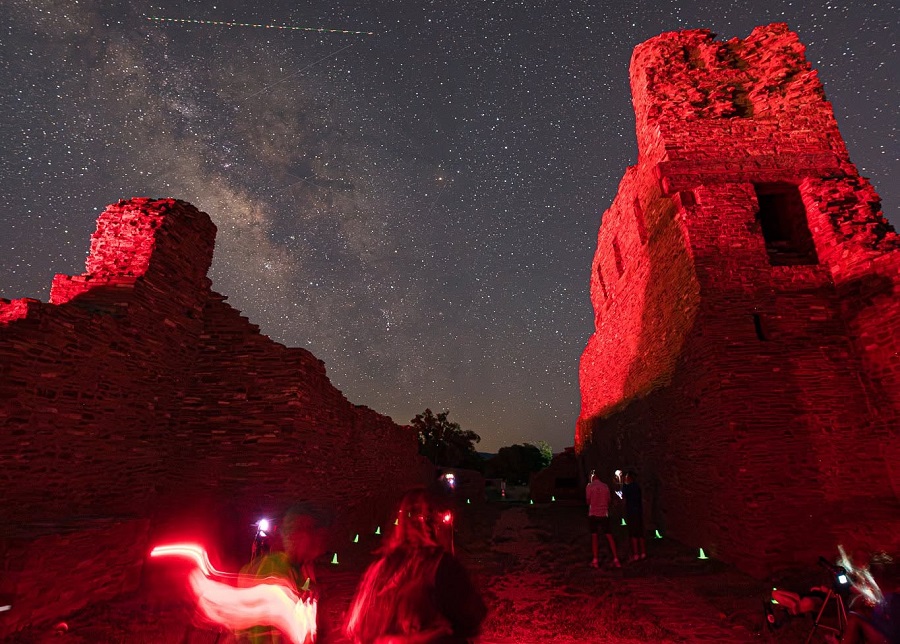
New Mexico skywatchers can look forward to a busy October, with Saturn in opposition, two meteor showers, and several close encounters between the moon and nearby planets.
These celestial events offer stargazers opportunities to observe both solar system targets and distant celestial objects. New Mexico’s remote desert landscapes and designated dark-sky sites provide especially favorable conditions for viewing the night sky.
Saturn shines at opposition
Saturn takes center stage Oct. 4, when the planet reaches opposition, placing Earth between Saturn and the sun. Around opposition, Saturn appears brighter than usual and remains visible for most of the night.
The ringed planet will be visible in the constellation Cetus. A backyard telescope should reveal its rings, though their appearance will depend on their changing angle as seen from Earth.
The event offers a convenient opportunity for beginning astronomers and families to observe Saturn, which can also be seen without a telescope.
Moon approaches Mars and Jupiter
Early risers can look for a close pairing of the crescent moon and reddish Mars in the eastern sky around Oct. 5.
Another notable event is expected around Oct. 6, when the moon and Jupiter appear close together. A lunar occultation, in which the moon passes in front of a planet, may be visible from some locations.
Jupiter will disappear behind the moon while both objects are still low on the eastern horizon. The occultation will not be visible from New Mexico.
Two meteor showers peak
The Draconid meteor shower is expected to peak around Oct. 8-9. The shower typically produces relatively few meteors, but its early-evening peak can make it convenient for observers who prefer not to stay up late.
The meteors appear to radiate from the constellation Draco in the northern sky. How many are visible will depend on local sky conditions and the observer’s location.
The Orionid meteor shower, associated with debris from Halley’s Comet, is expected to peak around Oct. 21-22. The shower is known for fast-moving meteors and occasional bright fireballs.
Moonlight may affect visibility, depending on the moon’s phase and position. Observers generally have better chances of spotting meteors after midnight and before dawn, when the radiant is higher in the sky.
Dark skies offer opportunities for deep-sky viewing
October also provides opportunities to observe objects beyond the solar system, including the Andromeda Galaxy and various nebulae. Binoculars or a telescope can help reveal objects that are difficult to see with the unaided eye.
Mars is also expected to pass near the Beehive star cluster during the month, offering another potential target for binocular observers.
The month’s full moon, traditionally known as the Hunter’s Moon, is another highlight for skywatchers. Its sheer brightness, however, can make faint stars and deep-sky objects harder to see even with the aid of binoculars and telescopes.
New Mexico’s remote deserts, national monuments and designated International Dark Sky places offer locations for observing celestial events away from urban light pollution. Among the state’s most notable dark-sky destinations are Cosmic Campground, Chaco Culture National Historical Park, Capulin Volcano National Monument, and Salinas Pueblo Missions National Monument, which was designated an International Dark Sky Park (Silver-tier) by DarkSky International in 2016.
Astronomy enthusiasts should check local observatory and astronomy club schedules for public viewing sessions and star parties.