

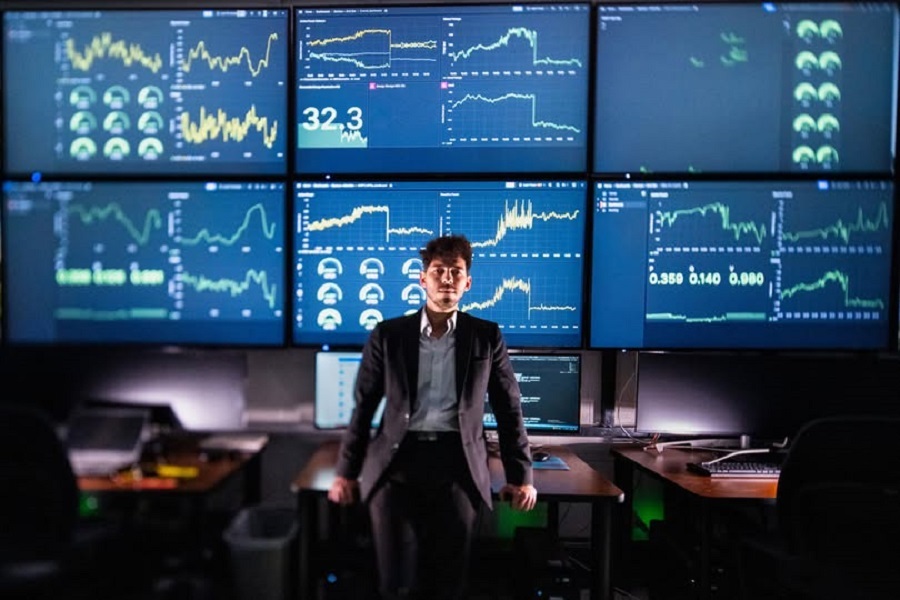
Sandia National Laboratories has long honed technologies for nuclear deterrence and national security. Now, a quieter revolution is underway: teaching the electric grid to think for itself.
Artificial intelligence is driving an explosion in data centers, and renewable energy soars across the grid. With this, voltage — the steady pressure that keeps power flowing cleanly — has increasingly become a fragile resource. Conventional mechanical fixes, like capacitor banks that switch on and off, have struggled to keep pace with rapid, unpredictable swings in demand and supply. Enter Sandia’s AI-driven controls, coordinating batteries, solar inverters, and other distributed resources for stability in real time.
Recent laboratory demonstrations have detailed this new initiative. The work addresses a national challenge that is very visible in New Mexico and other states like Texas: how to power the AI boom without sacrificing reliability for everything else. Data centers, voracious and sometimes spiky in their electricity needs, are reshaping grid planning. At the same time, utilities are increasingly integrating variable solar and wind, while aging infrastructure faces threats from severe weather conditions and potential cyberattacks.
From Simulation to the Field
Sandia’s effort, at its core, is a distributed energy resource management system (DERMS), enhanced with artificial intelligence. Instead of relying solely on expensive new hardware, the system uses advanced functions embedded in modern inverters. These devices connect solar panels, batteries, and other resources to the grid.
Engineer Rachid Darbali-Zamora, the project’s key figure, explained the underlying philosophy of the work. “The way we generate electricity and the loads being placed on the grid are evolving, but the backbone of the grid that connects these is staying the same,” he explained. “We need more control to ensure everything can be integrated… in a more reliable manner. A key goal is keeping voltage within operating limits as conditions change from second to second.”
The team started in simulation, and they moved to Sandia’s Distributed Energy Technologies Laboratory. There, they leveraged power hardware-in-the-loop testing that connects real commercial inverters and batteries to a real-time digital simulator of grid conditions. This allowed the team to stress-test the AI against communication delays, equipment limits, and sudden disruptions without risking the live grid itself.
Field demonstrations followed at two sites in Lubbock, Texas, where Sandia’s Scaled Wind Farm Technology (SWiFT) facility and the Texas Tech University GLEAMM microgrid, and a data center. Side-by-side tests — controller on one day, off the next — demonstrated quantifiable gains. Voltage deviations have strengthened, bringing performance closer to utility goals and enhancing power quality for sensitive loads.
Miguel Jimenez-Aparicio, a researcher and team member, observed that the field data aligned with lab results: “These demonstrations prove that AI can meaningfully improve how microgrids and distributed resources operate.”
National Security Meets Everyday Reliability
The implications go beyond commercial utilities. It could even be leveraged during a national emergency, such as war. Senior manager Charlie Hanley emphasized the defense angle: “In scenarios of national conflict or war, adversaries will target energy infrastructure… The Sandia-developed DERMS system helps to defeat such adversarial attacks through the application of agile and secure technologies.”
This aligns with Sandia’s expansive portfolio. Separate projects have developed brain-inspired neural networks capable of distinguishing between physical grid faults, say, like storm damage and cyberattacks, running on economical hardware already in the field. Its dual-use capabilities are critical because grids become more digitized and highly interconnected.
New Mexico itself provides a testbed. The state is home to large data center proposals, ambitious renewable targets, and national laboratories whose missions largely rely on reliable power. Wider U.S. energy trends raise the stakes, with data centers poised to claim a far larger share of electricity in the years ahead, while peak demand risks outstripping supply in some regions.
Path to Adoption of AI-Controlled Electric Grid
Sandia’s strength is its pragmatic approach. It used existing inverter hardware, enabling utilities to avoid massive capital outlays for traditional upgrades. The AI coordinates devices intelligently while respecting the electric grid’s physical limits, necessary for real-world deployment.
“The technology could strengthen power resilience and help protect critical defense and national security infrastructure during disruptions and attacks,” Sandia National Labs, in its social media post, wrote.
The project has advanced through the Department of Energy’s Energy I-Corps program, working with utilities and microgrid operators to hone the technology’s operational needs. It is now in Phase III, focusing on commercialization and further deployments. This fits into Sandia’s broader AI-for-grid efforts that include work on resilience metrics, renewable integration, and predictive analytics. The laboratory also participates in consortia such as the Open Power AI Consortium, seeking to scale these tools across the industry.
Challenges
Experts caution that AI is no cure-all. Grid modernization requires regulatory changes, investment in sensors and communications, and a scrutiny of the cybersecurity of the AI systems themselves. Aggregated loads across data center clusters, according to a study on Spatial Load Correlation in AI Data-Center-Dominated Power Systems, could pose fresh risks to grid stability, such as simultaneous voltage and frequency swings.
Questions remain about adaptability across diverse utility territories, integration with traditional systems, and equitable access — ensuring that rural or low-income regions benefit alongside tech hubs. Still, Sandia’s progress signals change. As Darbali-Zamora put it, AI helps “make sense of all the moving pieces on a modern distribution grid and do it in real time.”
Electricity demand is surging, and the demand for the grid to do more is even greater; intelligent controls may prove necessary. It started in a New Mexico lab, and the AI-controlled electric grid could help keep the lights on and the servers humming across the country.

