

Nearly 50 years after breaking ground in 1976, Charles Ross’s monumental earthwork “Star Axis” is finally set to be completed this year. His vision, shaped over decades on a remote New Mexico mesa, is about to become reality.
Last spring, Ross sat in his SoHo studio, but his mind was on eastern New Mexico. That’s where his life’s work, a monumental project that is both an observatory and a pyramid, rises toward the sky. “If you’re there in the winter during a snowstorm, it’s like the sky is painting the earth white,” Ross said. “There are also thunderstorms, and rainbows appear several times a week.”
‘Star Axis’: Ambitious Land Art Project
At 88, Ross has spent fifty years building “Star Axis,” an ambitious land art project that blends sculpture, architecture, and astronomy on a mesa 85 miles from Santa Fe. He came up with the idea in 1971 and started building in 1976. The structure, about 11 stories tall and made from earth, sandstone, granite, concrete, bronze, and stainless steel, is almost done. Supporters hope to open it to the public soon.
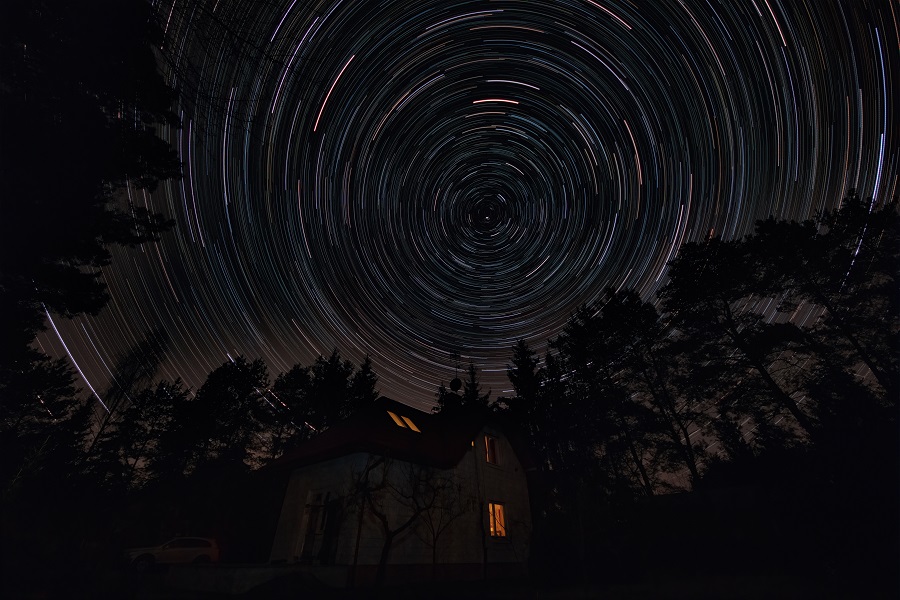
The central feature is the Star Tunnel, a 147-step stairway aligned with the North Star. As visitors ascend, the opening at the top frames views that demonstrate the 26,000-year cycle of axial precession — the gradual wobble of Earth’s axis that shifts which star serves as the North Star over millennia. Other features include a Solar Pyramid that casts an annual shadow, an Equatorial Chamber and an Hour Chamber, all designed to make cosmic movements visible.
Ross studied mathematics at the University of California, Berkeley, then earned a master’s degree in art, finding his artistic path almost by accident. His early experiments with prisms and light led him to explore planetary motion and ancient alignments similar to those of Egyptian pyramids. After four years searching the Southwest, he found the mesa.
As Ross put it, “your feet are planted on the ground, your head is in the space of the stars, and the horizon is at midsection.”
W.O. Culbertson Jr., a well-known New Mexico rancher, allowed Ross to build on the land after meeting Culbertson’s son by chance. Construction has been slow and careful, using local stonemasons and traditional methods. Ross and his wife, artist Jill O’Bryan, live off-grid near the site in the warmer months, then return to their SoHo loft for winter.
Rare, Major Land Art
The nonprofit Land Light Foundation manages the project, which has cost millions. Some funding comes from Ross’s other work, like large prism installations that project solar colors inside buildings and “solar burn” artworks made by focusing sunlight on wood. This spring, supporters started a $5 million fundraising campaign to finish construction and get the site ready for visitors.
“Star Axis” is major land art from the 1960s and 1970s, like Michael Heizer’s “Double Negative” and Robert Smithson’s “Spiral Jetty.” Ross’s project is about aligning with cosmic cycles while many modern works focus on erosion or change,
“It wasn’t enough to just know about this,” Ross said, referring to the precession cycle that causes Polaris to appear to pulse in the sky over thousands of years. “I wanted to walk through it.”
As the project nears completion, Ross, a Guggenheim Fellow whose work is in major museum collections, reflects on decades of dedication. The site’s isolation adds to the experience, with clear dark skies, dramatic weather, and a powerful feeling of standing between earth and space.
For now, the artist moves between his whitewashed SoHo studio, where he plans, and the red-dirt mesa, where his vision is nearly complete. In both places, the stars feel close.

