

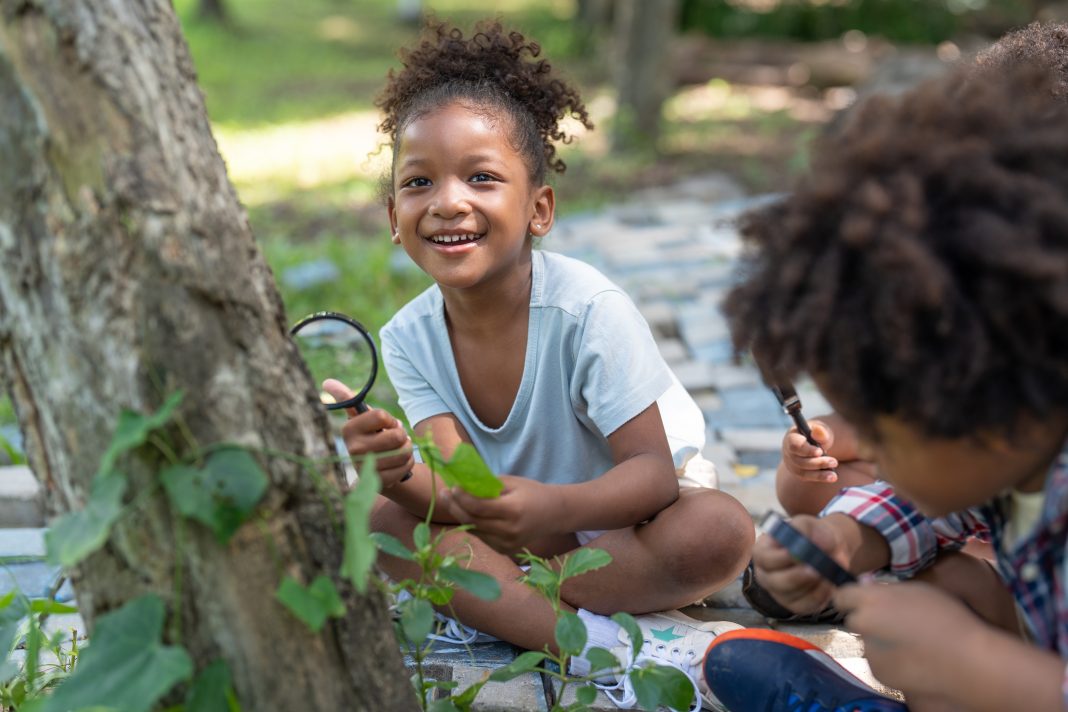
Learning goes beyond reading and writing, as students can gain valuable knowledge outside the classroom. This is what U.S. Sen. Martin Heinrich continues to advocate for.
Heinrich announced the reintroduction of the Revitalizing America’s Schoolyards Act on Thursday at Polk Academy of Agricultural Science. The measure seeks to equip schools nationwide with resources to transform traditional asphalt playgrounds. It aims to turn them into living, learning ecosystems like the one thriving in Albuquerque’s South Valley.
Polk provided the setting for Heinrich’s announcement. The middle school is part of Albuquerque Public Schools’ Sustaining the Future magnet program.
Sustaining the Future is a K–12 environmental STEM pathway that teaches students to care for land, water and the environment. It also helps them explore real-world solutions and future careers.
Student leaders led the senator through Polk’s Jardin de Los Sueños, or Garden of Dreams. They showcased a STEAM lab with aquaponic and hydroponic systems and an orchard with 40 fruit trees planted last year.
Why Outdoor Learning Matters
Student Alllyson Bojorquez stressed the mental health benefits of outdoor learning spaces.
“Students work hard on the farm, but they also get to walk around, enjoy themselves, talk with friends, and just have time to enjoy the space and help improve our mental health,” she said.
Heintrich explained why he chose Polk as the venue for the reintroduction of the legislation. He said the school exemplifies what he wants the norm in school campuses nationwide, not the exception. The senator reflected on his education, noting the contrast between his “packed dirt and concrete” youth and Polk’s interactive environment.
Heinrich, who began his career running outdoor education programs, emphasized landscapes support mental health and diverse learning styles.
“We know that some of the kids who were the most challenged to sit at their desk and focus, in that environment, just absolutely thrive,” he said.
The proposed Act would fund the conversion of school grounds into spaces that clean the air and provide organic food. It would also support “learning by doing” opportunities.
Why Polk Serves as a Model
At Polk, leaders have already deeply ingrained this philosophy. Principal Ben Bustos describes the campus not as an extension of the classroom, but as the classroom itself.
“Rooted in our community’s farming and ranching traditions, our students learn by doing,” Bustos said. “Whether it’s working in the garden, studying soil health, or understanding water systems through our acequia and community partnerships.”
Teacher Travis McKenzie highlighted the cultural significance of the program. He noted that the Living Schoolyards Act presents an opportunity to scale Polk’s success across the state.
McKenzie announced a new partnership with the Middle Rio Grande Conservancy District to build acequia infrastructure on campus. The initiative allows students to learn firsthand about water rights and traditional flood irrigation.
“We want to cultivate the next generation of water warriors,” he said.
Also speaking at the event were Gael Torres and Rosita Moreno. Torres highlighted the school’s transformation and its improved reputation driven by the agricultural program.
“Our school environment is very different from other schools,” Torres said. “… We have the opportunity to include outdoor learning into our classes. It’s amazing how we are all able to get together and maintain the garden.”
Closing in Spanish, Moreno emphasized that the work at Polk is about more than green spaces. She said it is about cultivating local, healthy products, and forming the leaders of tomorrow.

