


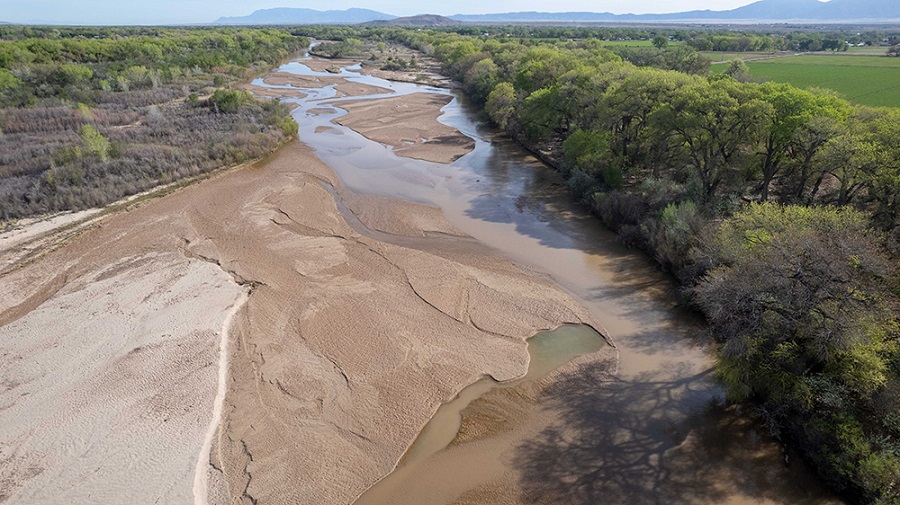
Some sections of the Rio Grande, including the stretch through Albuquerque, are moving toward another summer of drying due to a collapse in winter snowpack, US water managers warned.
The 2026 operating plan of the Bureau of Reclamation for the Rio Grande and the Pecos River mirrors the earliest snowmelt, among the recorded lowest snowpack levels, and reservoir storage is already drying up.
“Being faced with a third dry year in a row is a big challenge,” said acting Albuquerque Area Manager John Irizarry, adding that the agency is coordinating with stakeholders to stretch limited supplies.
Reservoirs near empty
Most reservoirs along the Rio Chama and Rio Grande are already holding less than 15 percent of their capacity. Heron Reservoir is at 11 percent; El Vado Reservoir, 13 percent; and Elephant Butte Reservoir, 13 percent. With these reservoirs near empty, there is little buffer left for the months ahead.
If monsoon rains fail, Elephant Butte could drop to around 2 percent by late August, which is lower than 3 percent in 2025, the Bureau said.
Early drying, dangerous conditions
Irrigation releases from Elephant Butte are scheduled to begin on April 28, and from Caballo Reservoir on May 29. Authorities cautioned that parched channels downstream of the dams may suddenly surge with water, which may result in unpredictable and dangerous conditions.
Upstream, drying in the San Acacia began March 27 — the earliest recorded in 30 years. The Bureau is already working with the U.S. Fish and Wildlife Service to rescue endangered fish trapped in shrinking pools.
The Rio Grande ran dry in Albuquerque in July last year. Officials say 2026 is on track for a repeat.
Pecos River outlook worse
The situation along the Pecos River is even more critical. As of March 31, snow water equivalent across the basin fell to 0 percent of the median. Projections from the Natural Resources Conservation Service have placed some 9,000 acre-feet of inflow into Santa Rosa Reservoir. But the snowpack melted before it reached the reservoir.
Any additional inflow will depend largely on rainfall.
Limited hope from monsoon
The National Weather Service is forecasting above-average precipitation during the summer monsoon. This offers possible relief, but forecasters expect hot, dry conditions to persist through May.
Snowpack far below normal
As of mid-April, snow water equivalent stood at only 4 percent of the median in the Rio Chama basin and 13 percent in the upper basin of the Rio Grande. The Sangre de Cristo Mountains registered slightly over one-fifth, or 21 percent, while snow in the Jemez Mountains has already fully dissipated.
The Natural Resources Conservation Service forecasts Rio Chama inflow into El Vado Reservoir at nearly one-fourth, or 24 percent of average. With a third straight dry year unraveling, water managers warn that water supplies for farms, ecosystems, and cities will once more face significant stress this summer.

